.png)


Best Restaurant Online Ordering Platforms: Commission-Free Options Compared (2026)
Online ordering is essential for restaurants. Relying on third‑party marketplaces like DoorDash, Uber Eats, or Grubhub often means 15–30% commissions per order, eroding thin margins and limiting control over the guest experience. Many operators evaluate options like GloriaFood online ordering, the Olo ordering platform, or Wix restaurant ordering when choosing a solution.
Operators increasingly choose commission‑free restaurant online ordering platforms that power websites, mobile apps, and social channels. GloriaFood fits small restaurants, Olo serves enterprise ordering with integrations, and Wix offers a website‑first approach with built‑in ordering. These tools help keep revenue, own customer data, and build loyalty for independent restaurants.
For website‑first buyers, the choice is between builders with built‑in ordering and dedicated ordering providers offering menu logic and POS sync. This guide compares commission‑free options in 2026 to help you choose the right online food ordering system for restaurants based on budget and growth.
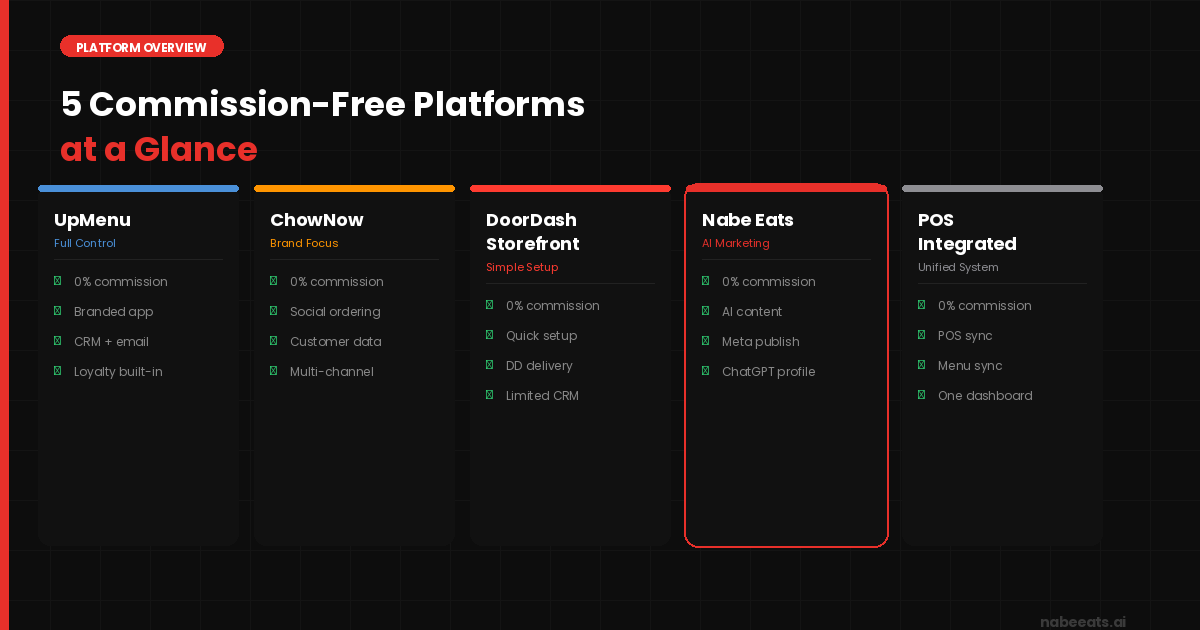
1. UpMenu: Zero Commission With Full Control
Best for: Restaurants that want a complete direct ordering system with built-in marketing tools.
UpMenu lets customers order directly from your own website or branded mobile app with no additional commissions. As a first-party ordering platform, it supports true direct online ordering—you own the customer data, control branding, and run repeat marketing without marketplace restrictions. You manage the menu, pricing, delivery preferences, and analytics in one place, helping increase restaurant sales over time.
Why it stands out:
Ideal for: Independent restaurants, cafes, pizzerias, bakeries, and chains focused on growth and brand loyalty.
2. ChowNow: Commission-Free With a Brand-First Approach
Best for: Restaurants that want direct online ordering across multiple digital channels.
ChowNow offers commission-free online ordering through your website, Facebook, Google, and Instagram. As a first-party ordering solution, you own customer relationships, data, branding, and marketing instead of giving them to a marketplace. It helps restaurants accept orders without per-order fees while sharing customer data to grow email lists and loyalty programs that belong to your business.
Why it stands out:
Ideal for: Restaurants active on social media that want a simple, omnichannel ordering solution supporting brand ownership.
3. DoorDash Storefront: Commission-Free Direct Ordering
Best for: Restaurants wanting a simple, commission-free online ordering page without complex integration.
A lightweight first-party ordering option. DoorDash Storefront enables direct online ordering for pickup and delivery on your website, avoiding per-order commissions. Unlike the marketplace, this first-party experience lives on your branded page, helping retain customer data, control branding, and support repeat marketing while using DoorDash fulfillment.
Why it stands out: It balances easy setup with the benefits of direct ordering ownership.
Ideal for: Restaurants testing direct online ordering before upgrading to a full-featured platform.
4. Nabe Eats: Zero Commission With AI-Powered Marketing
Best for: Independent restaurants that want a restaurant with online ordering paired with automated marketing and customer retention tools.
Nabe Eats gives restaurants a fully branded, zero-commission ordering system combined with AI-powered tools that handle social media content creation, ad management, and customer engagement automatically. The platform generates images, captions, and promotional content for your restaurant, then lets you either download the assets or publish them directly to Meta (Facebook and Instagram) without lifting a finger. It also includes a custom ChatGPT profile for your restaurant so customers can discover your menu and place orders through conversational AI.
Why it stands out:
Ideal for: Growing SMB restaurants that want to boost restaurant sales with automated marketing while keeping 100 percent of their order revenue.
5. POS-Integrated Commission-Free Ordering: Square, Toast, and Clover
Best for: Restaurants that want ordering built directly into their existing POS system.
Commission-free by design: Many modern POS platforms now include online ordering as part of the core product. While you’ll still pay standard payment processing fees, these tools avoid per-order marketplace commissions. The most common options are Square Online, Toast Online Ordering, and Clover Online, each tightly integrated with its respective POS.
System-level control: For buyers comparing an online ordering system for restaurants, these tools cover the core features users expect: centralized menu management, built-in payment processing, order throttling during peak hours, and configurable pickup time slots. Because the restaurant online ordering system is native to the POS, menus, prices, and availability stay automatically in sync.
Why it stands out: Orders, payments, and reporting live in one dashboard, reducing errors and extra software costs.
Ideal for: Restaurants already using Square, Toast, or Clover that want a unified POS and online ordering system while keeping 100 percent of their order revenue.
Commission-Free vs. Marketplace Platforms: The Real Math
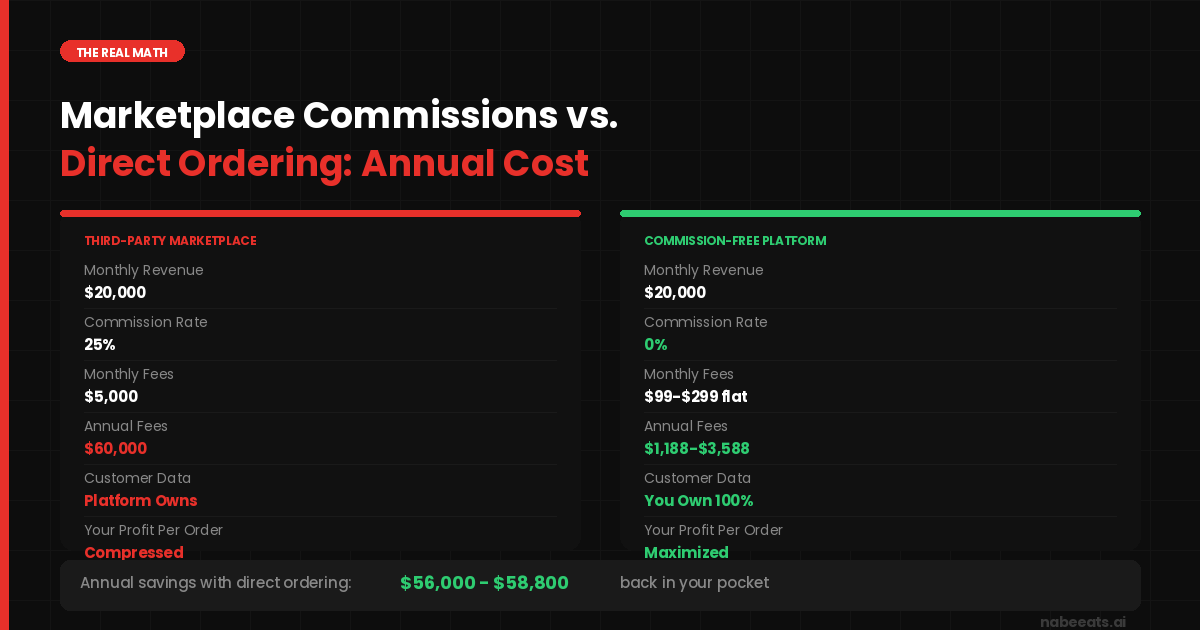
Marketplace commissions remain the fastest way to erode margins. Traditional third-party delivery apps still charge roughly 15 to 30 percent per order. A restaurant doing $20,000 per month in delivery orders on a 25 percent commission plan sends $5,000 monthly, or $60,000 annually, to the platform—before considering promos or ads. That money could instead fund staffing, equipment, or owned marketing.
Commission-free does not mean cost-free. With commission-free restaurant online ordering platforms, you typically pay a subscription or standard processing, but it’s critical to itemize all online ordering fees to compare apples to apples. Use this quick checklist:
- Subscription or flat monthly fee online ordering
- Payment processing (usually 2.6–3.5% + per-transaction)
- Delivery pass-through fees (if using third-party drivers)
- SMS/email marketing add-ons
- Hardware (tablets, printers, kiosks)
- One-time setup or onboarding
Here’s how the math changes in practice. On $20,000/month in direct orders, a $299 subscription plus 3% processing (~$600) totals about $899, or an effective rate of ~4.5%. Compare that to a 25% commission ($5,000): even after add-ons, flat-fee models often save $4,000+ monthly.
The bigger win is control and predictability. Beyond savings, direct ordering lets you own customer data, set pricing, and avoid sudden fee hikes—setting up the decision framework you’ll use when choosing the best platform next.
Which Platform Is Right for Your Restaurant?
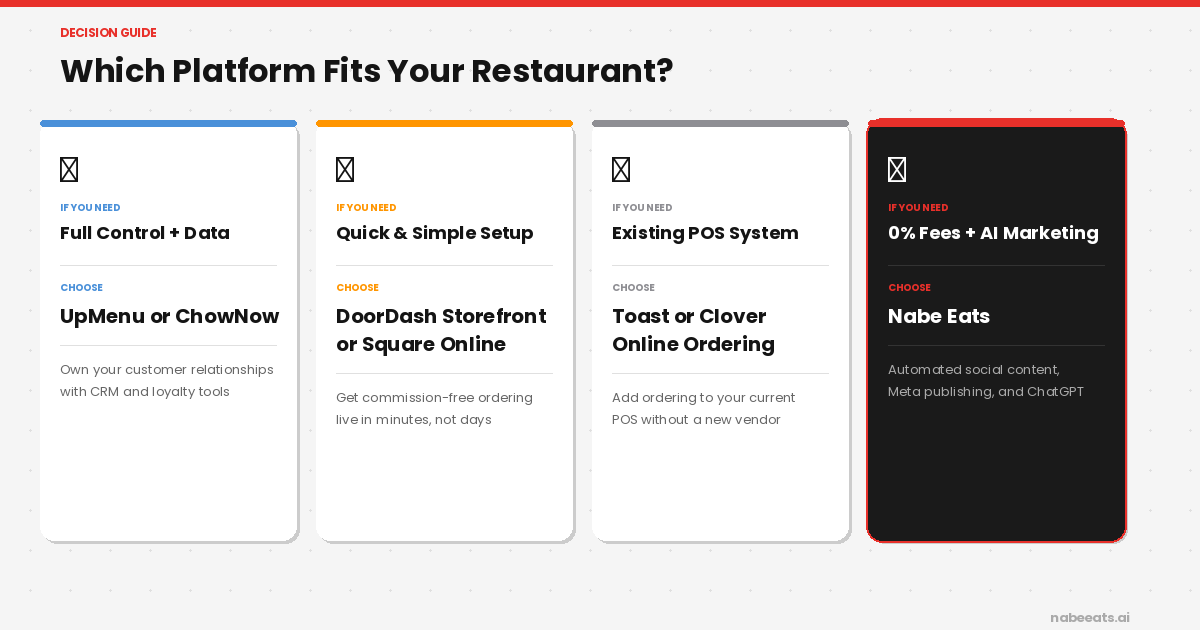
Choosing the best online ordering platform for restaurants depends on where you are now and what you need over the next 12–24 months. With more restaurant online ordering platforms offering commission-free options, the decision comes down to control, speed, and scalability.
For some operators, a website-first approach makes sense. Website builders with restaurant website online ordering enable fast launches, simple menus, and tight integration, but offer less customization than dedicated ordering tools.
If you want full control over branding and customer data, UpMenu or ChowNow are strong choices. Both emphasize owned guest information, branded experiences, and tools like loyalty and remarketing that drive repeat business.
If you need a quick, simple setup, DoorDash Storefront or Square Online are among the easiest paths to commission-free ordering. They’re ideal for teams that value speed and familiarity over deeper customization.
If you already run a POS-first operation with Toast or Clover, native online ordering is often the smoothest move. Orders, payments, and reporting stay in one place with minimal change.
If your priority is zero commissions plus automated marketing, Nabe Eats serves independent restaurants seeking sales lift without extra staff. Its AI tools keep promotions and social channels active.
- Single-location: ChowNow, UpMenu, or Square Online for branded control.
- Multi-location: Toast or Clover with centralized menus and reporting.
- Enterprise digital ordering: Platforms like Olo lead at scale with deep integrations.
- Website-first: Website builders with embedded ordering for fast launches.
- POS-first: Native POS modules to keep operations unified.
- Delivery-heavy: Commission-free storefronts paired with marketplaces for reach.
Regardless of your choice, owning a direct ordering channel matters. Moving even part of volume off marketplaces protects margins, preserves customer data, and supports long-term growth.
Frequently Asked Questions
What is a commission-free online ordering platform?
A commission-free online ordering platform is a system that lets customers place orders directly through your restaurant website or app without charging a percentage fee on each transaction. Instead of paying 15 to 30 percent per order like you would on DoorDash or Uber Eats, you typically pay a flat monthly subscription or only standard payment processing fees.
Are commission-free platforms really free?
Most commission-free platforms charge a monthly subscription fee, setup fee, or payment processing charges. The key difference is that they do not take a percentage cut of every order. Over time, the flat-fee model is almost always more cost-effective than marketplace commissions for restaurants processing a meaningful volume of online orders.
Can I use a commission-free platform and DoorDash at the same time?
Yes. Many restaurants use both simultaneously. DoorDash works well as a customer acquisition tool for reaching new diners, while your own ordering platform handles repeat customers at full margin. This balanced approach lets you benefit from marketplace visibility without giving up all your profits to commissions.
How much can I save by switching to commission-free ordering?
A restaurant processing $15,000 per month through third-party apps at a 25 percent commission rate is paying $3,750 per month in fees. Shifting even 30 to 40 percent of that volume to a commission-free platform can save $1,125 to $1,500 per month, or $13,500 to $18,000 per year in recovered margin.
Which commission-free platform is best for small restaurants?
For small restaurants with limited technical resources, DoorDash Storefront or Square Online offer the simplest setup process. For small restaurants that also want built-in marketing automation, Nabe Eats provides both ordering and AI-powered promotional tools without requiring a dedicated marketing staff.
.png)

.png)


