.png)


.png)
Ever paid more in fees than for the food—then opened the bag to soggy fries, missing sauces, and a 60-minute “on the way” update? If you’re searching for best restaurants online ordering, you’re not alone: modern takeout and delivery can feel overpriced, inconsistent, and weirdly risky—especially when a “great in-person” spot doesn’t travel well.
This guide gives you a quick, repeatable framework to judge quality and value before you order: what signals to look for in reviews, photos, and menus, where to verify them, and how to predict whether your order will arrive hot, intact, and complete.
You’ll walk away able to find restaurants that travel well and cut inflated prices and fees by ordering direct—whether you’re doing pickup or delivery, in any city and across cuisines. First, let’s define what “best” actually means for online ordering—beyond star ratings.
What “Best Restaurants Online Ordering” Really Means (It’s Not Just Star Ratings)
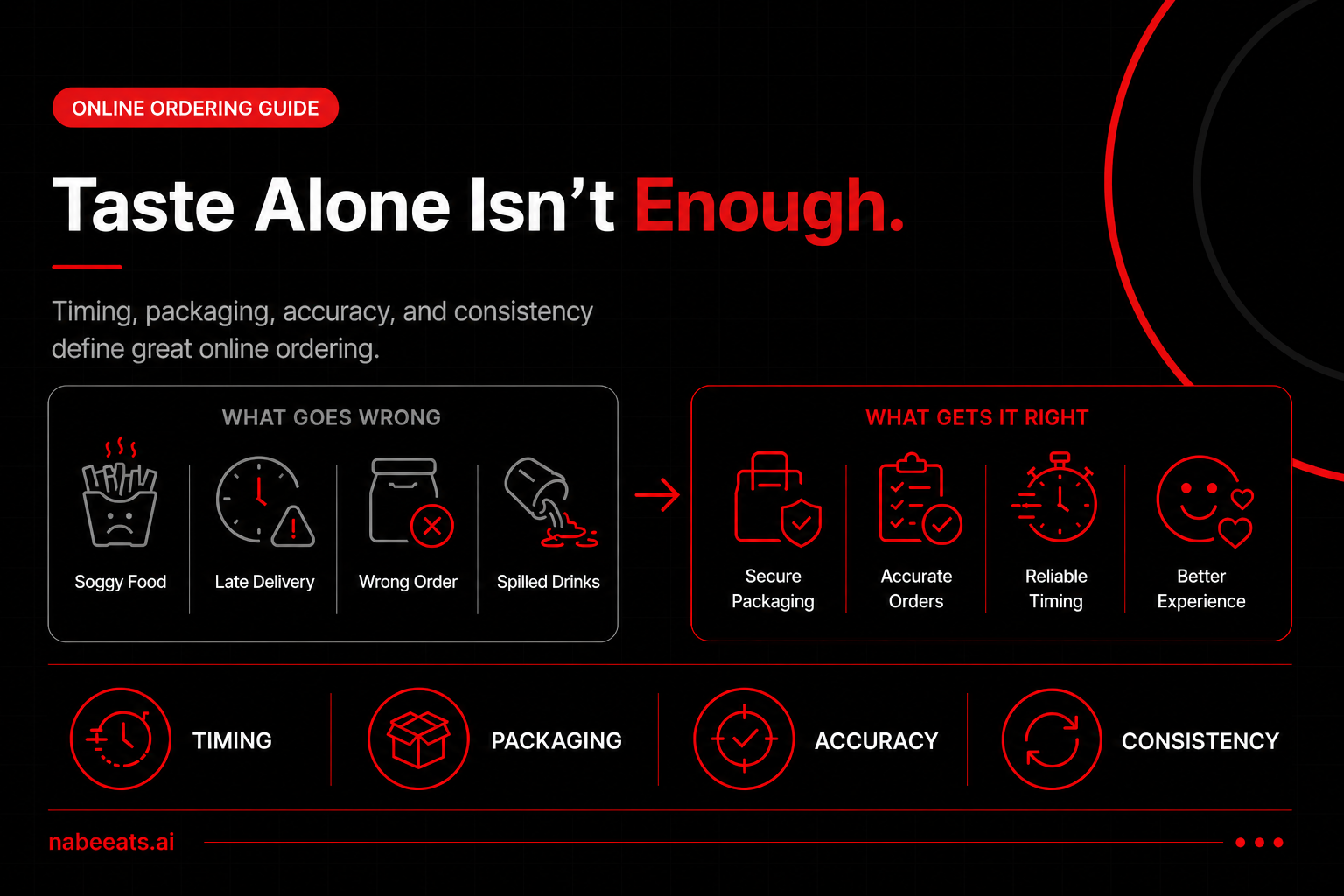
When people say best restaurants online ordering, they often mean “tastes great” or “has a high rating.” That’s a good start, but it’s not the job. Online ordering is a logistics test, not just a flavor test—and the winner is the restaurant that can deliver (or hand you) the same quality you expected, on time, in the right containers, with the right items, at a price that still feels fair.
That’s why a restaurant can be genuinely excellent in person and still be a risky bet for delivery. A busy dining room rewards ambiance, plating, and “eat it right now” dishes. Takeout and delivery reward repeatability, packaging decisions, and a menu built to survive 20–45 minutes of heat, steam, and movement.
Think about it: fries that are perfect at the table often arrive limp; crispy fried chicken can turn soggy if it’s sealed wrong; ramen can go from amazing to overcooked if it sits in hot broth too long. Meanwhile, foods like braises, curries, rice bowls, dumplings, and many baked pastas often travel better because they hold heat and texture more forgivingly.
So in this guide, “best” is a scorecard. You’re not trying to find perfection—you’re trying to reduce risk with signals you can verify before you spend $35–$70 on a meal that might disappoint.
Here are the core categories that actually define the best restaurants online ordering (pickup or delivery):
Notice what’s missing: hype, “must-try” lists, and even overall rating. Those things can still matter, but they’re not the best predictors of whether your meal will land well at home.
The same restaurant can be a 10/10 for dine-in and a 6/10 for delivery purely because the menu doesn’t travel well. When you’re judging
Practical examples you can use today:
Even within one cuisine, the “best” online-ordering pick can change. For Thai, a curry might be safer than crispy fish. For Mexican, a burrito bowl might outperform a hard-shell taco. You’re not lowering your standards—you’re ordering for the conditions.
For takeout and delivery, timing is quality. A meal that shows up 25 minutes later than expected can be cold, soggy, or over-steamed even if it started perfect. What you want is
A mildly skeptical rule: if a place constantly advertises ultra-fast delivery times but reviews regularly mention “took forever,” assume the ETA is marketing, not operations. The best operators build buffers. They quote what they can hit.
Packaging is not a detail—it’s the delivery version of plating. The best restaurants online ordering usually do at least two things well:
If you’ve ever opened a bag and found a melted dessert next to a hot entrée, you already know how much packaging decisions matter. Great packaging doesn’t have to be fancy—just thoughtful.
Accuracy is the category most people only notice when it fails. Missing items, wrong spice level, forgotten utensils, no sauces, swapped proteins—each one turns a good restaurant into a “never again.”
Accuracy is also one of the strongest signals of repeatability. If a restaurant nails the small stuff consistently, it usually nails the big stuff too. You’ll see this in reviews that mention specifics like “they always include extra napkins,” “mods were correct,” or “everything labeled.” Those are operational tells.
Online ordering can feel overpriced even when the restaurant is fair, because platform fees and inflated item prices stack up fast. Value is about what you get
Look for clear menu descriptions (sizes, counts, spice levels, what’s included) and consistent pricing across channels. If you see vague listings like “wings” with no count or “family meal” with unclear sides, you’re being forced to guess—and guessing is how you overpay.
Mistakes happen. The best restaurants online ordering experiences aren’t the ones where nothing ever goes wrong—they’re the ones where a problem gets resolved quickly and fairly. That includes responsive restaurant support for direct orders, and reasonable refund behavior on third-party platforms.
If reviews repeatedly mention “no help,” “ignored,” or “couldn’t reach anyone,” treat that as a real risk factor. A $10 credit after a $60 order shows up cold isn’t a win.
Star ratings are noisy because they blend together problems caused by different people and systems. A 4.6 might hide consistent delivery failures, and a 4.2 might include a bunch of one-star rants that were really driver-related. Here’s why you
How to Find the Best Restaurants Online Ordering Using Reviews, Photos, and Menu Clues
That’s why your next move isn’t “hope for the best”—it’s a 5–10 minute research pass that tells you whether a restaurant consistently delivers (literally) when you’re not in the dining room. The best restaurants online ordering aren’t just tasty; they’re predictable. And predictability leaves clues in public places: reviews, photos, menus, and operational details.
Use this step-by-step method to spot those clues fast—before you spend $40–$80 on a meal that shows up cold, soggy, or missing items.
Step 1: Read reviews like a detective (not a tourist)
Star ratings are blunt. You want patterns, and patterns live in recent comments. Start by filtering to the last 30–90 days (most platforms let you sort by “Newest”). A restaurant can improve—or fall apart—quickly if staffing or packaging changes.
Then scan for delivery/takeout “failure keywords.” Copy and paste these into the search box (Google, Yelp, and many delivery apps allow keyword search):
Here’s the rule that saves you: one complaint is noise; the same complaint repeated 4–6 times is a signal. If you see “missing sides” over and over, assume you’ll be checking your bag and possibly filing a refund request. If you see “packed well” repeatedly, that’s a real indicator of an operation that takes off-premise seriously.
Also look for “recovery language” that signals competence: comments like “they answered the phone,” “fixed it fast,” “remade it,” or “manager followed up” suggest the restaurant has an actual process. You’re not just buying food—you’re buying what happens when something goes wrong.
Step 2: Do photo forensics (packaging tells the truth)
Photos can reveal more than a paragraph of hype. You’re looking for evidence the restaurant understands heat, steam, and movement—because those three things ruin takeout quality.
Green flags in photos (what “good packaging” looks like):
Red flags in photos (warning signs you can see):
Quick example: if you’re choosing between two ramen shops, pick the one whose photos show broth in a separate sealed container and noodles/toppings packaged apart. That one detail predicts whether your noodles arrive springy or swollen.
Step 3: Use menu engineering clues to predict online-order reliability
Menus aren’t just lists—they’re operating manuals. The best restaurants online ordering tend to have menus that are built for execution, not just variety.
Look at menu size and focus:
Look for travel-friendly categories:
Look for clarity and modifiers: A good online-order menu makes it easy to get exactly what you want without a phone call. That means clear options like spice level, side choice, “sauce on the side,” “no ice,” and portion sizes. If modifiers are confusing or missing, that’s how you end up with “wrong order” frustration even when the kitchen did what the ticket said.
Look for allergy notes and cross-contamination warnings: Even if you don’t have allergies, these notes are a proxy for operational maturity. A restaurant that documents allergens tends to document other things too—like packaging steps and labeling.
This is an underused signal. If the menu (or the restaurant’s website) includes “reheat at 375°F for 6–8 minutes” or “vent lid before microwaving,” that’s a restaurant acknowledging reality: food travels, and they’re helping you land it well
Build a “Travels Well” Order: Best Menu Picks, Packaging Signals, and Customization Tips

If allergy notes and cross-contamination warnings are a proxy for operational maturity, the next proxy is even more practical: how the food actually holds up after 20–40 minutes in a bag. The best restaurants online ordering aren’t just tasty—they’ve engineered their menu, packaging, and prep for real-world travel.
Your goal is simple: pick items that stay hot/crisp/structured, then use a few “insider” customizations to prevent the most common delivery failures (steam-sog, wilted greens, broken sauces, and temperature clashes).
First, choose the right food type for travel performance. Different categories degrade in predictable ways, and you can use that to order with less risk.
Second, look for (or request) packaging best practices. Packaging is a make-or-break signal for best restaurants online ordering because it reflects whether the restaurant has learned from delivery mistakes.
Third, use customization tactics that protect texture and temperature. You’re not being “high maintenance”—you’re ordering like someone who understands how food behaves in transit. Keep notes short and specific, and avoid rewriting the recipe.
The biggest quality drop often happens before the driver even moves—during peak rush when food sits on a counter, then
Order Direct to Save Fees (Without Sacrificing Reliability): A Step-by-Step Playbook
Once you’re ordering with “travel behavior” in mind, the next lever is cost. The same meal can swing from “worth it” to “why did I do this?” based on fees alone. The good news: many of the best restaurants online ordering experiences come from ordering direct—if you do it in a way that keeps reliability high.
This is a simple playbook you can run in a few minutes: find the restaurant’s direct link, compare true total cost (not just the subtotal), pick the right fulfillment option, and confirm a few reliability details before you hit pay.
Step 1: Find the restaurant’s direct ordering link (5 places to check)
Don’t assume the first “Order” button you see is the cheapest or most direct. Third-party platforms often rank well in search, and some restaurants have multiple order pages.
Quick tip: If the “direct” page still looks like a third-party checkout (common), that’s not automatically bad. Many restaurants use a white-label provider that powers their ordering while keeping the customer relationship and often reducing fees.
Step 2: Do a true-cost comparison (a checklist that catches the hidden fees)
To protect your wallet, compare totals—not just menu prices. Platforms can “hide” cost in multiple line items, and sometimes the restaurant’s item prices are higher on the marketplace to offset commissions.
Use this checklist and you’ll rarely be surprised at checkout:
A real-world comparison to run: Build the exact same cart in both places (same items, same modifiers). Screenshot the final checkout screen before you pay. On a $40–$60 dinner, saving $8–$15 is common once you account for item markups plus fees—meaning ordering direct can be like getting a free side or dessert without changing what you eat.
Step 3: Understand your direct-order fulfillment options (and choose the best one)
“Order direct” doesn’t always mean “the restaurant’s own driver shows up.” What matters is how the order is routed and how predictable the handoff is.
How to decide fast: If the restaurant is close and the food is heat-sensitive, choose pickup. If it’s farther or you’re ordering for a group, delivery can still be worth it—just confirm the safeguards below so you’re not paying extra for a worse experience.
Step 4: Add reliability safeguards before you pay (so “direct” doesn’t mean “no support”)
The biggest fear with ordering direct is, “What happens if something goes wrong?” You can reduce that risk with a few quick checks that take under a minute.
.png)

.png)


