.png)


One SMS vendor quotes you $99/month, another says $0.02 per text, and a third insists you “need” a short code—so how much does sms marketing cost for a restaurant, really, and how do you budget it without surprises?
The truth is your bill can swing widely based on the sending route (10DLC vs short code vs toll-free), the platform’s pricing model (per-message vs monthly plans), and the compliance work (opt-ins, STOP handling, and required disclosures) that keeps you out of trouble. In this guide, you’ll see where hidden fees show up, what costs change as your list grows, and how frequency and message type (campaign blasts vs transactional texts) impact monthly spend.
Most importantly, you’ll get restaurant-specific sample budgets by list size and cadence—plus ROI benchmarks by promotion type so you can defend the spend with numbers. Let’s start by defining the cost components that make SMS pricing look confusing at first glance.
How much does SMS marketing cost for restaurants? The cost components that drive your bill
If you’ve ever asked, how much does sms marketing cost, you’ve probably heard everything from “pennies per text” to “hundreds per month.” The spread comes from bundling, sending routes, and compliance.
To compare quotes, break the bill into four buckets: platform/software fee, message send fees (outbound + inbound), carrier pass-through fees, and compliance/verification costs. Together they decide whether “$0.01/text” is real.
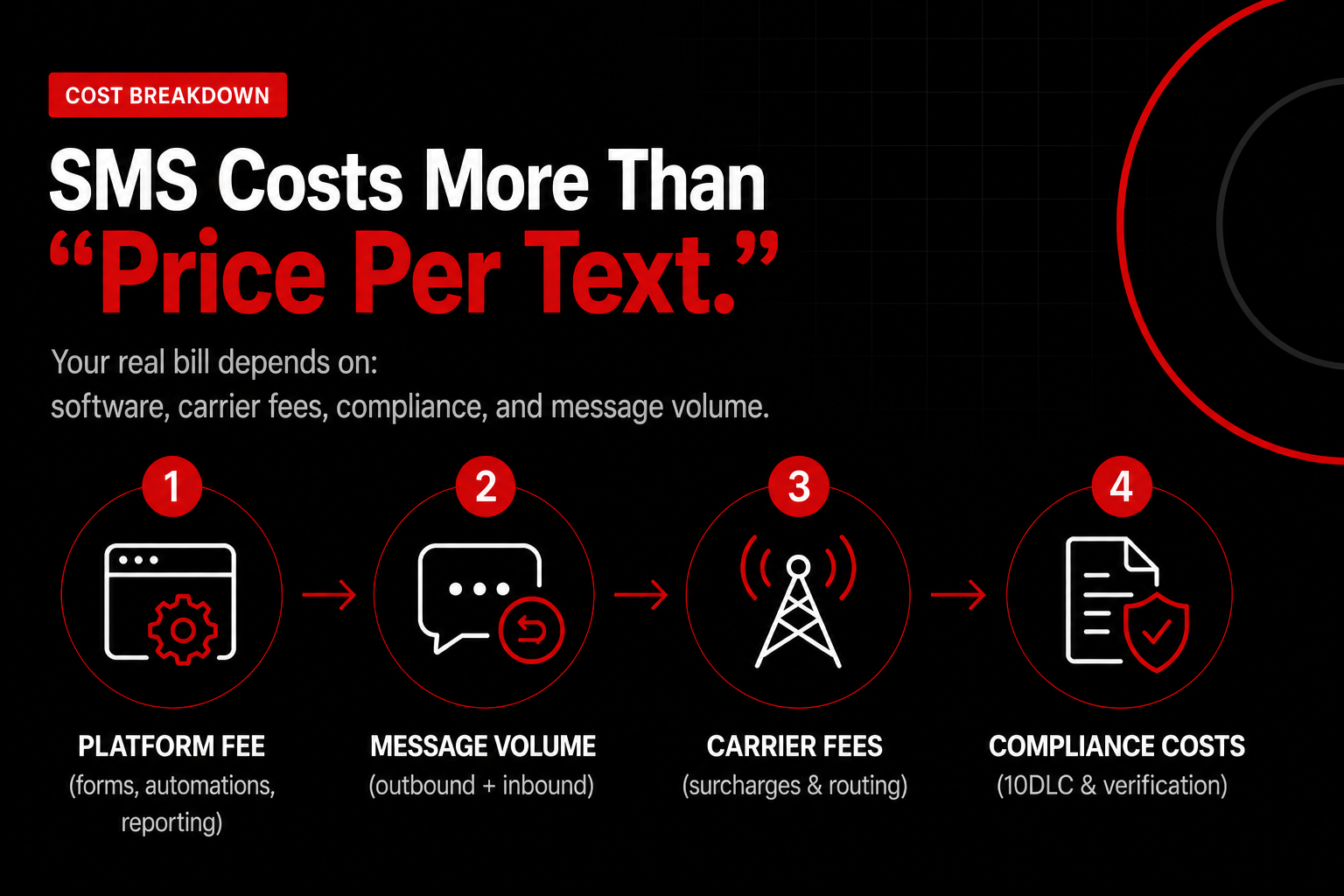
1) Platform/software fee (your “seat” in the system). Most sms marketing platforms charge monthly for list growth forms, keyword signups, segmentation, automations, reporting, and POS/loyalty integrations. For restaurants, this is what turns SMS into repeatable revenue—bounce-back offers, lapsed-member nudges, and scheduled promos.
2) Message send fees (outbound + inbound). Outbound texts are the per-message price. Inbound messages are replies like “STOP,” “YES,” or “What are your hours?” Some providers include inbound; others bill for it. If you run two-way campaigns, inbound volume can add up.
3) Carrier pass-through fees (the part your vendor doesn’t fully control). In the U.S., carriers add fees on top of base sending costs. They may appear as “carrier fees,” “surcharges,” or “pass-through,” and they vary by route and message type. If a quote doesn’t say whether carrier fees are included, you don’t know your real cost.
4) Compliance/verification costs (required to send at scale). Legit programs require identity and brand verification. For U.S. restaurant marketing, that often means 10DLC registration. Registration can include a one-time setup plus ongoing fees tied to your brand and campaign. Some vendors include this; others list it separately. Skip it and you risk filtering, throttling, or blocks.
Next, understand message types, because pricing and rules aren’t the same for everything you send.
Marketing/promotional messages are sales-driven: “20% off dinner tonight,” “Free dessert for loyalty members.” These require explicit opt-in, clear disclosures, and easy opt-out. Push too hard and you can trigger filtering or complaints.
Transactional/operational messages support an action the guest already took: reservation confirmations, waitlist updates, order-ready notifications, delivery status, and login codes. They often have different compliance expectations and may route differently than marketing texts. If a vendor lumps both together, you can pay the wrong rate and create compliance risk.
Now for the biggest myth: “per text” pricing isn’t the whole story. Your cost and message count can inflate even when you think you’re sending one text.
Encoding and message length matter. A standard SMS segment is 160 characters in GSM. Add special characters or emojis and you may switch to Unicode, where a segment is typically 70 characters. Go over the limit and your “one message” becomes multiple segments billed separately.
MMS vs SMS changes the math. Add an image and it’s MMS. MMS usually costs more per send than SMS and can have different deliverability rules. It can perform well for restaurants, but it can wreck budgets if you assume it’s “just another text.”
Inbound replies count. A weekly promo can trigger questions. If inbound is billed, a high-response campaign raises total cost—and staff workload unless you use templates or routing.
How does this map to typical restaurant usage patterns?
Before you accept any proposal, use this checklist to force an itemized quote
Once you see these components clearly, you’ll understand why two vendors can quote different totals for the same campaign. Next, we’ll look at how these costs get packaged into common pricing models—per-message rates vs monthly plans—and why many restaurants prefer one approach depending on list size, cadence, and how often guests reply.
How much does SMS marketing cost under different pricing models (per-message vs monthly plans)
Once vendors bundle fees into plans, the budgeting question becomes: how much does sms marketing cost under each pricing model?
Restaurants usually choose usage-based (per-message) pricing or monthly subscription/tiers. Both work, but they reward different realities: send frequency, list size, and how often guests reply.
.png)
1) Per-message (usage-based) pricing: pay for what you send
With usage-based pricing, you pay a set rate per outbound message (often different for SMS vs MMS). Send less, pay less—useful for a single location testing SMS.
What’s usually included: basic sending, list management, and a keyword/opt-in flow.
When it’s cost-effective: best for inconsistent volume—seasonal patios, catering spikes, holidays, or a new list. If you text 1–2 times per month, you avoid paying for unused capacity.
Common gotchas to check before you commit:
Operator heuristic: usage-based stays simple at low volume; with frequent promos and two-way texting, costs get harder to predict.
2) Monthly subscription plans: predictable spend, but watch “included” limits
Monthly plans bundle a platform fee with an included message allowance. Predictability depends on what “included” covers.
What “included messages” usually means: you get a pool of outbound messages. If you send to 2,000 subscribers and your text is 1 segment, that’s 2,000 messages. If it becomes 2 segments, that’s 4,000. Longer copy burns allowance fast.
Overage rates drive surprises. Ask the overage rate and whether unused messages roll over.
Feature gating is the other lever. Tiers often lock key tools behind higher plans, including:
Operator heuristic: if you want SMS to run like a system, monthly plans can save labor—if the tier includes what you need.
Restaurant realities that change the math (and the right model)
Your true cost isn’t just “price per message.” It’s how your operation behaves.
A simple break-even framework you can use in 10 minutes
To answer how much does sms marketing cost for your restaurant, estimate monthly message volume, then compare effective cost per message.
In the example: 6 × 2,000 × 1.2 =
Now compare:
Break-even: (monthly fee + expected overages) ÷ expected message volume. The lower effective rate (with the right features) usually wins.
How to evaluate cheap sms marketing services without getting burned
Cheap sms marketing services can work when needs are simple: small list, one location, occasional blasts, minimal replies, no integrations.
They get risky when SMS must drive revenue weekly. Watch for:
Checkpoint: request a sample invoice matching your estimated volume (including realistic replies). If they can’t show a real-world bill, assume the sticker price won’t hold.
Even with identical pricing models, costs and results can change based on how messages are delivered—10DLC vs short codes and carrier requirements.
10DLC vs short code vs toll-free: how sending routes change restaurant SMS costs and deliverability
That “delivery route” detail is where a lot of the price gap comes from. When you ask how much does sms marketing cost, you’re not just paying for the platform—you’re paying for the phone number type, the carrier approvals behind it, and the speed/consistency of delivery when you hit “send.”
In plain terms, your sending route is what the guest sees on their phone and how carriers decide whether to deliver your message quickly, slowly, or not at all.
10DLC (10-digit long code) looks like a normal local phone number (e.g., a regular 10-digit number). It’s the most common route for restaurant programs today because it balances cost and deliverability—if you register properly. Typical throughput (how many texts per minute) varies by carrier and your approved campaign, but a practical expectation for many restaurant brands is dozens to a few hundred messages per minute, not thousands.
Short codes are the 5–6 digit numbers you’ve seen from big brands (like “12345”). They’re built for scale and speed. Throughput is typically much higher than 10DLC—often hundreds to thousands of messages per second depending on setup—making them a fit for large lists and time-sensitive blasts.
Toll-free looks like an 800/888-style number. It’s often used for support and two-way messaging (think catering inquiries, waitlist updates, or “Text us if you’re running late”). It can work for marketing too, but deliverability depends heavily on verification and message content. Throughput can be solid, but it’s generally positioned between 10DLC and short code for many use cases.
How much does sms marketing cost by route: fees, carrier charges, and “hidden” line items
Route choice affects cost in two ways: setup/recurring fees and carrier pass-through fees per message. That’s why two sms marketing platforms can share the same “$X/month” yet produce different bills.
Budgeting tip: get an all-in estimate covering registration/verification, number lease, carrier pass-through fees, and expected per-message rate for your route.
Operational reality: approval timelines and what they do to your launch plan
Restaurants don’t launch SMS in a vacuum. You’re usually timing it around a new menu, a slow season, a grand opening, or a holiday rush. Route choice affects how fast you can realistically go live.
Practical planning move: build your SMS launch checklist backward from your target promo date. If you want a “48-hour flash deal,” choose a route and vendor that can be approved and stable before you start teasing it on social or in-store.
Deliverability and risk: why the cheapest route can be the most expensive
Deliverability is where operators lose money without realizing it. If you’re trying to drive a Tuesday night lift and 20–40% of your messages get filtered, delayed, or blocked, you didn’t just waste send costs—you lost the sales you were counting on.
Carriers aggressively filter messages that look like spam, come from unregistered routes, or behave like a “burst” from an unknown sender. This is why proper registration, consistent sending behavior, and clear opt-in/opt-out language matter operationally—not just legally.
Real-world example: if you send 5,000 texts for a lunch promo and only 3,500 actually land in the inbox on time, your effective cost per delivered message jumps by 43% (5,000 paid sends ÷ 3,500 delivered). That changes your ROI math fast, even if your per-message rate looked “cheap.”
Short codes generally earn strong trust signals with carriers when set up correctly, which is why high-volume brands often choose them. 10DLC can perform extremely well too—but only when your brand/campaign is registered and your content matches what was approved. Toll-free can be reliable for conversational flows, but marketing blasts without verification and best practices can trigger filtering.
Which route should you choose? Restaurant scenarios that map to cost and urgency
Use these scenarios to decide what to ask vendors for.
After choosing 10DLC, short code, or toll-free, turn it into a predictable monthly budget based on list size and send frequency.
Real-world SMS marketing budgets for restaurants (by list size, frequency, and campaign mix)
Once you’ve chosen a sending route and pricing model, build a monthly budget around (1) list size, (2) campaign frequency, and (3) campaign mix—because not every text should be priced or treated the same.
For predictable planning, use an all-in SMS unit cost of $0.015–$0.03 per delivered message (carrier + messaging fees), plus any platform fee. Some cheap sms marketing services advertise lower rates; confirm the quote includes carrier pass-through and compliance monitoring.
Campaign mix cost assumptions (use these as your baseline “budget buckets”):
Scenario table (described): Each scenario includes weekly promos, two “burst” weeks, a loyalty nudge, an events/catering push, and an operational estimate. Ranges reflect per-message variability and whether your sms marketing platforms bundle messaging into a monthly plan.
Assume: 4 weekly promos (2,000), 2 bursts (1,000), 2 loyalty nudges to 50% (500), 1 catering push to 20% (100), plus ~600 operational texts.
Assume: 4 weekly promos (8,000), 2 bursts (4,000), 2 loyalty nudges to 50% (2,000), 1 events push to 15% (300), plus ~1,200 operational texts.
Assume: 4 weekly promos (40,000), 2 bursts (20,000), 4 loyalty nudges to 40% (16,000), 2 events/catering pushes to 10% (2,000), plus ~5,000 operational texts.
Operational texts can become the biggest line item. Example: 3,000 marketing subscribers but ~12,000 operational texts/month. With ~12,000–20,000 marketing messages, total volume can hit ~25,000–35,000/month.
Hidden or forgotten fees that change your real budget:
How list growth and opt-outs affect your budget over time: Plan +15–25% above a “normal month” for seasonal bursts, list growth, and extra operational volume. Example: if Scenario 2 is $500/month, budget $575–$625 to avoid pausing campaigns due to overages.
Quote comparison checklist (so your scenario math matches the contract):
After you set a realistic spend range, pressure-test it by estimating revenue lift per campaign type and calculating break-even response rate and ROI.
The Bottom Line
You started here because vendor quotes for how much does sms marketing cost can feel all over the map. Now you know the price usually comes down to three levers: your pricing model, your sending route (10DLC vs. toll-free vs. short code), and your campaign cadence + list size.
Next steps: (1) estimate your monthly send volume (messages per campaign × campaigns per month × list size), (2) ask vendors for an itemized quote (platform, messaging, setup, and compliance fees), and (3) set a simple break-even target per campaign type so ROI is measurable.
Don’t treat compliance as optional—it protects deliverability and your brand. Start small with one or two campaign types, track redemptions and revenue lift, then scale with confidence.
.png)


.png)


