.png)


.png)
It’s 4:30 p.m., covers are soft, and email is averaging ~20% opens—so you need a faster lever. That’s why sms marketing platforms are becoming a go-to for restaurants facing last-minute demand swings, third-party marketplace margin pressure, and the need to drive repeat orders on your own terms.
This guide shows you how to compare tools, avoid compliance and deliverability mistakes that can get your number flagged, and model ROI before you sign a contract. We’ll define what counts as an SMS marketing platform (not just a POS texting add-on or a generic mass-texting app), then break down the evaluation pillars: compliance, deliverability, integrations, segmentation, automation, and reporting/ROI.
Because SMS success depends on restaurant constraints—rush windows, multiple locations, and airtight consent—we’ll start with what “restaurant-grade” really means.
What Restaurants Need From SMS Marketing Platforms (and What Most Tools Get Wrong)
Restaurant-grade texting isn’t about sending more messages. It’s about sending the right message to the right guest from the right location at the right time—without creating a compliance or brand problem.
That’s why evaluating sms marketing platforms like a generic retail business leads to disappointment. Restaurants have tighter timing windows, more operational chaos, and a faster “I’m annoyed” threshold. Your platform has to match those realities.
Below are the restaurant-specific use cases your tool should handle, the constraints it must survive, and the failure modes that knock otherwise “good” tools out of the running.
Restaurant use cases your platform must support (or you’ll leave money on the table)
Most restaurants don’t need SMS for weekly newsletters. You need it for real-time revenue moves tied to demand, labor, and inventory. The best sms marketing platforms make these moves easy to launch fast.
These depend on timing, local context, and data. If a vendor can’t show how they handle these scenarios, it’s probably built for another industry.
Operational realities: what looks simple on a demo gets messy in real restaurants
SMS is a “small task” that becomes a big task with multiple locations, managers, and no time. Good sms marketing for restaurant programs win because the platform fits how restaurants run.
Start with multi-location structure. A single unit can get away with one audience. A group can’t. You’ll need the ability to:
Speed-to-launch matters. If it takes days to build segments and approve copy, you miss the moment. A good tool should let you go from “we’re slow tonight” to “campaign scheduled” in under 15 minutes.
Restaurants don’t have a full-time lifecycle marketer. The platform must work when the “SMS owner” is a GM handling call-outs and deliveries. That means fewer steps, fewer mistakes, and defaults that keep you compliant.
Customer expectations: frequency tolerance is lower, and relevance is everything
Guests give you their phone number with more trust than an email address. They’ll tolerate fewer messages and punish irrelevant ones with STOP—or by ignoring you until performance dies.
Most restaurants do best when SMS is high-value and occasional. If your tool encourages blasting everyone because it’s easy, that’s a red flag. You want controls that prevent fatigue:
If your message could apply to any location, on any day, at any time, it probably won’t perform. Good sms marketing platforms make specificity easy.
What most tools get wrong (and how it shows up in your results)
Many SMS vendors look similar on a checklist. The difference shows up after a few campaigns when results swing—or opt-ins stall.
Common pitfalls in real restaurant texting programs:
When these fail, symptoms are predictable: you discount more for the same response, you text less because it feels risky, and your list stops growing because staff doesn’t trust the program.
Must-have vs. nice-to-have: a restaurant-first filter (single-unit vs. multi-unit)
Before you compare vendors, decide what you won’t compromise on. This prevents buying an impressive demo that becomes a daily headache.
For single-unit restaurants, your must-haves:
For single-unit restaurants, nice-to-haves:
For multi-unit groups and franchises, your must-haves:
For multi-unit groups and franchises, nice-to-haves:
If a vendor can’t meet your must-have list, stop there. No amount of “AI copy” fixes missing fundamentals in sms marketing for restaurant programs.
Even the best offer won’t work if your message doesn’t reach guests—or if you’re not legally covered to send it. That’s why the next step in evaluating sms marketing platforms is getting serious about compliance and deliverability.
Compliance & Deliverability Checklist for SMS Marketing Platforms in Restaurants
If your texts aren’t compliant and they don’t land, nothing else matters. In sms marketing for restaurant, promos often go out in tight lunch/dinner windows, which increases legal exposure and deliverability risk. Use this checklist as a non-negotiable filter when evaluating sms marketing platforms—before automation, segmentation, or AI copy.
Important: Practical guidance, not legal advice. Rules are shaped by TCPA, CTIA guidelines, and carrier policies, and they vary by situation. Your vendor should help implement basics, but you still own compliance.
Checklist 1: Consent basics (you can’t “growth hack” this)
Checklist 2: Brand registration and sender types (how your texts actually get through)
Carriers don’t treat all SMS the same. Sender type affects throughput, filtering, and setup work.
Checklist 3: Deliverability drivers (why “sent” doesn’t mean “received”)
Deliverability is shaped by identity, content, links, list hygiene, and sending pattern. Restaurants are vulnerable because you send bursts before meal periods.
Checklist 4: Data governance (you need proof, not vibes)
If a guest complains, you need to show when and how they opted in, what they were told, and what you sent.
Checklist 5: Vendor questions to ask (copy/paste these into your demo)
If a platform can’t answer these questions—or says “we handle everything” without showing receipts in the product—treat it as a red flag. Compliance and deliverability are the foundation of sustainable SMS growth when revenue depends on meal-period timing.
Once you’ve locked in the compliance and deliverability basics for sms marketing platforms, the next differentiator is performance: how well the tool segments guests (by visit history, location, and preferences) and how easily it automates restaurant workflows without adding hours of work each week.
How to Compare SMS Marketing Platforms: Restaurant Feature Framework (Segmentation, Automation, Integrations)
Now that you’ve confirmed the compliance and deliverability basics for sms marketing platforms, you’re evaluating what actually makes the phone ring (and keeps your team from drowning in manual work). The fastest way to shortlist tools is to score them on three restaurant-grade capabilities: segmentation, automation, and integrations.
Why these three? Because most revenue lift from sms marketing for restaurant comes from sending fewer, more relevant texts—not blasting your entire list. And most labor savings come from automated flows triggered by real guest behavior (a visit, a reservation, a cart, a birthday), not from “schedule a campaign” features.
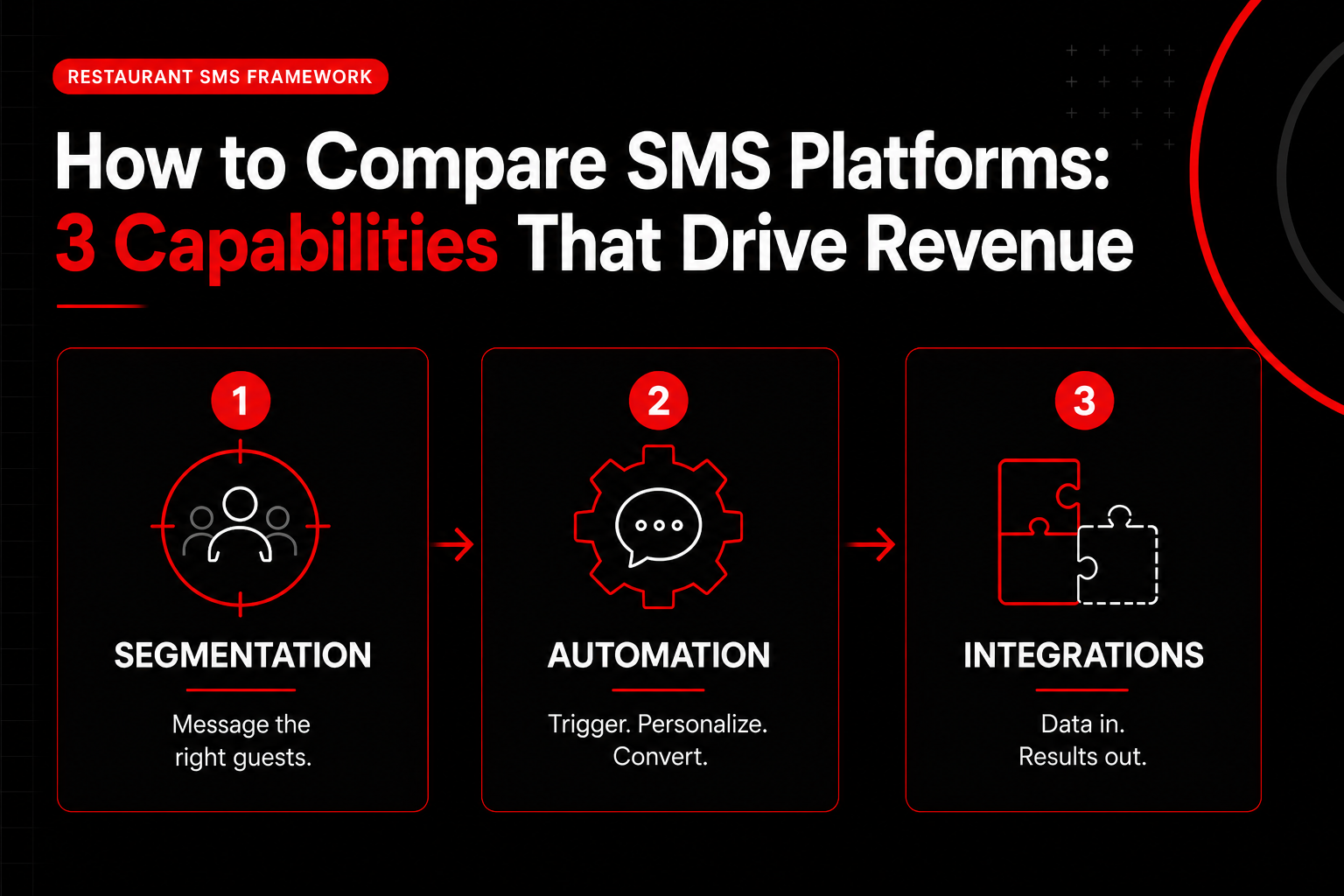
1) Segmentation That Matters for Restaurants (Not Generic Demographics)
Restaurant SMS works when you message the right guests at the right moment. Your platform should build segments from behavioral and transaction data—not manual tags.
Use this checklist to compare segmentation depth. A platform earns a “yes” only if you can create the segment and keep it updated automatically from integrated data.
Mini-examples you should be able to build in minutes:
What to look for in a demo: Have the vendor build a lapsed-guest segment live from POS visit data, then add location + ticket size. If they need a CSV export, it’s spreadsheet marketing.
2) Automation Recipes That Mirror Restaurant Workflows
Great sms marketing platforms don’t just let you schedule blasts. They run “set it once” programs that trigger automatically, then improve over time with reporting.
When you compare automation, score two things: trigger quality (what events can start a flow) and control (timing, conditions, suppression rules, and handoff to humans when needed).
Automation recipes you should expect (and how they drive revenue or reduce labor):
Automation controls that separate strong platforms from “basic texting tools”:
3) Integrations: The Data That Must Flow Both Ways
Integrations turn sms marketing platforms into a revenue engine. Restaurants need data flowing into SMS for targeting and triggers, and flowing back out for measurement.
POS integration (non-negotiable for serious ROI): Your SMS tool should ingest:
Loyalty integration: Trigger by tiers, points, redemptions; confirm impact.
Reservation/waitlist integration: Confirmations, reminders, no-show reduction, lapsed bookers.
Online ordering integration (first-party): Cart recovery, reorder prompts, delivery vs pickup.
CRM/email integration: Shared profiles, suppression, unified reporting.
Google/Meta integrations: Sync audiences and conversion tracking.
Two-way data flow requirements (ask this directly):
If a vendor can’t name synced fields and frequency (real time vs daily), it’s partial. Daily sync can miss the best window.
4) Multi-Location Controls: Brand Consistency Without Slowing Stores Down
If you operate more than one location (or manage franchises), compare multi-unit capabilities like you would compare POS permissions. The goal is simple: corporate controls the brand and compliance, while local managers can execute offers that fit their store’s reality.
Practical scenario: Corporate launches a brand-wide “Tuesday Kids Eat” promo template. Each location can toggle on/off, set a store-specific link, and schedule based on local staffing. Reporting rolls up to corporate while showing each store’s redemption and incremental sales.
5) Use a Scoring Matrix to Shortlist Fast (Plus Red Flags)
Use a weighted scoring matrix to stay objective. Rate each platform 1–5 per criterion, multiply by the weight, and total it. This prevents a flashy demo from hiding operational gaps.
Scoring matrix template (suggested weights for restaurants):
How to use it today: In each demo, run the same test: build one segment (lapsed VIPs), one automation (post-visit feedback), and one report (revenue or redemption by location). Score only what you can verify.
Red flags that should push a platform off your shortlist:
Pricing gets tricky: features and how messages are sent, tracked, and attributed drive cost as your list grows across locations.
How Much Does SMS Marketing Cost? Pricing Models, Hidden Fees, and Cheap SMS Marketing Services Tradeoffs
Once you start comparing sms marketing platforms, you’ll notice the pricing pages rarely tell the full story. The “$X/month” headline is only one part of your total cost, because your actual spend is driven by how many messages you send, what type of messages they are, and how complex your setup becomes across locations.
So if you’re asking how much does sms marketing cost for a restaurant, the honest answer is: it depends on your list size, message frequency, and the platform’s fee structure. The good news is you can estimate it with a simple formula (below) and avoid the common surprises that blow up budgets.
Common pricing models you’ll see in sms marketing platforms (and what’s typical for restaurants)
Restaurant operators typically see five pricing models. The model matters as much as the sticker price because plans scale differently.
Typical for restaurants: a base software fee plus sending usage. Single units stay modest; multi-location brands with frequent promos, triggered flows, and MMS see usage dominate.
What actually drives your monthly SMS bill
Two restaurants can both say, “We do SMS,” and have completely different costs because the biggest cost drivers are operational choices. Here’s what moves your bill the most across sms marketing platforms:
Practical takeaway: don’t estimate cost using “messages per month” alone. Estimate it using “messages per month plus automated sends plus MMS plus segments,” then add any fixed fees.
Hidden fees checklist (what to ask before you sign)
To compare sms marketing platforms, ask vendors to confirm these costs in writing to avoid budget surprises.
If they can’t explain costs clearly, treat it as an operations red flag.
A simple formula to estimate monthly SMS spend
Here’s a practical way to estimate your monthly bill before you send a single campaign. You can do this in a spreadsheet in 10 minutes.
Monthly SMS Cost Estimate = Platform Base Fee + Location/User Add-ons + Registration/Number Fees + Usage
Where:
Two quick tips that make this estimate more accurate:
Three restaurant scenarios (single-unit, 3 locations, 10+ locations)
These examples won’t match your exact pricing, but they show the math so you can model how much does sms marketing cost for your operation.
Scenario 1: Single-unit quick service (simple promos)
Estimated monthly sends = (1,200 × 4 × 1.2) + (400 × 1.2) = 6,240 segments.
Scenario 2: Three-location casual dining (segmented offers + photos)
Estimated SMS segments = (6,000 × 6 × 1.3) + (2,000 × 1.3) = 49,400 segments, plus 1,500 MMS.
Scenario 3: 10+ locations (multi-unit operator with heavy automation)
Estimated SMS segments = (40,000 × 8 × 1.4) + (20,000 × 1.4) = 476,000 segments, plus 5,000 MMS.
Cheap SMS marketing services: when they work, and when they’re risky
Cheap sms marketing services can work in specific cases. The key is knowing what you’re giving up and what your restaurant needs.
Cheap options can work if:
Cheap options get risky if:
The tradeoff is cheap vs predictable. Missing controls and setup help leads to lower delivery, higher opt-outs, and spreadsheet work.
When comparing sms marketing platforms, price in fees, usage, add-ons, and staff time. Saving $100/month isn’t savings if it costs 5 extra hours.
Next, we’ll turn cost into action: clean consent capture, reliable data sync, and a simple campaign calendar.
Implementation Playbook: Launch SMS Marketing for Restaurant Growth (First 30 Days)
You’ve priced the tool and shortlisted the best-fit sms marketing platforms. Now you need a 30-day rollout that protects deliverability, keeps consent clean, and gives your team a repeatable routine. This playbook gives clear steps, owners, and metrics so your sms marketing for restaurant program drives revenue without compliance headaches.
Use this as a day-by-day sequence. For multi-unit groups, pilot one location first, then replicate.
Days 1–3: Pre-launch setup (do this before you text anyone)
1) Complete sender registration and brand setup. Most restaurant-grade sms marketing platforms require brand/campaign registration (A2P/10DLC in the U.S.). Treat it as deliverability work, not paperwork. Keep a checklist: legal business name, EIN, address, website, and a short description of your texting purpose (offers, updates, loyalty).
2) Lock in opt-in language you can reuse everywhere. Use consistent copy across QR codes, online ordering, reservations, and Wi‑Fi. Keep it plain-English and specific:
Set expectations and stick to them; frequency creep drives opt-outs and hurts deliverability.
3) Align privacy policy + terms with what you’re actually doing. Your website privacy policy should mention SMS, what you collect (phone number, visit/order behavior), and how to opt out. Link your “SMS Terms” and “Privacy Policy” in signup forms and the footer.
4) Train staff and assign roles with approvals. SMS is immediate, so add guardrails. Use a simple RACI:
Use a two-person rule for mass sends: one builds, one reviews.
Days 4–10: List growth channels (keep consent clean and consistent)
Early results are limited by list size, so launch multiple opt-in paths. The goal is opted-in guests who want your messages. Clean consent reduces complaints and improves conversion.
In-store channels (highest intent):
Online channels (volume + automation-friendly):
How to keep consent clean: Use one canonical opt-in statement, store timestamp + source (QR, checkout, Wi‑Fi), and don’t upload old lists without proof of permission.
Days 11–20: Message strategy (cadence, timing windows, and offers that convert)
Restaurant SMS works when it’s tied to the guest’s next meal, not generic advertising. Keep it simple and repeatable.
Cadence guidelines:
Timing windows by meal period:
Offer types that work:
Personalization tokens: First name, location, and last-ordered category are enough. Avoid spam signals: no ALL CAPS, minimal punctuation, one link, lead with value, and include opt-out reminders as required.
Days 21–30: First automations to deploy (set-and-improve)
Automations are where sms marketing platforms earn their keep. Start with four:
Weekly reporting cadence + simple testing plan (so you improve every week)
Run a weekly 20-minute review with a GM-friendly dashboard.
Weekly dashboard:
A/B tests (one at a time): Offer vs offer, send time, or framing. Keep segments consistent and change one variable.
Simple campaign calendar:
For multiple locations, target by radius so “dine-in tonight” only hits nearby guests. With weekly tracking in place, you can decide whether to scale, switch tools, or renegotiate pricing.
Restaurant ROI Model for SMS Marketing Platforms: Calculate Payback, Break-Even, and Scale
You’re tracking opt-ins, opt-outs, clicks, redemptions, and attributed revenue. Now translate those numbers into profit so you can budget, compare sms marketing platforms, and define “good” for your restaurant.
The goal isn’t more texts. It’s incremental contribution margin: profit you wouldn’t have earned without SMS, after message costs, discounts, and labor.
.png)
Step 1: Define restaurant success metrics (and separate revenue from margin)
Pick 3–5 success metrics that match how you grow, and track them by campaign and month-to-date.
Revenue is not profit. A discount can spike sales and crush margin. Convert results into contribution margin (sales minus variable costs like food, packaging, and delivery/marketplace fees).
If you don’t know your margin, start with a working assumption. Many restaurants land around 55%–70% contribution margin on dine-in/takeout (lower on third-party delivery).
Step 2: Build the ROI formula (what to include—and what most people forget)
A restaurant-grade model for sms marketing platforms:
Incremental Profit = (Incremental Revenue × Contribution Margin %) − Offer/Discount Cost − SMS Program Costs
ROI % = (Incremental Profit ÷ SMS Program Costs) × 100
This is where “how much does sms marketing cost?” becomes a profit hurdle you must clear each month.
Labor tip: Include time. A clean assumption is 2–4 hours/week per unit in steady state, multiplied by a loaded hourly cost.
Step 3: Break-even math (the fastest way to decide if a platform tier is worth it)
Break-even asks: How many incremental orders cover monthly SMS cost?
Break-even incremental orders per month = Total Monthly SMS Program Costs ÷ Incremental contribution margin per order
Incremental contribution margin per order = (AOV × Contribution Margin %) − Discount impact per order
Worked example (single-unit restaurant)
Break-even incremental orders/month = $579 ÷ $13.80 = 42 orders.
Worked example (multi-unit group: 8 locations)
Break-even incremental orders/month = $2,989 ÷ $12.88 = 233 orders—about 1 extra order per day per store.
Step 4: Attribution that’s good enough to make decisions (without pretending it’s perfect)
Attribution won’t be perfect, but you can get directional truth. The right method depends on channels and whether your sms marketing platforms integrates with POS/ordering.
Practical rule: Use at least two methods (e.g., codes + baseline). If both agree, act.
Step 5: Scale decision rules (increase frequency, segments, MMS, or upgrade tiers based on marginal ROI)
Scale when the next message is profitable.
Decision shortcut: Compare tiers by incremental break-even. If Tier B costs $250 more, you only need $250 more incremental margin.
Put this model next to your shortlist to spot which sms marketing platforms are cheap on paper but expensive in missed automation or wasted sends. If you’re still asking “how much does sms marketing cost?” the only answer that matters is your break-even math—and you control it with targeting, offers, and frequency.
Next up: cost gotchas, compliance concerns, and when a budget tool is enough versus when you need a full-featured platform.
Frequently Asked Questions
What’s the difference between SMS marketing platforms and a mass texting app?
SMS marketing platforms are built for opt-in marketing at scale—think consent tracking, audience segmentation, automation, and reporting that ties back to revenue. A mass texting app usually focuses on sending messages fast, but it often lacks compliance workflows, deep deliverability controls, and restaurant-ready integrations that protect your number (and reputation) over time.
Is SMS marketing compliant for restaurants, and what proof of consent should I store?
Yes—SMS marketing for restaurant promotions can be compliant if you capture clear opt-in and honor opt-outs immediately. Store the phone number, timestamp, opt-in source (keyword, web form, QR, POS, online ordering), and the exact consent language shown at signup so you can prove permission if you ever get a carrier or customer complaint.
How many texts per month should a restaurant send without increasing opt-outs?
For most restaurants, 4–8 texts per month is a safe starting range: enough to stay top-of-mind without training people to opt out. If opt-outs rise after a send, reduce frequency and tighten targeting—irrelevant blasts, not “too many texts,” are usually the real issue.
Do I need POS integration to measure ROI from sms marketing platforms?
No—you can still measure ROI with trackable links, unique promo codes, and offer redemption at checkout, even without a POS connection. That said, POS or online ordering integration makes attribution faster and cleaner, especially when you’re running multiple offers across locations.
Are cheap sms marketing services safe to use for promotions?
Sometimes, but only if they support compliant opt-in/opt-out, include messaging templates and consent fields, and can protect deliverability (not just “send messages”). Many cheap sms marketing services cut costs by limiting compliance tooling, support, or carrier-grade throughput—so the risk is paying less per text while losing more in blocked messages, complaints, or list churn.
What’s the quickest way to shortlist sms marketing platforms for restaurants?
Pick the platform that (1) makes compliance easy to prove, (2) connects to the data you already use (online ordering, reservations, POS, loyalty), and (3) shows revenue impact within 30 days through clear reporting. If a tool can’t do those three, it’s not “best”—it’s just another texting tool.
The Bottom Line
You started here to use SMS to fill seats and drive repeat visits—without the “one wrong text” risk. Your decision comes down to four pillars: compliance and deliverability first, then features and integrations (online ordering, reservations, POS, loyalty), then pricing, and finally ROI proof you can defend.
Next steps: build a 2–3 vendor shortlist, score them with your matrix, and ask for written consent, opt-out, and deliverability details. Then run a 30-day pilot with clean measurement so revenue impact is obvious.
Match the tool to your reality—single-unit vs multi-location, and whether you need promos, retention, or catering—and you’ll pick the right sms marketing platforms with confidence.
.png)


.png)


