.png)


Restaurants now lose 15% to 30% of every third-party delivery order to marketplace commissions, while rising ad costs make customer acquisition harder than ever. That pressure is why more operators are evaluating chownow for restaurants as a way to protect margins, own guest relationships, and build a more predictable revenue stream. In 2026, guest data is no longer just a marketing advantage — it directly impacts repeat orders, retention, and long-term profitability. Direct ordering gives you access to customer emails, order history, and loyalty insights that marketplaces often keep for themselves.
This guide breaks down how ChowNow works, what its pricing looks like, how its POS and delivery integrations function, and how restaurants use built-in marketing tools to drive repeat business without relying entirely on third-party apps. Next, we’ll look at how ChowNow operates day to day and why its model differs from marketplace-first delivery platforms.
How ChowNow for Restaurants Works in 2026
At its core, ChowNow for restaurants gives operators a direct online ordering system tied to channels customers already use. Instead of sending diners into a marketplace filled with competitors, ChowNow helps restaurants create branded ordering experiences connected to their own websites, mobile apps, Google listings, and social media profiles.
ChowNow acts as the digital ordering layer between guests and restaurant operations. Customers place orders through branded channels, orders route into the POS or kitchen workflow, and restaurants fulfill pickup or delivery without marketplace-style commission fees on every order. For many independent operators, that turns online ordering into an owned revenue channel instead of a high-cost acquisition tool.
The platform usually starts with a branded ordering page embedded into a restaurant website. Restaurants without modern ordering sites can also use ChowNow-hosted pages optimized for mobile and desktop traffic.
That matters because off-premise dining now represents a major share of revenue for many restaurants. Customers expect ordering to be fast, mobile-friendly, and simple. Slow checkout flows or confusing menus can reduce conversions quickly during busy meal periods.
ChowNow addresses this with centralized menu management and standardized ordering across devices. Guests browsing on desktop should see the same pricing, modifiers, photos, and upsells as customers ordering from Instagram on a phone late at night.
One of the biggest operational differences with ChowNow for restaurants is how ordering channels connect under one system. The ecosystem typically includes:
Google integration has become especially important because many diners now begin ordering through search instead of delivery apps. When customers search for a restaurant or terms like “pizza near me,” direct ordering buttons inside Google reduce clicks between discovery and checkout. Fewer steps often improve conversion rates.
Social ordering serves a similar purpose. A restaurant promoting a limited-time menu item on Instagram can link directly to an ordering page instead of sending customers to a third-party marketplace. That gives the restaurant more control over the promotion, ordering path, and customer relationship.
Operationally, ChowNow is designed to fit existing restaurant workflows rather than forcing staff to manage a separate manual system. Orders can integrate with major POS systems so tickets flow into kitchen operations automatically. Depending on setup, orders may print in the kitchen, appear on kitchen display systems, or sync with front-of-house workflows.
For operators, this reduces one of the biggest digital ordering pain points: order re-entry. Without integrations, staff often transfer orders manually from tablets into POS terminals during rush periods. That creates delays, increases labor pressure, and raises the risk of mistakes.
For example, a five-location burger chain processing 400 online orders daily could lose more than three labor hours every day if employees spend 30 seconds manually entering each order. Integrated systems reduce that friction significantly.
Customer experience is another major focus. ChowNow’s ordering flow emphasizes speed and convenience for both pickup and delivery. Customers can browse menus, customize items, save payment details, reorder favorites, and schedule future orders from desktop or mobile devices.
Restaurants also maintain greater control over menu presentation. That includes modifiers, combo structures, dietary labeling, and upsell opportunities. A sushi restaurant can promote premium add-ons during checkout, while a pizza shop can highlight catering bundles before major sporting events. These merchandising options are harder to manage consistently on marketplace platforms where the interface is controlled by the marketplace itself.
Delivery works differently as well. Third-party marketplaces primarily operate as demand-generation platforms that aggregate restaurants into one app experience. Customers compare restaurants side by side and often choose based on price, placement, or delivery speed.
ChowNow’s model is structured around helping restaurants drive customers into direct ordering channels they control. Restaurants can still use integrated courier networks for delivery logistics, but the customer relationship stays tied more closely to the restaurant brand instead of a marketplace app.
That distinction affects long-term customer ownership. Marketplace platforms often provide limited customer data and fewer opportunities for direct engagement. With direct ordering systems, restaurants typically gain access to order history, email addresses, phone numbers, purchase frequency, and other behavioral insights.
That information supports loyalty programs, SMS campaigns, retention offers, and targeted promotions. A Mediterranean restaurant might identify customers who regularly order family meals and send catering promotions before graduation season. A coffee chain could reward repeat weekday customers with app-exclusive afternoon offers.
This ownership-first approach is central to how ChowNow positions itself in restaurant technology. The goal is not simply processing transactions. The larger objective is to help restaurants build sustainable digital sales channels that support repeat business, stronger margins, and direct guest relationships.
Functionality alone does not determine whether a platform is the right fit. Restaurants still need to evaluate subscription costs, operational complexity, delivery economics, and expected order volume before deciding. In the next section, we’ll examine ChowNow’s pricing structure, fee model, and overall economics to understand where the platform makes financial sense.
ChowNow for Restaurants Pricing, Fees, and ROI
For many operators evaluating chownow for restaurants, the biggest question is whether the economics improve profitability compared to third-party delivery marketplaces. That calculation matters as food, labor, and customer acquisition costs continue rising.
ChowNow primarily uses subscription pricing instead of charging large commissions on every order. Restaurants pay recurring platform fees for direct online ordering while keeping more revenue from each transaction.
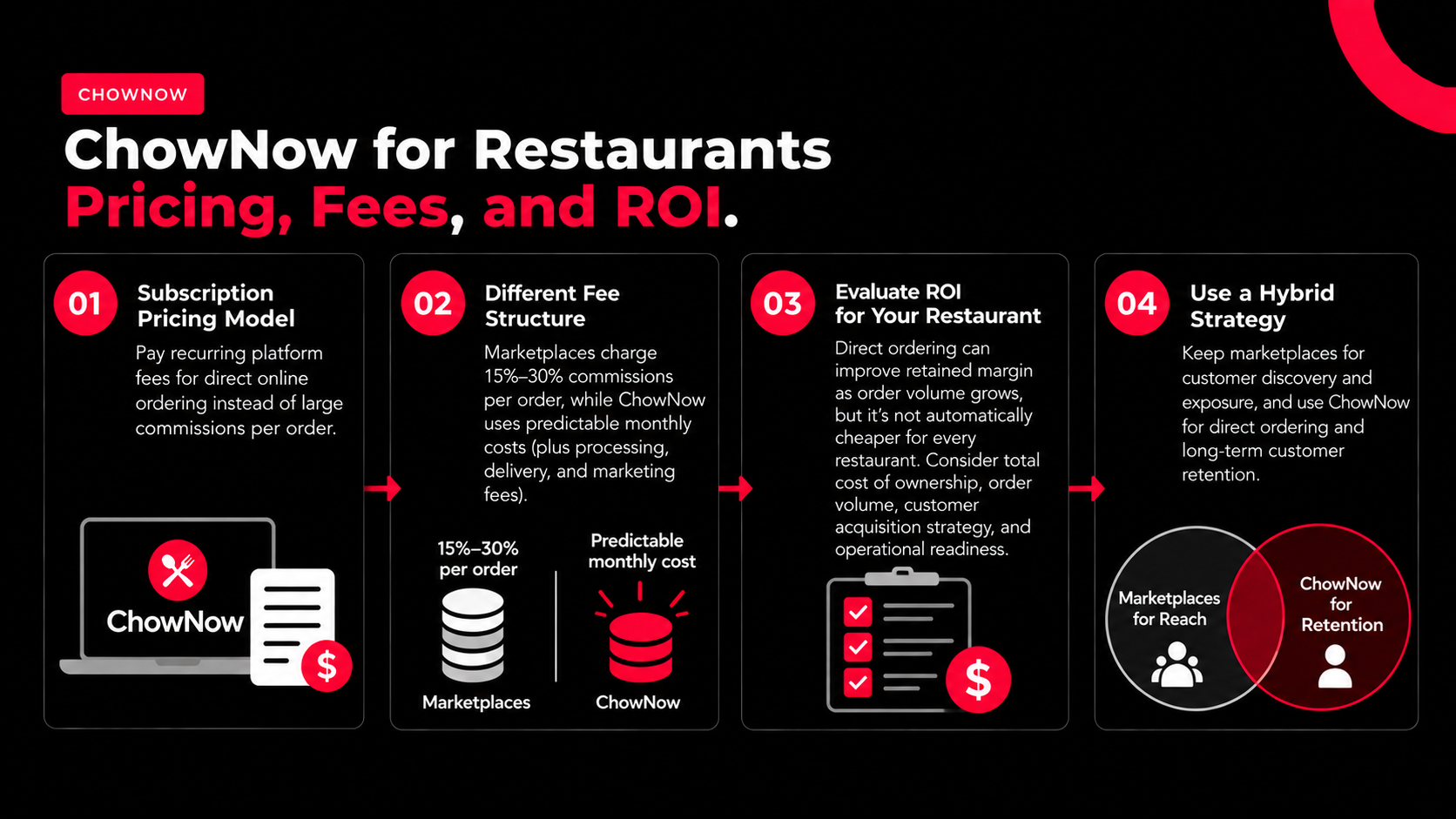
That creates a different financial equation than marketplaces charging 15% to 30% commissions. On a $40 order, a 25% commission removes $10 before payment processing, packaging, or delivery costs. For restaurants operating on thin margins, those fees quickly reduce profit.
With chownow for restaurants, operators trade variable commission costs for more predictable monthly software expenses. Predictability helps restaurants budget and stabilize margins.
However, subscription-based ordering is not automatically cheaper in every situation. Restaurants should evaluate total cost of ownership, order volume, customer acquisition strategy, and operational readiness before deciding whether direct ordering works in their favor.
Most restaurants evaluating ChowNow should expect several categories of costs:
The key distinction is that most of these costs are fixed or semi-predictable instead of scaling with every order. As order volume grows, the effective cost per order usually declines.
Consider a practical example. A single-location fast casual restaurant generates 1,200 monthly online orders with an average ticket of $38. Through a marketplace charging 25%, monthly commission costs alone would total about $11,400.
If the restaurant redirects a meaningful percentage of customers to direct ordering through ChowNow, the economics change quickly. Assume the restaurant pays $700 to $1,200 monthly across subscription fees, processing differences, and marketing support. Even after delivery expenses and promotions, retained margin can improve substantially once direct ordering volume scales.
That does not mean restaurants should abandon marketplaces. Third-party apps still provide customer discovery and exposure, especially in dense urban markets. Many operators use a hybrid strategy: marketplaces for reach and direct ordering for retention.
The goal is not eliminating marketplace usage. It is reducing dependence on high-commission channels over time.
This matters when evaluating customer lifetime value. Marketplace orders often belong primarily to the platform, limiting guest data and marketing access.
Direct ordering changes that equation. If a customer orders directly several times per year instead of through a marketplace, retained revenue compounds significantly. Saving even $6 to $10 per order can preserve thousands in annual profit from repeat customers.
For independent restaurants, ROI often depends on existing customer demand and brand recognition. A neighborhood pizzeria with strong local awareness may see positive economics quickly because customers are willing to order directly once given a convenient option.
For example, a pizza shop averaging $60,000 in monthly online sales through apps at a 23% blended commission rate would pay roughly $13,800 monthly in marketplace fees. If the restaurant redirects 35% of those orders to direct channels, annual savings can exceed $57,000 before software and marketing costs.
By contrast, a newly launched restaurant without an established audience may struggle to generate direct traffic immediately. Marketplace visibility can still play a major role in customer acquisition until repeat business grows.
Multi-location operators evaluate ROI differently. Direct ordering economics are often tied to operational consistency, centralized customer data, and scalability.
A five-location restaurant group processing $500,000 in monthly digital sales can face six-figure annual commission exposure through marketplaces. Even modest reductions in marketplace dependence may produce major savings.
There are also operational considerations that affect ROI beyond commission savings. Restaurants should evaluate:
One overlooked factor is marketing investment. Direct ordering platforms are rarely “set it and forget it” systems. Restaurants that promote ordering channels through QR codes, loyalty offers, packaging inserts, and social campaigns usually see stronger ROI.
That is why operators should view chownow for restaurants less as a marketplace replacement and more as infrastructure for long-term digital independence. The economics improve when restaurants consistently convert first-time marketplace buyers into repeat direct customers.
Guest Data Ownership and Marketing Automation Strategies
For many operators evaluating chownow for restaurants, the key feature is not online ordering alone. It is the ability to own and use guest data. That includes customer names, phone numbers, email addresses, order history, visit frequency, ticket size, and purchase preferences.
That distinction changes how restaurants grow. On third-party marketplaces, the platform owns the customer relationship and controls promotions, rankings, and remarketing. Even if guests order repeatedly, the marketplace often remains the brand they remember.
Direct ordering platforms shift that dynamic. With chownow for restaurants, operators can build retention strategies instead of relying on marketplace exposure and paid placement. Repeat guests usually spend more and cost less to retain than newly acquired customers.
The economics are significant. Bain & Company research found that increasing customer retention by 5% can increase profits by 25% to 95%. In restaurants, repeat customers often order more frequently and choose direct channels when the experience is convenient.
That is why marketing automation is now central to restaurant operations. Restaurants compete on convenience, attention, and consistency across digital channels.
Chownow for restaurants supports retention through email, SMS campaigns, and loyalty promotions. Operators can use ordering data to create campaigns based on guest behavior rather than sending the same offer to everyone.
Restaurants can segment customers into groups such as:
These segments allow more relevant offers. A family-style Italian restaurant might promote Sunday dinner bundles to guests who previously ordered catering trays. A fast-casual concept could target weekday office customers with lunch specials before noon.
Segmentation also protects margins. Constant blanket discounts train customers to wait for promotions. Data-driven automation helps restaurants increase repeat business without reducing profitability.
Email remains one of the highest-return channels available. According to Litmus, email marketing generates an average return of $36 for every $1 spent. Owned email lists also protect restaurants from marketplace algorithms and rising ad costs.
SMS marketing is valuable for time-sensitive campaigns because text messages often achieve open rates above 90%. Restaurants can quickly promote limited offers, event reminders, loyalty rewards, or same-day traffic-driving specials.
The operational advantage comes from automation. Restaurants can build workflows triggered by customer behavior instead of managing campaigns manually. Examples include:
Automation reduces workload while creating consistent communication. Many restaurants lose repeat business simply because there is no follow-up after a positive experience.
Direct ordering data also improves customer lifetime value, or LTV. Small increases in ordering frequency can create major long-term revenue gains. A guest spending $35 once per month generates about $420 annually. If campaigns increase ordering to twice monthly, annual value rises to roughly $840 before referrals or upsells.
Guest data creates operational insights beyond marketing. Restaurants can identify top-performing menu items, track purchasing trends, analyze daypart demand, and measure which promotions generate profitable repeat behavior.
A regional pizza chain may discover that customers who add desserts to their first order are more likely to reorder within 60 days. Another operator may find that direct-ordering customers have higher average tickets than marketplace customers because family bundles and add-ons are easier to feature in owned ordering flows.
These insights help restaurants make smarter decisions across pricing, staffing, menu engineering, and marketing allocation. They also help restaurants reduce reliance on assumptions and focus on measurable customer behavior.
The contrast with marketplace dependence becomes clearer over time. Marketplace platforms optimize for their own ecosystem first. Visibility can change based on sponsored listings, algorithm updates, or delivery radius adjustments. Restaurants have little control over customer discovery and almost none over post-purchase communication.
That dependence creates risk. Restaurants may invest heavily in marketplace sales only to face rising commissions or declining visibility later. Since the platform owns the relationship, operators struggle to move customers into direct channels.
Owned channels provide more stability. Email subscribers, SMS lists, loyalty members, and direct-ordering customers become long-term business assets that restaurants control independently.
This is one of the clearest advantages of chownow for restaurants. The platform is designed not only to process transactions but also to help restaurants build customer relationships that grow more valuable over time.
For independent operators, this matters because large chains already invest heavily in loyalty systems, CRM tools, and analytics. Direct ordering platforms help restaurants compete by giving smaller businesses access to retention strategies once limited to enterprise brands.
The strongest restaurant growth strategies in 2026 are increasingly built around first-party customer relationships instead of marketplace exposure alone. Restaurants that understand guest behavior, communicate consistently, and automate retention campaigns are better positioned to improve margins and reduce dependence on paid acquisition channels.
Integrations, POS Connectivity, and GMB for Restaurants
For operators evaluating ChowNow for restaurants, the main question is whether the platform fits existing workflows. Ordering software that adds extra tablets, duplicate processes, or manual entry slows service and raises labor costs during peak hours.
Integrations matter because a direct ordering platform only becomes useful when it connects ordering, payments, delivery, customer data, and local discovery into one workflow. Restaurants that reduce manual order handling often improve ticket accuracy, reduce staff interruptions, and process more orders without adding labor.
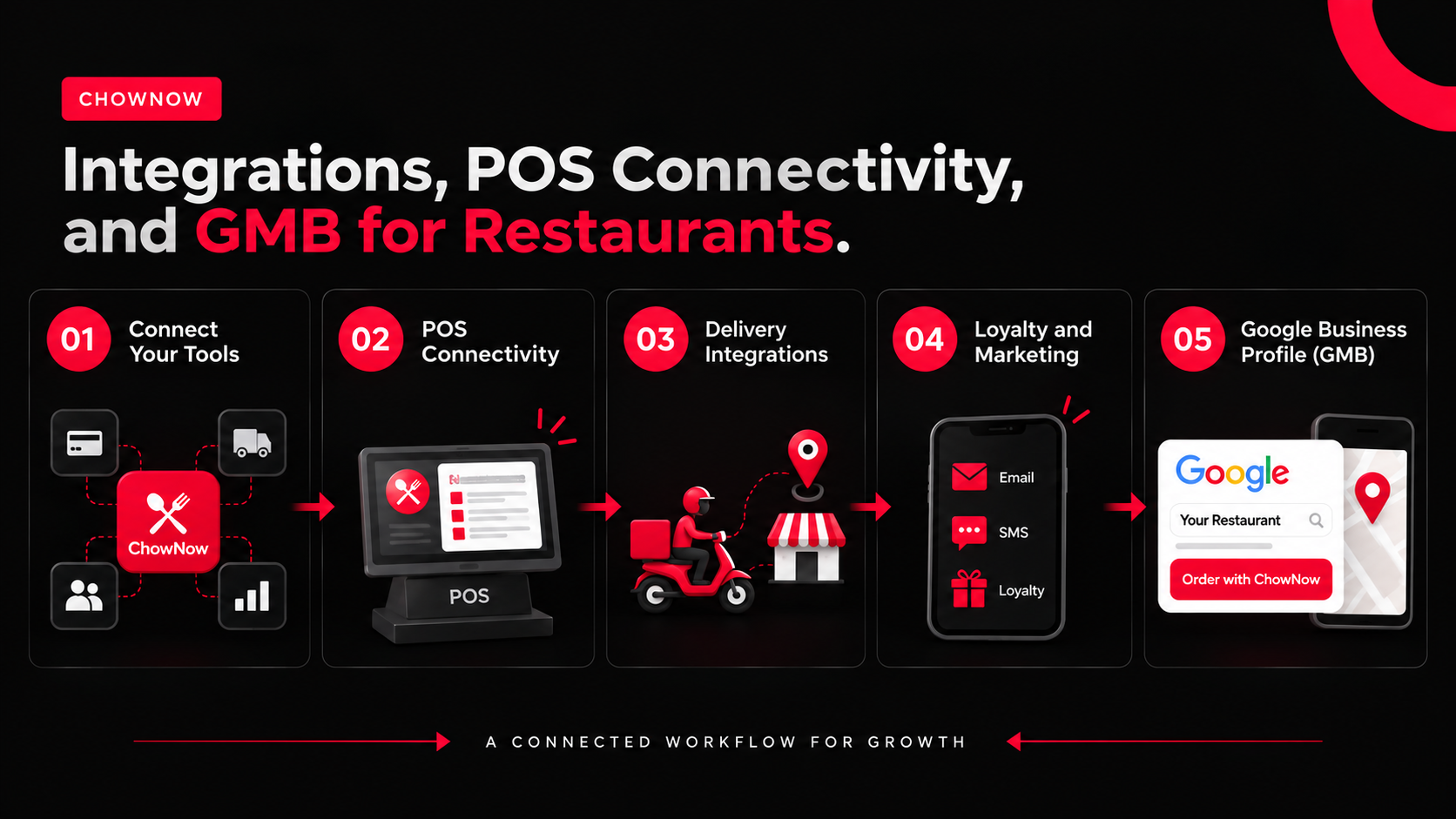
POS connectivity is central to that infrastructure. ChowNow supports integrations with major restaurant POS systems, allowing online orders to flow directly into kitchen workflows instead of requiring staff to re-enter tickets manually.
Without POS integration, staff must monitor a separate tablet, confirm incoming orders, manually enter items into the POS, and reconcile payments later. Minor delays create bottlenecks during lunch and dinner rushes.
Integrated ordering changes the workflow entirely. Orders appear automatically in the POS, fire to kitchen printers or display systems, and sync with reporting tools in real time. This creates several operational advantages:
Restaurants should still verify integration depth before implementation. Some systems support full menu syncing and inventory updates, while others only pass orders through at a basic level. Operators should ask about modifier support, synchronization frequency, outage handling, and refund workflows before launch.
This becomes more important for multi-location brands. Restaurant groups with regional pricing, different menus, or location-specific promotions need centralized management without creating confusion for store managers.
Beyond POS connectivity, restaurants should evaluate delivery integration options. Many independents want to maintain direct customer ownership while still offering delivery convenience. ChowNow supports fulfillment through delivery partners instead of requiring restaurants to build in-house driver operations.
Delivery economics vary by market. Restaurants should review delivery radius controls, dispatch timing, customer communication tools, and driver handoff workflows before selecting a setup.
Loyalty and marketing integrations also influence long-term direct ordering performance. Owned ordering channels become more valuable when customer data flows into retention campaigns automatically. Restaurants that connect ordering systems with email, SMS, and loyalty tools can build repeat purchase strategies instead of depending entirely on marketplace discovery.
For example, a fast-casual restaurant could automatically trigger:
These automated workflows help restaurants increase customer lifetime value without constant manual campaign management.
Google ordering integrations are another critical consideration. Local search is one of the highest-intent discovery channels in the restaurant industry. Customers searching for a restaurant on Google often already intend to order. If the experience redirects users through multiple pages, conversion rates can drop quickly.
This is why gmb for restaurants has become a major operational priority. A properly optimized Google Business Profile allows customers to place pickup or delivery orders directly from Google Search and Google Maps.
When ChowNow connects with Google ordering, restaurants can direct customers toward commission-free ordering experiences instead of losing traffic to third-party marketplaces within search results.
Restaurants should optimize their Google Business Profile ordering setup by focusing on several operational details:
For multi-location operators, managing gmb for restaurants at scale requires centralized oversight. Inconsistent location data creates customer frustration and can reduce local search visibility.
Restaurant groups should create governance processes for Google Business Profile management, including ownership roles, standardized menu updates, and regular audits across locations.
Another operational consideration is reporting visibility across systems. Leadership teams need attribution data showing where orders originate, which channels drive repeat customers, and how direct ordering compares across locations.
Restaurants evaluating ChowNow for restaurants should also assess operational support during onboarding. Integration projects often involve menu mapping, POS testing, Google Business Profile verification, delivery configuration, and staff training across multiple systems.
Once integrations, local discovery workflows, and operational systems are aligned, restaurants need a rollout plan that drives staff adoption, customer awareness, and consistent order growth across every location and channel.
Building a Direct Ordering Growth Strategy Beyond Third-Party Apps
Once your ordering infrastructure is live, growth depends on how consistently you move customers from third-party marketplaces to owned channels. That shift rarely happens automatically. Restaurants using chownow for restaurants typically see the strongest results when direct ordering is treated as an ongoing marketing system rather than a one-time launch announcement.
The goal is simple: increase the percentage of orders coming through channels you control while improving margins and guest retention over time. That requires coordinated promotion across email, social media, search visibility, in-store experiences, and customer incentives. The restaurants that succeed are usually the ones that make direct ordering part of every guest interaction.
Driving Traffic to Direct Ordering Channels
Email remains a high-ROI channel for restaurants because it reaches guests who already know your brand. Litmus reports an average return of $36 for every $1 spent. Consistency matters more than volume.
Focus on automated campaigns tied to customer behavior:
Use segmentation aggressively. Family-meal customers should not receive the same messaging as late-night pickup guests. Better targeting improves repeat orders without increasing ad spend.
Social media should support direct ordering, not just brand awareness. Posts should send customers to your ordering link, not a marketplace profile.
Use limited-time offers, pinned posts with QR ordering links, and short videos showing pickup convenience or delivery packaging quality.
Many guests search a restaurant name in Google before ordering. Optimized Google Business Profiles, website metadata, and ordering links help capture those customers before they reach third-party marketplaces.
Make sure your direct ordering link appears consistently across:
In-store QR codes on receipts, packaging, and loyalty signage create easy entry points for repeat direct orders.
Creating Incentives That Shift Ordering Behavior
Customers need a reason to change habits. Third-party apps are convenient, familiar, and heavily marketed. Your direct ordering strategy must create enough value to overcome that convenience gap.
The most effective incentives are immediate, simple, and financially sustainable. Instead of broad discounting, focus on offers that preserve margins while changing behavior.
Examples include:
Restaurants often underestimate how powerful packaging inserts can be for customer migration. If a customer orders through a marketplace, include a direct-order incentive card inside the bag. Even a modest conversion rate can materially impact margins over time.
For example, shifting just 20 orders per day from a marketplace charging 20% commission to a direct ordering platform can save thousands annually for a mid-volume restaurant. Those savings can then be reinvested into customer acquisition and retention.
Retention Tactics That Increase Repeat Orders
Acquiring customers is expensive; retention drives profitability. Direct ordering platforms truly help restaurants increase repeat orders without relying on third-party apps. Returning guests typically spend more and order more often over time.
Effective loyalty programs stay simple:
Automation matters. Integrated loyalty tied to chownow for restaurants or your broader tech stack reduces staff workload and keeps rewards consistent during busy shifts.
Promotions should match demand patterns. If Tuesdays are slow, offer Tuesday-only rewards instead of daily discounts to protect margins.
SMS campaigns also drive repeat orders because open rates usually beat email. Short, time-sensitive lunch or dinner offers perform best when messages stay concise and actionable. Send them near ordering windows for stronger conversion.
Managing Operational Challenges During Rollout
Even strong marketing campaigns fail if operations are inconsistent. One of the biggest mistakes restaurants make is promoting direct ordering heavily before staff workflows are fully aligned.
Staff adoption starts with training. Employees answering phones, packing orders, and interacting with guests should understand:
Menu consistency is another critical issue. Customers become frustrated quickly when pricing, availability, or modifiers differ between platforms. Assign one person or team responsibility for menu governance across all channels.
Fulfillment expectations also need careful management. Direct ordering customers expect the same convenience and reliability they receive from marketplaces. If delivery windows are inaccurate or pickup experiences are slow, conversion efforts stall quickly.
Many operators improve fulfillment performance by setting conservative prep times initially, then optimizing based on order flow data. Accurate expectations are usually more valuable than aggressive delivery promises.
Multi-location operators should standardize processes wherever possible. Consistent branding, loyalty structures, and fulfillment policies reduce customer confusion and simplify marketing execution across stores.
Measuring What Actually Drives Profitability
Growth without measurement leads to wasted marketing spend. Restaurants should track core metrics instead of vanity numbers like social followers alone.
Repeat order rate is a critical indicator of direct ordering health. If first-time customers do not return, retention strategy needs adjustment. Many restaurants target repeat purchases within 30 days.
Customer acquisition cost tracks ad and promotion spend required to acquire each direct-order customer. Compare CAC against lifetime value and margin improvement versus marketplace orders.
Direct ordering often delivers stronger profitability than third-party marketplaces. Tracking contribution margin by channel supports smarter promotional decisions.
Pay attention to:
Effective operators review these metrics monthly and adjust campaigns continuously. Direct ordering growth usually comes from consistent execution and ongoing customer communication. As more restaurants evaluate direct ordering platforms in 2026, operators should also assess onboarding complexity, contract flexibility, support responsiveness, and long-term scalability before choosing a platform.
Frequently Asked Questions About ChowNow for Restaurants
What makes ChowNow for restaurants different from Uber Eats or DoorDash?
ChowNow for restaurants focuses on direct ordering instead of marketplace discovery. Rather than paying large commissions on each order, restaurants use branded ordering channels to keep more revenue, retain guest data, and strengthen customer relationships.
Does ChowNow provide delivery drivers for restaurants?
ChowNow can connect restaurants with delivery networks, but it is not a delivery marketplace with its own large driver ecosystem like Uber Eats. Operators gain flexibility to choose delivery options that fit their margins, staffing, and service areas.
Can ChowNow integrate with major restaurant POS systems?
Yes, ChowNow for restaurants integrates with many popular POS platforms, helping reduce manual entry and operational mistakes. Before signing, operators should confirm compatibility with their POS version, menu structure, and multi-location setup.
Is ChowNow a good fit for small independent restaurants?
ChowNow often works best for restaurants with repeat customers that want more direct orders. Restaurants with strong branding, active social media, and optimized GMB for restaurants typically gain the most value because they can drive traffic to their own ordering channels.
How long does implementation typically take?
Implementation depends on menu complexity, POS integration, and website readiness, but many restaurants launch within weeks. Multi-location groups or operators switching platforms may need extra time for menu synchronization, staff training, and marketing rollout.
Can ChowNow help restaurants grow outside of third-party apps?
Yes, many restaurants use ChowNow within a broader direct ordering strategy that includes email marketing, SMS campaigns, loyalty programs, and GMB for restaurants optimization.
The Bottom Line on ChowNow for Restaurants
For many operators, the real decision is not just delivery versus pickup — it is marketplace convenience versus long-term customer ownership. ChowNow for restaurants gives brands more control over guest data, ordering experiences, and commission costs while supporting a stronger direct relationship with customers.
That said, the right platform depends on how well it fits your existing operations and growth strategy. Before making a switch, evaluate POS integrations, marketing workflows, customer acquisition plans, and the expected ROI from shifting more orders to direct channels. Restaurants that pair direct ordering with consistent email, SMS, and local search marketing are often better positioned to increase repeat business and reduce reliance on third-party marketplaces over time.
As first-party ordering continues to shape restaurant growth in 2026, operators who invest in owned customer relationships will likely have a stronger competitive advantage in both profitability and retention.
.png)


.png)


