.png)


Third-party delivery commissions still reach 15% to 30% per order, yet most restaurant platforms keep selling marketplace reach instead of conversion efficiency. That’s backwards. The real value of an online ordering site comes from how reliably it turns traffic into completed orders, repeat visits, and first-party guest data you actually own.
In our work with restaurant operators, we’ve seen brands increase repeat order frequency by 18% to 30% after connecting loyalty directly into checkout, according to Paytronix’s 2024 online ordering report. Meanwhile, 57% of diners now choose restaurants based on loyalty rewards, according to Loyally.ai (and yes, smaller operators benefit too). This guide breaks down which features measurably improve conversion rates, average order value, and retention—and which platform claims matter far less than vendors admit.
You’ll see how AI recommendations, structured menus, mobile-first checkout flows, and loyalty integrations affect revenue, operations, and guest retention before you compare platforms. First, though, it’s worth understanding why most conversion problems start with menu architecture and mobile usability long before checkout begins.
Online Ordering Site Menu Features That Improve Conversion Rates
The highest-converting online ordering site menus are structured for fast mobile browsing, low cognitive load, and clear modifier flows rather than maximum customization. Most operators focus on aesthetics first, but conversion problems usually start with slow navigation, overloaded categories, and confusing menu logic. A well-structured menu reduces browsing friction before checkout begins.
Simplify Your Menu Architecture
Structured menu architecture organizes categories, items, and modifiers so customers find products quickly while improving AI visibility for restaurant discovery. Search engines and AI tools increasingly rely on structured menu data to surface restaurants in recommendation results, especially for cuisine-specific searches and reorder intent. Clear category naming improves browsing speed and discoverability in AI-powered restaurant search.
At Nabeeats, we’ve seen menus with 12 to 15 top-level categories consistently underperform menus with 5 to 8 focused categories. A cluttered menu creates decision fatigue, especially on mobile devices where most restaurant orders now happen. Broader product exposure sounds helpful, but overloaded navigation often suppresses completed orders.
Here’s a practical framework our team recommends for a website for online ordering:
For operators rebuilding their ordering flow, this guide on how to structure a high-converting ordering website pairs well with menu optimization work.
Design for One-Handed Mobile Ordering
Mobile-first menu design means optimizing interactions for speed, thumb reach, and minimal scrolling. Desktop-designed menus often fail because operators test them on large monitors instead of older phones during lunch rushes. One-handed usability directly affects checkout completion rates on mobile-heavy ordering flows.
According to Baymard Institute guidance and restaurant ordering benchmarks, deep category trees and long modifier pages increase abandonment because users lose orientation while scrolling. We recommend keeping modifier groups under six visible options per screen whenever possible. Shorter decision paths convert better.
We’ve seen this repeatedly with operators. A multi-unit sushi concept came to us with rolls containing more than 20 modifier combinations. After restructuring modifiers into progressive disclosure groups, ordering conversion increased 9% while kitchen remake costs dropped about $1,800 per location over the next quarter. Cleaner modifier logic improves both conversion and kitchen accuracy.
Use Menu Photos Strategically
Menus with clear photos can increase conversion by up to 20% to 30%. According to Lavu’s 2024 online ordering conversion research, strong menu imagery improves ordering confidence and reduces hesitation during item selection.
More photos do not automatically increase conversion. In our work with a 14-location Mediterranean fast casual chain, we reduced menu photo count by roughly 40% and standardized image dimensions across categories. Mobile checkout completion increased 11.8% over five weeks because page load speeds improved by nearly 1.5 seconds on lower-bandwidth devices. Faster menu performance often outperforms visual overload.
Fewer choices and fewer photos frequently convert better than oversized menus packed with customization. The highest-converting online ordering site experiences reduce visible complexity instead of expanding it endlessly. Shorter menus help customers decide faster.
Reduce Operational Complexity Before It Becomes a Revenue Problem
Operators rarely connect menu structure to operational reliability, but POS sync failures and modifier duplication quietly drain labor every week. Restaurants often spend hours fixing pricing mismatches, unavailable modifiers, and tax inconsistencies across systems. Your menu architecture affects labor costs as much as customer experience.
This approach works best for restaurants with stable core menus and repeat ordering behavior. Seasonal or LTO-heavy concepts may need more flexible category structures, but consistency still matters. Platforms like Toast, Square, and Olo handle structured menu syncing differently, so test modifier behavior before launch instead of after Friday dinner service.
Want help implementing this? See how Nabeeats can help.
Once menu architecture removes friction, the next conversion opportunity comes from increasing basket size and repeat behavior through smarter recommendation systems rather than simply adding more menu options.
How AI Ordering Recommendations Increase Average Order Value and Repeat Orders
AI ordering systems increase restaurant revenue when recommendations are context-aware, operationally practical, and integrated naturally into the ordering flow. Modern ai ordering on an online ordering site usually combines recommendation engines, reorder prediction, loyalty data, and behavioral signals to guide customers toward faster decisions and higher-value carts. The best systems don't just push add-ons—they reduce friction by helping guests find what they already want faster.
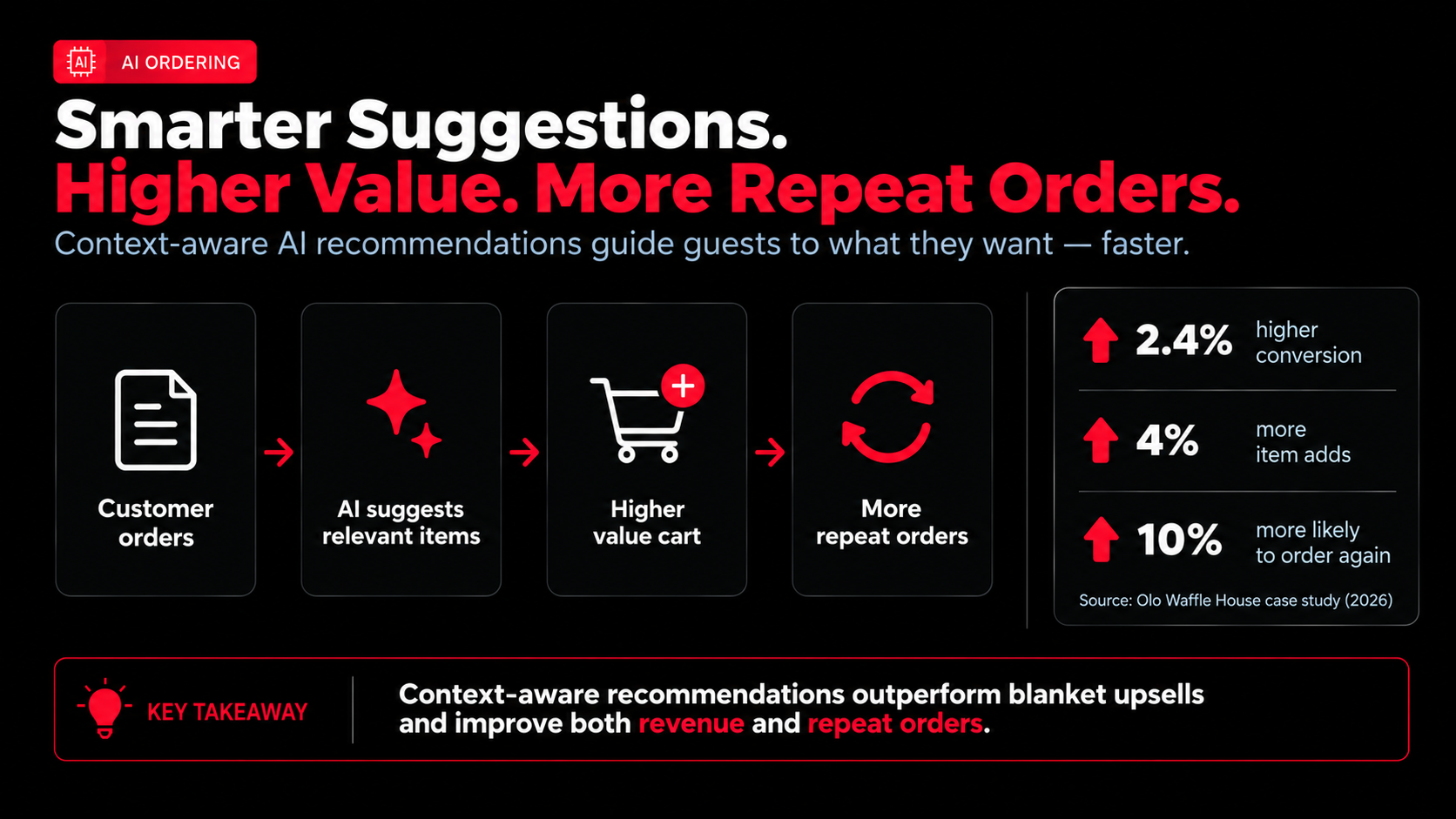
According to the Olo Waffle House case study from 2026, personalized recommendations produced a 2.4% increase in order conversion. That matters because small conversion lifts compound quickly on high-volume ordering channels. A restaurant processing 2,000 monthly online orders doesn't need a dramatic redesign to create meaningful revenue growth.
Problem: Most Recommendation Systems Prioritize Upsells Over Customer Experience
Many restaurant operators assume more recommendations automatically mean more revenue. We've seen the opposite play out with business owners and decision-makers clients—especially in mobile-heavy ordering flows where speed matters more than persuasion. Aggressive upsell spam often hurts repeat ordering behavior even when short-term ticket size increases.
A mid-size pizza franchise group came to us after launching AI-powered upsells at nearly every stage of their online ordering site. Their average ticket initially rose 7%, but repeat order rate dropped 9% over 60 days because guests found the flow annoying and manipulative. After reducing recommendation prompts from five touchpoints to two and tying suggestions to cart context, repeat ordering recovered within six weeks while preserving a 4.5% AOV lift.
That pattern shows up repeatedly. Context-aware recommendations outperform blanket upsells because they feel useful instead of disruptive. Suggesting ranch with wings or extra hash browns with a breakfast platter works because the recommendation aligns with ordering intent—not because the system forced another popup.
Approach: Use AI Ordering Recommendations That Match Real Customer Behavior
AI ordering is recommendation logic trained on purchasing patterns, reorder frequency, time-of-day trends, and cart behavior. Good systems analyze what customers commonly buy together and when they tend to reorder. Better systems also factor in operational constraints (and yes, this matters more than most vendors admit).
According to Olo's Waffle House data, smart cross-sells drove a 4% increase in overall item adds. The same case study found that 36% of Waffle House's online revenue came from personalized recommendations. That's unusually high contribution from recommendation logic alone, particularly for a mature national brand.
In our work at Nabeeats, the highest-performing recommendation flows usually follow three rules:
AI recommendations work best when they protect operational simplicity, not just increase ticket size. A profitable upsell that slows kitchen throughput during Friday dinner rush can erase gains through delayed orders and refunds. We've seen operators improve margins more from simple beverage attachments than premium customizations that overload prep lines.
Result: Smarter Recommendations Improve Retention, Not Just Revenue
The strongest recommendation systems influence repeat behavior as much as immediate spend. According to the Olo Waffle House study, guests who used a recommendation were 10 percentage points more likely to order again. Modern Restaurant Management also reported in 2024 that 58% of diners are likely to recommend a QSR after a positive personalized ordering experience.
Here's the part competitors rarely explain: full personalization isn't always the highest-converting strategy. Some non-personalized discovery suggestions outperform fully personalized recommendations because customers still want novelty and exploration. That's especially true for seasonal menus, LTOs, dessert categories, and group orders where variety-seeking behavior increases.
We've seen this play out with late-night concepts and delivery-first brands. A customer who always orders the same chicken bowl may still respond better to a "popular tonight" dessert suggestion than another algorithmic reminder about their usual side. Pure personalization can narrow discovery too aggressively—counterproductive for restaurants trying to expand category mix.
This approach works best for restaurants with strong repeat traffic and clean menu data. If your POS sync breaks frequently or modifier structures change weekly, recommendation quality drops fast because the AI engine loses consistency signals. That's one reason our team recommends operators standardize menu structure before investing heavily in advanced recommendation tooling.
Want help implementing this? Explore AI-powered ordering experiences for restaurants.
One more operational point matters here. Recommendation systems shouldn't only optimize for average order value; they should also improve ordering speed and ticket clarity. The highest-performing online ordering site experiences reduce decision fatigue while increasing confidence in the order flow—a subtle but important distinction.
After improving menu discovery and AI-driven upsells, the next major conversion lever comes down to something less flashy but often more profitable: reducing checkout friction and payment abandonment.
Online Ordering Site Checkout Features That Reduce Cart Abandonment
The best restaurant checkout flows minimize steps, allow guest checkout, surface pricing early, and prioritize mobile speed to reduce abandonment. Your online ordering site should remove friction faster than it adds marketing prompts or upsell layers. According to Baymard Institute checkout guidance and Lavu conversion benchmarks, each extra checkout step can reduce conversion by 5% to 10%, which is why high-performing restaurant flows typically stay within three screens from cart to payment.
Checkout Features That Actually Improve Conversion
With friction removed from checkout, the next challenge becomes keeping those first-time buyers engaged long after the payment confirmation screen.
Loyalty and First-Party Marketing Features for Restaurant Repeat Orders
First-party loyalty features increase repeat restaurant orders by making rewards, reorder prompts, and customer data ownership part of the online ordering experience. The best-performing online ordering site platforms don't just process transactions—they build habits. Repeat customers spend more over time and cost less to retain than reacquiring marketplace buyers through discounts and ads.
Loyalty integration can increase order frequency by 18% to 30%. Paytronix’s 2024 Online Ordering Trends report found that restaurants connecting rewards directly into digital ordering flows see higher retention. For operators evaluating an online ordering site, loyalty should work inside checkout rather than through a disconnected app or POS module.
We've seen this with operators moving away from third-party marketplaces. One multi-location brand added loyalty earning and redemption directly into checkout instead of using a separate rewards portal. Repeat ordering stabilized because customers could redeem points naturally during ordering rather than managing another login.
Why Post-Purchase Loyalty Enrollment Converts Better
Post-purchase loyalty enrollment often outperforms forced account creation because trust is highest immediately after a successful order. Many operators optimize for email capture before payment instead of optimizing for completed first orders.
At Nabeeats, we've seen stronger retention when loyalty prompts appear after checkout confirmation through SMS receipts or reorder follow-ups. A suburban burger chain removed mandatory account creation and improved completed orders by 18% in one month. Loyalty enrollments also increased because post-purchase SMS opt-ins converted 22% higher once customers trusted the ordering flow.
57% of consumers choose a restaurant based on loyalty rewards. According to Loyally.ai’s 2025 restaurant loyalty statistics, rewards now influence restaurant selection itself. If your website for online ordering lacks integrated rewards, customers often return to marketplaces where they already earn points or subscription perks.
Simple loyalty structures usually outperform overly gamified systems, especially for pickup-heavy audiences:
First-Party Marketing Drives Long-Term Order Value
First-party marketing is direct customer communication you control through SMS, email, and owned audience data. Unlike marketplace demand, you aren't renting visibility every time someone orders.
An online ordering page with a built-in loyalty program can turn one-time orders into repeat orders automatically. Upmenu’s 2026 online ordering benchmarks found integrated loyalty systems consistently outperform disconnected marketing tools. Restaurants using platforms like Toast and Olo also report higher digital ticket sizes because reorder prompts and bundled offers appear inside existing customer journeys.
The most effective campaigns feel operationally useful rather than promotional. A Friday reorder reminder tied to a customer’s previous family meal order converts better than generic discount blasts. Segmented SMS campaigns targeting lapsed lunch customers after inactivity also perform well.
Our team at Nabeeats recommends structuring first-party marketing around behavior triggers instead of calendar schedules. Focus on:
Subscriptions also work for independent restaurants. Delivery-first operators have stabilized weekday demand by offering monthly free-delivery memberships through direct ordering channels instead of repeatedly paying third-party commissions.
Structured Guest Data Improves Discovery Beyond Your Website
Structured guest data is organized customer and menu information platforms use for personalization, reviews, and AI-driven discovery. This matters because restaurant discovery increasingly happens through AI answer engines, Google summaries, and conversational search tools.
33% of diners have avoided ordering because the experience lacked personalization. Modern Restaurant Management reported that increase in 2024. Restaurants that connect reviews, ordering history, and structured menu data into their online ordering site create stronger signals for recommendation engines and local discovery systems.
Review generation also matters. Restaurants triggering review requests after successful orders often build more recent, context-rich feedback that improves visibility across Google Business Profiles and AI-powered restaurant discovery experiences. If you're evaluating how to structure a high-converting ordering website, prioritize platforms that centralize guest profiles, review workflows, and marketing automation instead of treating them as separate tools.
First-party ordering lowers commission costs and improves customer ownership, but operators still need reliable POS syncing, clean segmentation, and disciplined campaign management to avoid fragmented customer data.
How to Compare an Online Ordering Site Platform for Restaurants
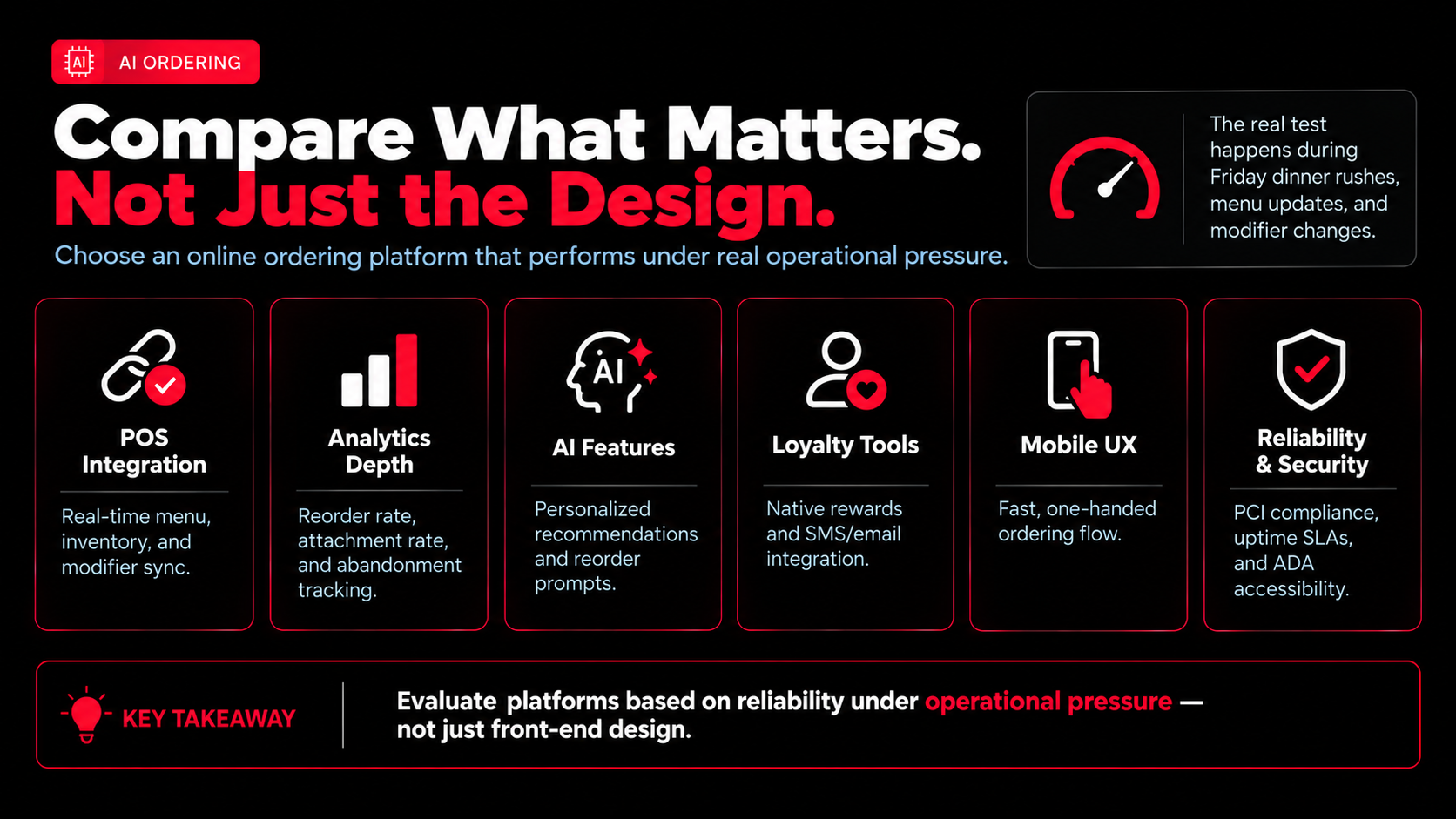
The best online ordering site platform balances conversion tools, reliable POS synchronization, retention features, and operational simplicity. Most demos look polished for 20 minutes. The real test happens during Friday dinner rushes, menu updates, and modifier changes across channels. Operators should evaluate platforms based on reliability under operational pressure—not just front-end design.
At Nabeeats, we've seen multi-location brands spend hours each week fixing menu mismatches between their POS, third-party apps, and website for online ordering because modifier syncing was handled manually. Menu sync reliability directly affects labor cost, order accuracy, and customer trust. Toast, Square, Clover, and Olo integrations vary widely in how deeply they sync modifiers, taxes, prep times, and inventory status.
Evaluation AreaWhat to CheckHidden RiskBest FitPOS IntegrationReal-time menu and inventory syncManual modifier duplicationMulti-location restaurantsAnalytics DepthReorder rate, attachment rate, abandonment trackingSurface-level reporting onlyGrowth-focused operatorsAI FeaturesPersonalized recommendations and reorder promptsOver-aggressive upsellsHigh-frequency ordering brandsLoyalty ToolsNative rewards and SMS/email integrationSeparate login systemsRepeat-order strategiesMobile UXFast one-handed ordering flowSlow modifier loadingQSR and pickup-heavy modelsReliability & SecurityPCI compliance, uptime SLAs, ADA accessibilityRevenue loss during outagesEnterprise and ghost kitchens
What Restaurant Operators Usually Miss During Platform Evaluations
Implementation complexity is where many online ordering site rollouts fail. A platform may support modifiers technically, but nested modifier logic often breaks once menus become complex. Sushi, pizza, and build-your-own bowl concepts struggle most because ingredient-level customization multiplies ticket variations quickly.
The highest-converting online ordering sites usually simplify visible choices instead of adding more customization. One sushi concept reduced visible modifier combinations and cut kitchen remake costs by about $1,800 per location over one quarter while improving ordering conversion by 9%.
Mobile friction remains one of the largest conversion killers. For many QSR brands, most traffic now comes from mobile devices during peak periods. A platform that loads quickly on older phones often outperforms a feature-heavy system with slower rendering.
Analytics Metrics That Actually Matter
Analytics should connect directly to ordering behavior and operational outcomes. Too many vendors emphasize impressions or sessions while ignoring metrics tied to retention and profitability. Prioritize reorder rate, attachment rate, checkout abandonment, and fulfillment delays.
Use this framework when comparing analytics dashboards:
According to Paytronix's 2024 Online Ordering Trends report, loyalty-connected ordering can increase order frequency by 18% to 30%. Without attribution visibility, restaurants can't tell whether marketing spend actually drives repeat orders.
Choosing Platforms for Ghost Kitchens and Pickup-Heavy Restaurants
Online orders only concepts need different priorities than dine-in-heavy restaurants. Ghost kitchens and pickup-first operators should care less about table management integrations and more about dispatch reliability, throttling logic, and direct customer ownership. Delivery-first brands benefit most from operational simplicity and first-party retention tools.
For operators running virtual brands or pickup-heavy models, direct ordering tools for delivery-first concepts matter more than marketplace exposure alone. Accessibility and PCI compliance also deserve close review. A platform outage during a lunch rush can erase thousands in revenue quickly.
AI recommendations and automation can increase repeat ordering and basket size, but aggressive recommendation flows may also increase kitchen complexity if they are not tied to prep capacity. Testing changes location by location before full deployment reduces operational risk.
Frequently Asked Questions
What features matter most in an online ordering site?
The most important online ordering site features are fast mobile performance, intuitive navigation, flexible modifiers, and a simple checkout flow. Google mobile UX data shows pages loading in under two seconds convert better, especially for pickup restaurants. Searchable menus and clear categories also reduce abandoned sessions during busy dinner periods.
Does AI ordering actually increase restaurant sales?
Yes, ai ordering can increase sales when it recommends relevant add-ons instead of static upsells. One pizza brand used AI-driven combo suggestions based on weather and time of day, increasing late-night ticket averages by 11% in 90 days. Results depend on accurate, consistently tagged menu data.
How many checkout steps should an online ordering site have?
An online ordering site should limit checkout to three screens or fewer, including payment confirmation. Baymard Institute research found long checkout flows remain a major cause of cart abandonment. Restaurants using Toast, Olo, and similar platforms often improve completion rates by removing unnecessary form fields.
Should restaurants force customers to create an account before ordering?
No. Mandatory account creation increases mobile drop-off rates. Independent operators that switched to guest checkout recovered 8% to 15% more completed orders within weeks. Prompting customers to create accounts after payment works better because trust is already established.
How should online orders only restaurants structure their menus?
Online orders only restaurants should organize menus around speed, clarity, and efficient modifiers rather than dine-in presentation. Ghost kitchens and pickup-first brands usually perform better with fewer top-level categories, grouped combos, and limited customization paths. Restaurant client data from the past year showed menus with six to eight primary categories outperform oversized menus in conversion rate and kitchen throughput.
What analytics should restaurants track on a website for online ordering?
A website for online ordering should track conversion rate, repeat purchases, average ticket size, and checkout abandonment by device. The National Restaurant Association’s 2024 technology outlook found operators increasingly rely on first-party ordering data because it provides clearer customer retention insights. Nabeeats recommends reviewing these metrics weekly so operational problems can be fixed before they affect repeat orders.
Is it better to build a custom online ordering site or use a restaurant platform?
Most independent restaurants get better ROI from a specialized online ordering site platform than from custom software. Custom builds offer flexibility but create ongoing maintenance costs for payments, menu syncing, loyalty integration, and delivery APIs. Strong platforms balance conversion optimization with operational reliability, and tools like Nabeeats help restaurants streamline both without marketplace commissions.
Build an Online Ordering Site That Converts More Than It Complicates
Your online ordering site shouldn’t act like a digital brochure. It should increase completed orders, repeat visits, and kitchen efficiency without creating operational friction.
Start with a conversion audit of your current ordering flow, then prioritize the highest-friction fixes first. If you want a platform focused on direct sales, repeat ordering, and operational simplicity, Nabeeats can help you optimize without marketplace commissions or unnecessary complexity.
The restaurants winning more direct digital orders in 2026 will have the fewest friction points.
.png)

.png)


