.png)


Third-party delivery commissions now reach 15% to 30% for many restaurants, and total marketplace costs can climb to 35% once delivery and marketing fees stack up, according to Kwick2Go and Fleksa’s 2026 benchmarks. That’s why restaurant operators are reevaluating every online ordering platform decision—not just to cut fees, but to protect margins, customer data, and repeat-order revenue.
In our work with restaurant groups and independent operators, we’ve seen a clear shift toward direct ordering, AI-powered personalization, and first-party retention tools across Google, Instagram, Apple Maps, and SMS. Most comparison guides miss the operational details that actually shape profitability (and yes, this is where expensive mistakes happen): POS integration depth, payout timing, checkout friction, and customer ownership. This guide breaks down how to evaluate an online ordering platform based on long-term economics, operational fit, and direct sales growth potential while showing how aggregators compare with direct ordering systems. Next, we’ll compare marketplace commissions against direct-ordering cost structures.
Online Ordering Platform Pricing Models Compared for Restaurants
An online ordering platform typically costs restaurants either a marketplace commission of 15% to 30% per order or a direct-ordering fee structure based on payment processing and software subscriptions.
Marketplace commissions still dominate restaurant delivery economics. According to Kwick2Go’s 2026 Online Ordering Commission Fee Comparison, third-party marketplace fees commonly range from 15% to 30% per order. On a $40 order with a 12% operating margin, a 25% commission can erase nearly all profit before labor and packaging costs.
Direct ordering systems usually operate closer to 3% all-in cost structures. Fleksa’s 2026 vendor pricing comparison describes restaurant-controlled ordering as 0% commission plus roughly 2.4% to 2.9% card processing fees. For operators focused on repeat business, that gap materially changes contribution margins.
Pricing ModelTypical Cost StructureBest FitMain TradeoffMarketplace commission model15%–30% per orderNew restaurants needing discoveryLower margins and limited customer ownershipFlat-fee subscription$69–$499 monthly + processingGrowing direct-order volumeFixed costs at low volumePayment-processing-onlyAround 2.9% + $0.30Small independents testing direct orderingLimited automation and marketingHybrid pricingMonthly fee + reduced commissionMid-size and multi-location brandsMore complex forecasting
Marketplace Commission Models and Real Margin Compression
Marketplace pricing is straightforward—but expensive at scale. According to FoodyOS State of Restaurant Tech 2026, DoorDash uses 15%, 25%, and 30% commission tiers, while Uber Eats uses similar Lite, Plus, and Premium structures. Higher tiers generally improve marketplace visibility but also increase acquisition costs.
An online ordering aggregator should be treated like a paid acquisition channel, not a neutral sales layer. Many operators initially view marketplace orders as incremental revenue instead of marketing spend. Once they model contribution margins correctly, they often discover their highest-volume channel produces the weakest cash flow.
Here’s a practical example:
That difference compounds quickly. A single-location restaurant processing $60,000 monthly through marketplaces could spend thousands more annually than with direct ordering.
Flat-Fee Subscription Models and Break-Even Thinking
Flat-fee systems shift costs from variable commissions to predictable software subscriptions. According to Ressto’s 2026 pricing analysis, Toast lists direct online ordering around $69 monthly, while platforms like Owner.com can reach $499 monthly.
Commission-free platforms are not automatically cheaper for every restaurant. Smaller operators under $10,000 in monthly online volume often discover fixed software costs exceed marketplace commissions temporarily.
A small café running $4,000 monthly in direct orders may pay:
At that scale, a marketplace’s 15% basic tier could cost less in the short term. The upside is customer ownership and retention potential, but operators should model six to twelve months of economics rather than launch-month performance.
Break-even analysis matters more than headline pricing. A fast-casual chain compared a $499 flat-fee platform against a 5% hybrid model. Once monthly direct sales crossed roughly $10,000, the flat-fee structure became cheaper. Before that threshold, percentage pricing preserved cash flow better.
Hidden Costs Most Restaurant Buyers Miss
The cheapest-looking online ordering platform often becomes expensive after implementation. According to Chowly’s 2026 comparisons, several providers advertise 0% commission while monetizing onboarding, delivery integrations, premium support, branded apps, or CRM functionality separately.
Payout timing affects profitability more than most operators expect. Restaurants can create 7–10 day working-capital gaps during platform migrations because payout schedules differ between processors and marketplaces. For independent restaurants managing payroll weekly, delayed settlements can become operationally painful.
Operators should evaluate these variables before signing annual agreements:
A 9-unit burger franchise underestimated reconciliation complexity after migrating away from marketplaces. Their accounting team spent extra hours weekly fixing tax mappings and refund discrepancies before standardizing payout rules across channels.
Payment-Processing-Only Models for Smaller Restaurants
Payment-processing-only setups appeal to lean operators because they remove heavy subscription overhead. Square Online Ordering, for example, lists 2.9% plus 30 cents per online transaction without additional commissions on some entry-level plans.
Simple payment-only economics work best for restaurants still validating direct demand. A neighborhood café processing fewer than 200 online orders monthly often benefits more from simplicity than advanced automation or loyalty infrastructure.
That said, lower software cost doesn’t guarantee better long-term economics. Operators can save 2%–3% in platform fees while losing more through abandoned carts, weak reorder flows, or missing Apple Pay and Google Pay integrations. Checkout friction matters.
One 14-location Mediterranean chain increased completed orders 18.7% after simplifying checkout and enabling guest payment options. Their gains came from conversion improvements, not commission negotiations.
Want help implementing this? See how Nabeeats can help.
Single-Location vs Multi-Location Economics
Single-location restaurants usually prioritize affordability and simplicity first. Multi-location groups prioritize integration depth, centralized reporting, menu governance, and payout consistency.
Multi-unit operators should calculate labor efficiency alongside platform fees. An online ordering platform that reduces manual menu syncing or automates SMS remarketing may justify higher subscription costs because operational savings scale across locations.
There’s also a strategic difference between direct ordering and marketplaces. Even when marketplace commissions appear competitive, operators still sacrifice first-party customer data, remarketing control, and reorder visibility. Many brands now use marketplaces primarily for discovery while steering repeat customers into branded direct channels through QR codes, loyalty offers, and SMS campaigns.
For a deeper breakdown of how aggregators compare with direct ordering systems, focus on customer ownership alongside fee structures.
Once operators understand the economics, the next evaluation question becomes more strategic: which capabilities actually justify paying more for an online ordering platform?
How Restaurants Evaluate an Online Ordering Platform Beyond Commission Fees
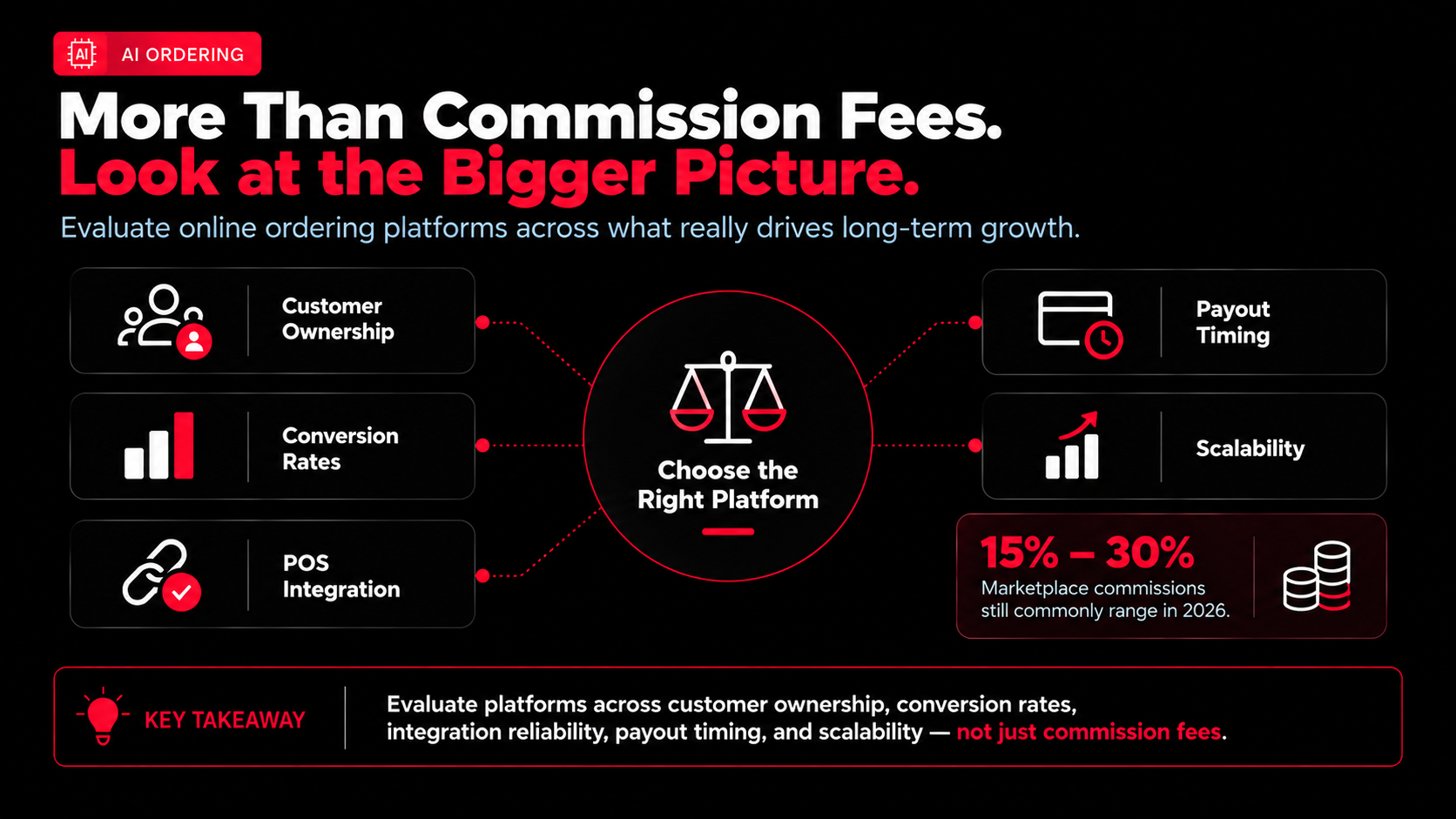
The best online ordering platform for a restaurant is the one that balances customer ownership, conversion rates, integration reliability, payout timing, and long-term scalability rather than simply offering the lowest commission. Operators that evaluate platforms only on fee percentages usually miss the operational details that determine repeat orders and profit retention. That mistake gets expensive fast—especially once you scale beyond a single location.
Marketplace commissions still commonly range from 15% to 30% in 2026. According to Kwick2Go and FoodyOS 2026 pricing comparisons, major delivery platforms continue operating in tiered commission structures tied to visibility and fulfillment support. The implication for restaurant operators is straightforward: software cost matters, but customer ownership and operational efficiency matter more over a 24-month horizon.
Define Your Ownership Requirements First
Customer ownership is the first filter you should apply to any online ordering platform. If you can't export customer data cleanly, you don't fully control your demand generation strategy. Ask vendors exactly what data you can access, how often exports happen, and whether order history, SMS consent, and customer preferences remain portable if you switch systems later.
In our work with restaurant operators at Nabeeats, we've seen brands collect thousands of customer emails but fail to connect them to purchase behavior or reorder timing. That's usually a CRM integration problem, not a marketing problem. Platforms that sync directly with tools like Klaviyo, Mailchimp, HubSpot, or Toast Loyalty create much stronger remarketing loops because they connect customer identity to actual order patterns.
Use this short ownership checklist during demos:
A lower commission tier can still be strategically weaker if the platform limits customer relationship control. That's why many growing operators now compare how aggregators compare with direct ordering systems before signing multi-year contracts.
Test Checkout Speed Before Comparing Fees
Checkout friction is one of the most underestimated profit variables in restaurant ecommerce. A smoother mobile checkout often drives more margin improvement than negotiating another 1% off processing fees.
We've seen this play out with business owners and decision-makers clients repeatedly. A 14-location Mediterranean fast-casual chain we worked with initially focused almost entirely on commission reduction during its online ordering platform migration. Direct orders increased only 6% in the first 90 days because customers had to create accounts before paying.
After switching to guest checkout with Apple Pay and Google Pay, completed orders increased 18.7% in six weeks. Average ticket size also rose by $4.12 because fewer users abandoned customization screens midway through ordering. Small UX changes. Big economics.
During platform evaluations, test these workflows yourself (seriously, don't rely on demos alone):
Restaurants consistently overestimate customer loyalty and underestimate convenience friction. The strongest online ordering platforms prioritize reorder speed, saved payment methods, and clean mobile navigation—not flashy dashboards.
Audit POS Integrations and Menu Sync Reliability
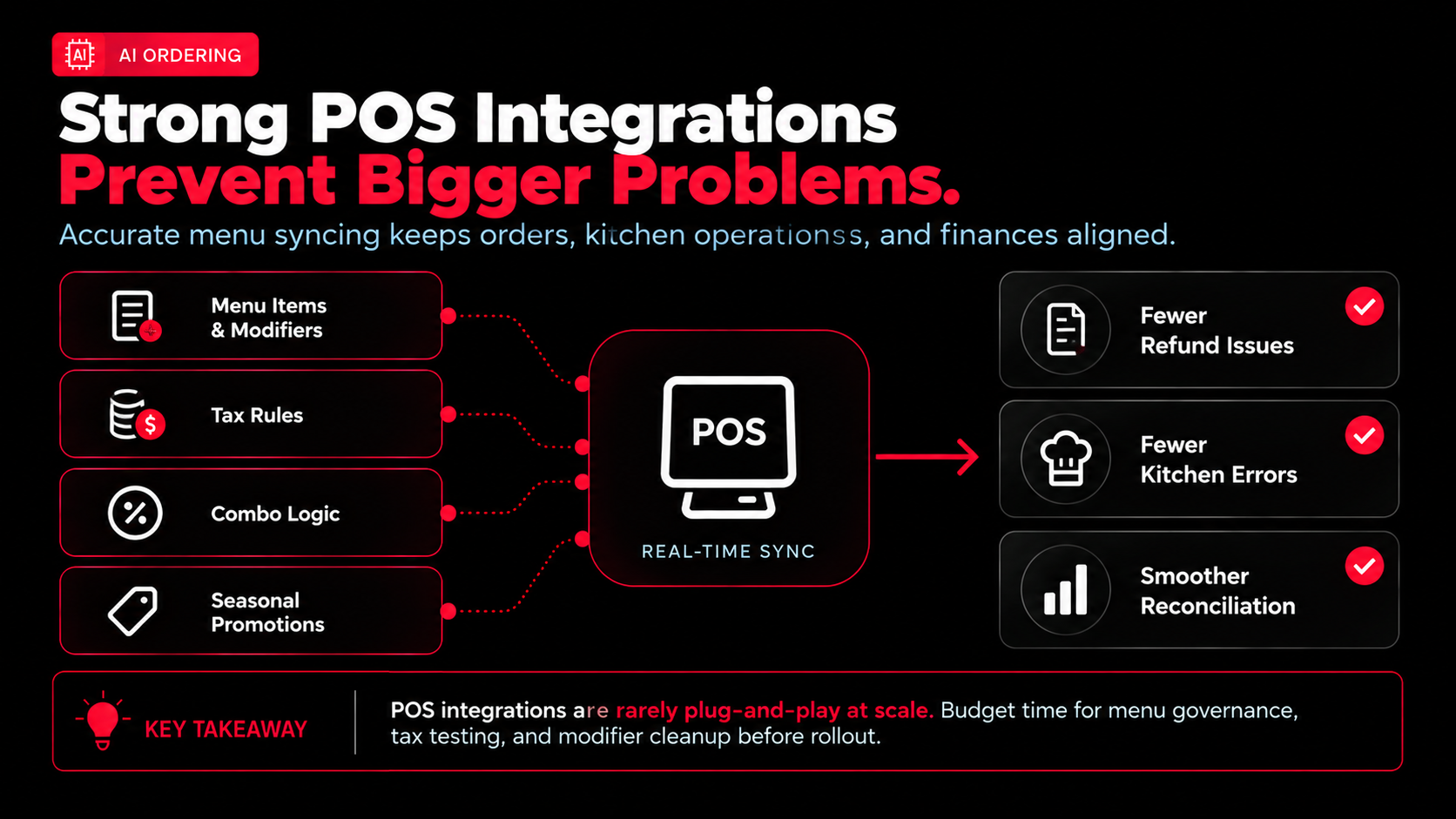
POS integration quality is operational infrastructure, not a feature checkbox. A platform with weak menu syncing will create refund issues, kitchen errors, and reconciliation headaches within weeks.
According to Chowly's 2026 restaurant technology comparison, most direct-ordering systems advertise broad POS compatibility, but compatibility doesn't guarantee synchronization quality. That's the catch many operators discover too late. Menu modifiers, tax rules, combo logic, and seasonal promotions often behave differently across channels.
We've seen this directly with a nine-unit burger franchise migrating away from marketplace-heavy ordering. Their accounting team spent an extra 5-7 hours weekly fixing tax and payout discrepancies during the first two months because SKU mapping behaved differently across systems. Once menu normalization and payment batching rules were standardized, reconciliation time dropped by roughly 60%.
Ask vendors operational questions—not just integration counts:
POS integrations are rarely plug-and-play at scale. Multi-location operators especially should budget implementation time for menu governance, tax testing, and modifier cleanup before rollout.
Model Payout Timing and Cash Flow
Payout timing is cash-flow infrastructure. The cheapest-looking online ordering platform can still create operational stress if settlement timing becomes inconsistent.
We've seen operators experience 7-10 day working-capital gaps during migrations away from marketplaces because processors batched payouts differently than expected. That issue becomes even more painful during seasonal inventory spikes or payroll weeks. Most vendor sales conversations barely mention this topic.
According to Fleksa's 2026 pricing analysis, direct ordering systems usually operate around 3% all-in cost structures once payment processing is included. Yet payout cadence varies dramatically between providers. Some settle daily. Others hold reserves for chargeback protection or batch payouts across multiple channels.
Before signing, request written answers for:
Finance teams should model payout cadence before platform migration—not after launch. This approach works best for operators with stable liquidity reserves; if you're already managing tight payroll cycles, prioritize predictable settlement structures over slightly cheaper software pricing.
Evaluate Scalability and Operational Complexity Together
Scalability is the ability to grow order volume without multiplying operational overhead. The strongest online ordering platform reduces admin work as sales increase instead of creating more manual intervention.
A single-location café using Square Online may only need payment processing and lightweight ordering flows at first. According to Gingerserve's 2026 comparison, Square's free tier operates with payment fees around 2.9% plus $0.30 per transaction. That's often enough for smaller operators testing direct ordering demand.
Growth changes the equation quickly, though. Multi-location brands usually need centralized menu governance, AI-powered reorder flows, CRM automation, loyalty integrations, and cross-channel consistency across Google, Instagram, Apple Maps, and voice ordering. That's where infrastructure quality starts outweighing entry-level pricing.
Want help implementing this? See how Nabeeats can help.
The next major shift goes beyond platform evaluation alone. Once operators understand the structural buying criteria, the conversation turns toward how AI ordering, conversational commerce, and multi-channel discovery are reshaping customer expectations—and changing where restaurant orders originate in the first place.
AI Ordering and Multi-Channel Direct Ordering Trends in 2026
AI ordering systems help restaurants increase completed orders, automate personalization, and capture demand across channels staff cannot always manage during peak periods. The biggest operational shift in 2026 is that customers no longer think in terms of “ordering channels” at all. They expect to start an order on Google, continue through Instagram, reorder from Apple Maps, ask a voice assistant to repeat a previous meal, or message a restaurant through WhatsApp without friction.
Multi-channel direct ordering connects every customer touchpoint back to the same first-party infrastructure. That includes Google Business Profiles, Instagram ordering links, branded apps, Apple Maps integrations, QR menus, SMS reorder flows, and AI phone ordering systems. The modern online ordering platform increasingly behaves more like a commerce operating system than a standalone website.
According to Chowly’s 2026 platform comparison, direct ordering systems now support website ordering, branded mobile apps, Google integrations, and loyalty-linked reorder workflows from one backend. Restaurants that rely on only one digital entry point usually leave demand uncaptured during peak discovery moments.
We’ve seen this with operators that assumed their website handled direct demand effectively. One Mediterranean chain discovered nearly 28% of repeat guests searched through Google Maps instead of typing the restaurant URL. After enabling direct Google ordering tied to its existing online ordering platform, repeat conversion improved almost immediately.
How AI Ordering Changes Real Restaurant Workflows
AI ordering sounds futuristic, but most gains come from workflow automation. The strongest AI use cases usually involve reducing friction inside repeat ordering behavior rather than replacing labor outright.
At Nabeeats, effective implementations typically combine four capabilities:
A regional sushi chain expected discount-heavy campaigns to drive retention after launching first-party ordering automation. Instead, its best-performing workflow was a reorder reminder sent 11 days after purchase featuring the customer’s favorite meal without a coupon. Repeat purchase frequency increased 22% over three months while promotional margin erosion stayed under 3%.
That result reflects a larger pattern. Restaurants often think AI means aggressive personalization or chatbots, but convenience usually wins. Fast reordering, remembered preferences, and intelligent timing often outperform generic discount blasts.
AI Phone Ordering Often Solves Missed Demand First
AI phone ordering is growing quickly because it addresses missed calls during peak volume. The real ROI usually comes from demand recovery, not payroll reduction.
A 22-location pizza operator in Texas deployed AI phone ordering during football season. Call abandonment dropped from 17% to 4% across eight weeks because the system handled simultaneous inbound calls on Friday nights, generating roughly $31,000 in incremental monthly revenue. Labor barely changed initially, but captured demand improved sharply.
Human staff can’t answer every call while expediting, handling walk-ins, and managing delivery dispatch simultaneously. AI systems can.
Still, not every concept is suited for conversational ordering. AI ordering performs best in restaurants with tighter menu structures and predictable modifier logic. Concise fast-casual menus usually outperform highly customized diner menus in voice AI environments.
The Operational Limits Most AI Demos Ignore
Many AI ordering demos look polished because they showcase ideal ordering paths instead of real-world complexity. Seasonal promotions, regional slang, nested modifiers, and substitutions create problems quickly. Highly customizable menus require continuous AI training, not one-time setup.
One regional chain saw complaint tickets jump 19% after introducing seasonal drinks the AI had never encountered before. The issue was weak retraining after menu changes. Successful operators now review failed intents weekly and update modifier rules continuously.
Menu governance also becomes critical across channels. Restaurants managing Google ordering, kiosks, apps, AI voice systems, and an online ordering aggregator simultaneously often create inconsistent pricing or modifier logic accidentally. Fragmented menu ownership routinely increases order correction workload during promotions.
A practical framework helps:
Simpler menus often convert better anyway. One ghost-kitchen group improved mobile conversion 14% after reducing modifier combinations by roughly 35% inside its direct ordering flow.
Why First-Party Data Matters More Than AI Hype
First-party ordering data becomes valuable when restaurants use it to automate repeat behavior without training customers to wait for discounts. The long-term advantage of a direct online ordering platform is behavioral visibility, not just lower commission costs.
Marketplace systems still play an acquisition role for many brands, but customer ownership remains limited inside an online ordering aggregator environment. Restaurants can see order totals, yet often lack visibility into reorder cadence, item affinity, or customer lifetime patterns. That’s why operators increasingly compare how aggregators compare with direct ordering systems before expanding digital channels further.
According to Fleksa’s 2026 pricing analysis, direct restaurant ordering systems usually operate around 3% all-in processing costs compared with marketplace economics that can climb toward 25% to 35% after commissions and fees. The financial difference matters, but the retention advantage compounds over time.
Operators eventually ask whether these systems perform reliably under real service pressure, not polished demos. That’s where implementation evidence and operational benchmarks matter more than feature lists.
Restaurant Online Ordering Platform Case Studies and ROI Examples
Restaurants see the strongest ROI from an online ordering platform when they combine direct ordering with retention, faster checkout, and operational simplicity instead of focusing only on commission savings. The operators winning in 2026 treat marketplaces as acquisition channels while building repeat ordering habits inside systems they control. That shift changes margins and customer lifetime value.
Third-party marketplace commissions still commonly range from 15% to 30% per order. According to Kwick2Go’s 2026 commission comparison and FoodyOS State of Restaurant Tech 2026, restaurants often absorb 25% to 35% total order costs once delivery, marketing, and processing fees are included. Operators now evaluate an online ordering platform around retention economics, not just delivery access.
Independent Pizzeria: Use Marketplaces for Discovery, Not Loyalty
A two-location pizzeria in Phoenix relied heavily on DoorDash during weekend rushes. Order volume looked strong, but margins kept shrinking because repeat customers continued ordering through marketplaces months after their first purchase. The issue wasn’t demand—it was channel dependency.
According to FoodyOS and Fleksa’s 2026 pricing benchmarks, DoorDash tiers commonly run 15%, 25%, and 30% depending on visibility and marketing placement. Direct ordering systems usually operate around 3% all-in after card processing. The pizzeria realized they didn’t need to eliminate marketplaces; they needed to move repeat buyers into their own online ordering platform.
Their approach stayed simple:
Repeat direct orders increased because convenience improved—not because discounts increased. Within four months, direct digital orders represented roughly half of repeat customer volume. Marketplace orders still mattered, but mostly for acquisition and late-night discovery.
Many operators miss this distinction. Acquisition and profitable retention can coexist if they are separated intentionally.
Fast-Casual Chain: When Flat-Fee Pricing Starts Winning
A six-location salad chain evaluated whether a subscription-based online ordering platform would outperform percentage-based transaction pricing as order volume increased. Leadership initially focused only on sticker price.
According to Chowly’s 2026 comparison, Owner.com offered pricing around $249 monthly plus 5% per order or a flat $499 monthly plan. Percentage pricing often stays cheaper for lower-volume restaurants. Once order counts rise consistently, fixed-fee structures can improve margins significantly.
Commission-free software is not automatically cheaper at every growth stage. Restaurant groups often move into expensive flat-fee systems before direct order volume justifies the cost.
The chain modeled three scenarios:
Monthly Direct OrdersPercentage Plan CostFlat-Fee CostBetter Option800 ordersHigher variable savings$499 fixedPercentage2,500 ordersFees scale rapidlyStable costFlat-fee5,000+ ordersMargin pressure growsPredictable economicsFlat-fee
Their break-even point landed in the low-to-mid 2,000 monthly order range. Beyond that threshold, fixed pricing created stronger economics and easier forecasting.
The bigger operational gain came from loyalty triggers and reorder reminders integrated into checkout. Average repeat frequency improved more from personalized reorder prompts than coupon campaigns.
Café Example: Why Simplicity Sometimes Wins
Not every restaurant needs enterprise tooling immediately. A single-location café in Portland proved that clearly.
The owner wanted online ordering without managing complex integrations, AI workflows, or custom mobile apps. They launched with Square Online because the setup matched their reality: limited staff, a smaller menu, and moderate digital order volume. According to Gingerserve’s 2026 pricing analysis, Square Online typically charges 2.9% plus 30 cents per transaction with no added commission on the free tier.
For smaller operators, operational simplicity often beats feature depth. Software overhead becomes expensive when owners already manage scheduling, inventory, and hiring.
The café focused on three improvements instead:
Results came quickly. Mobile order completion improved because customers made decisions faster. Staff also spent less time resolving modifier confusion during peak periods.
This approach works best for restaurants with straightforward menus and limited customization needs. High-volume multi-location operations with loyalty automation or advanced CRM segmentation may eventually outgrow simpler systems.
Menu Simplification Often Beats Discounting
One of the strongest operational lessons we’ve seen had little to do with commissions.
An urban ghost-kitchen group operating six virtual brands across two facilities assumed delivery speed drove conversion most aggressively, so they tested deeper discounts and expanded modifiers. Conversion barely changed.
Then they simplified the ordering experience.
Reducing menu complexity improved conversion more than aggressive promotions. After cutting modifier combinations by roughly 35% and reorganizing bundles inside their online ordering platform, mobile conversion increased 14% within 30 days. Kitchen ticket times also dropped nearly two minutes per order.
Customers ordering on phones rarely want endless decision trees. They want speed, clarity, and confidence that the order will arrive correctly.
High-performing checkout improvements usually include:
A cheaper platform lacking those capabilities can quietly reduce conversion over time.
Why Long-Term Economics Matter More Than Cheap Software
The strongest operators evaluate an online ordering platform like infrastructure—not just software expense. Lower monthly fees disappear quickly if the system creates weak retention, slower checkout, or fragmented customer data.
According to ChowNow and Fleksa’s 2026 benchmarks, direct ordering systems commonly eliminate marketplace commissions beyond payment processing. But owning customer relationships only matters if the platform helps activate them through reorder flows, CRM segmentation, and operational consistency.
That’s why more restaurant groups now study how aggregators compare with direct ordering systems before committing to platform contracts. Economics depend heavily on order mix, staffing models, and growth goals.
With these outcomes established, the next step is addressing implementation timelines, migration concerns, support expectations, and how to avoid operational surprises during deployment.
Frequently Asked Questions
Is a commission-free online ordering platform always cheaper for restaurants?
No. A commission-free online ordering platform is not always cheaper once you include marketing costs, payment processing, support fees, and order volume. Restaurants doing fewer than 300 direct online orders per month may spend more on a flat-fee platform plus paid traffic than they would using selected marketplaces. The National Restaurant Association 2025 State of the Industry report lists customer acquisition as a major technology cost pressure for independent restaurants, so operators should model total acquisition cost, not just commission rates.
What’s the difference between an online ordering platform and an online ordering aggregator?
An online ordering platform powers your branded direct ordering experience, while an online ordering aggregator distributes your restaurant across marketplaces like Uber Eats, DoorDash, and Grubhub. The main difference is ownership: direct platforms usually provide customer data, remarketing tools, and lower long-term transaction costs, while aggregators focus on marketplace reach and discovery. Many restaurant groups use both instead of treating them as competing options.
How long does it take to implement an online ordering platform with POS integration?
Most restaurants can launch an online ordering platform in 7 to 21 days if their POS system supports modern API integrations. Platforms that integrate with Toast, Square, Clover, or Revel usually deploy faster because menu sync and order injection workflows already exist. Delays usually come from menu cleanup, modifier logic, and printer routing rather than the software itself.
What customer data should restaurants own in their ordering platform agreement?
Restaurants should own customer emails, phone numbers, order history, loyalty activity, and marketing permissions collected through the online ordering platform. Nabeeats recommends reviewing contract language around data portability and export rights before signing because some providers restrict remarketing access after cancellation. Deloitte’s 2025 restaurant digital engagement benchmarks found operators using first-party CRM campaigns generated up to 28% higher repeat-order frequency than restaurants relying only on marketplace visibility.
How does payout timing affect restaurant cash flow?
Payout timing affects payroll flexibility, food purchasing cycles, and operating cash. An online ordering aggregator may hold funds for 5 to 7 business days, while some direct ordering systems settle in 1 to 3 days depending on Stripe, Square, or processor settings. Faster settlement improves liquidity, though restaurants with high chargeback rates or sudden sales spikes may still face processor reserve requirements.
Does AI ordering only work for large restaurant chains?
No. AI ordering works for independent restaurants when it solves a narrow operational problem such as missed phone orders or after-hours ordering. Over the past year, smaller operators improved phone answer rates by more than 20% using AI voice ordering connected to POS systems like Toast and Square. The approach works best for restaurants with recurring order patterns, while menus with constant changes still need human oversight.
What’s the best way to choose an online ordering platform in 2026?
The best online ordering platform matches your operational maturity, order volume, and customer acquisition strategy instead of chasing the lowest advertised fee. A single-location café may prioritize simplicity and fast payouts, while a 12-unit fast-casual group may need centralized reporting, CRM automation, and AI-assisted marketing tied to direct ordering growth. As you compare providers, focus on ownership, integrations, and scalability first. Tools like Nabeeats can streamline evaluation without locking restaurants into marketplace dependency.
Choose an Online Ordering Platform That Builds Long-Term Margin
Your online ordering platform shouldn’t just process transactions—it should help you protect margin, own customer relationships, and simplify operations as your restaurant grows.
The upside of direct ordering is stronger customer ownership and long-term profitability, but this works best when systems, payouts, and marketing workflows stay simple. If you’re still weighing how aggregators compare with direct ordering systems, start by modeling your true per-order margin, not just the advertised commission rate.
Start with a channel-by-channel profit audit, then evaluate whether Nabeeats can help you centralize ordering, automate retention, and grow direct sales without adding operational friction.
.png)

.png)


