.png)


.png)
Delivery now represents 22% of all U.S. restaurant spending, up from 9% in 2019, according to Bloomberg reporting cited by The Hungry Times—and operators running online orders only concepts are discovering that demand alone doesn’t guarantee profit. A ghost kitchen can fill fast and still lose margin to 15–30% marketplace commissions, poor staging flow, and labor-heavy packaging systems (honestly, this is where most operators get blindsided).
We’ve seen this play out with restaurant brands shifting underperforming dine-in locations into pickup-first hubs: the winners treat delivery-first operations as a disciplined operating model, not a side channel. The restaurants scaling profitably in 2026 are building tighter menus, smarter kitchen workflows, AI-assisted ordering systems, and stronger direct-order retention from day one.
You’ll learn how to structure the model, choose the right tech stack, manage staffing and fulfillment, and reduce dependence on third-party apps before margins disappear. First, let’s define what an online-orders-only restaurant actually looks like—and when the economics make sense.
What an Online Orders Only Restaurant Model Actually Looks Like
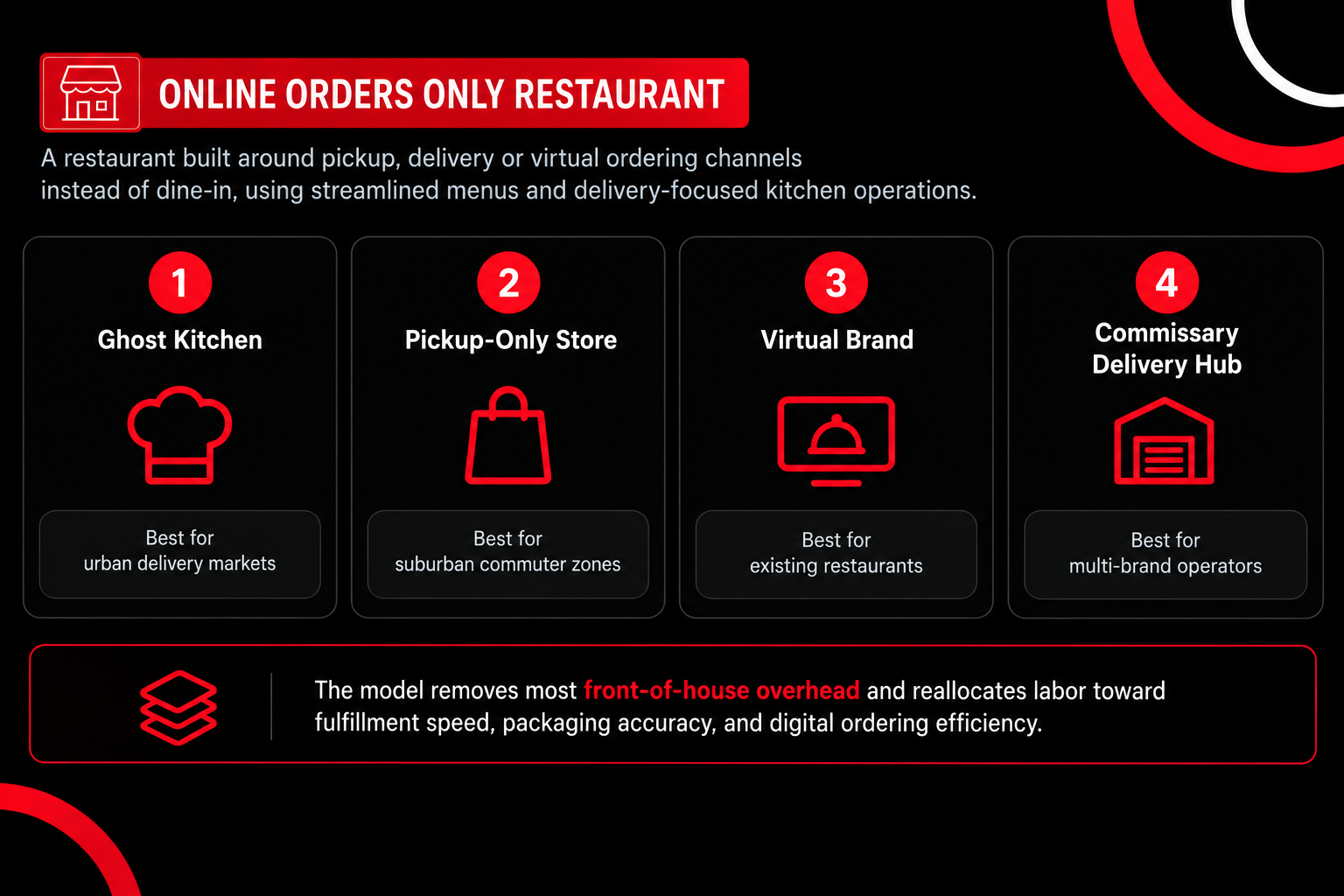
An online orders only restaurant is a food business designed around pickup, delivery, or virtual ordering channels instead of dine-in service, typically using streamlined menus, digital ordering systems, and delivery-focused kitchen operations. The model removes most front-of-house overhead and reallocates labor toward fulfillment speed, packaging accuracy, and digital ordering efficiency. That structure can take several forms depending on your budget, market density, and existing kitchen footprint.
The global ghost kitchen market reached $74.2 billion in 2025 and is projected to hit $218.9 billion by 2034. According to Dataintelo’s 2025 Ghost Kitchen Market Research Report, operators continue shifting toward delivery-first formats because labor and occupancy costs remain volatile. For independent restaurants, that creates opportunity—but only if unit economics stay disciplined.
How do online-only restaurants work?
Online-only restaurants work by accepting orders through delivery marketplaces, a website for online ordering, mobile apps, or AI-assisted phone systems, then routing those orders into a kitchen optimized for off-premise fulfillment. The kitchen becomes the product engine while digital ordering becomes the storefront. No dining room. No hostess stand. Different operational priorities entirely.
In our work with restaurant operators at Nabeeats, we've seen four structures dominate the category:
ModelTypical Setup CostBest FitMain AdvantageMain RiskGhost kitchenMediumUrban delivery marketsLower occupancy costsMarketplace dependencePickup-only storeMedium to highSuburban commuter zonesBetter direct-order marginsPickup congestionVirtual brandLowExisting restaurantsUses spare kitchen capacityBrand overlap confusionCommissary delivery hubHighMulti-brand operatorsCentralized production scaleOperational complexity
A virtual brand often gives operators the lowest-risk entry point. One multi-unit fast-casual chain we worked with launched a delivery-only wing concept from existing kitchens instead of opening another storefront. They tested demand with almost no additional real estate expense—and independent cloud kitchens already represented 45.3% of the market in 2025, according to Dataintelo.
Why smaller menus usually win
Smaller menus usually outperform larger menus in online orders only operations because delivery kitchens depend on consistency, prep speed, and packaging integrity. More SKUs create more modifier errors, slower ticket times, and higher refund risk. That's the part many operators underestimate.
We've seen this play out with restaurant clients repeatedly. A delivery-first burger concept carrying 62 menu items reduced the menu to 28 core products and immediately improved kitchen throughput during dinner rushes (honestly, this is where most teams drop the ball). Order accuracy improved because staff stopped juggling low-volume specialty items that slowed assembly.
Here’s what tighter digital-first menus usually improve:
Menu simplification also reduces operational admin work across marketplaces, POS systems, and inventory tools. Even a five-location operation can lose 4–6 management hours weekly fixing pricing mismatches and unavailable modifiers across platforms.
Converting an existing kitchen vs. building a commissary
Converting an underperforming dine-in location into an online-only operation usually works best for independent operators testing demand. You already control the lease, equipment, utilities, and staffing base. That dramatically lowers startup risk compared to launching a standalone commissary.
We advised a five-unit Mediterranean brand in Texas that converted one weak dine-in store into a pickup and delivery hub during a lease renewal period. They originally added every delivery marketplace available, but 72% of sales came from just two channels while tablet management added nearly 11 labor hours weekly. After consolidating channels and improving direct ordering, direct-order mix grew from 18% to 41% in eight weeks.
A commissary kitchen makes more sense when you're running multiple brands or need centralized prep across several delivery zones. The upside is scale efficiency, but be aware of the complexity—especially courier staging, dispatch timing, and delivery radius management. Delivery growth does not automatically mean profitable growth.
Only 17% of restaurants reportedly achieved net-positive delivery margins in 2025. According to reporting cited by Financial Times and Bloomberg, marketplace commissions still range between 15% and 30% per order. That’s why many operators now prioritize owned channels and building a direct ordering website for delivery-first brands instead of relying entirely on third-party apps.
Want help implementing this? See how Nabeeats can help.
Once the business model is clear, the next challenge becomes operational execution—specifically the ordering systems, integrations, and kitchen workflows that keep online-only restaurants profitable at scale.
How to Build an Online Ordering Site and Tech Stack for Delivery-First Restaurants
The best online ordering stack for a delivery-first restaurant combines a direct online ordering site, POS integration, kitchen workflow tools, and AI ordering systems that reduce missed calls and manual labor. Your goal is operational control, not just more order volume. That means building a system where orders flow cleanly from customer to kitchen to courier without extra tablets, duplicate data entry, or bottlenecks during peak hours.
Start With a Direct Online Ordering Site
A direct online ordering site is a restaurant-owned digital ordering channel connected to your POS, customer database, and marketing tools. Marketplace apps help discovery, but owned channels protect margin and customer data. According to reporting cited by The Hungry Times in 2025, marketplace commissions still range from 15% to 30% per order, which explains why only 17% of restaurants reported net-positive delivery margins.
In our work with restaurant operators at Nabeeats, we've seen this play out repeatedly. One pickup-only concept we advised cut sponsored marketplace spend by 60% and redirected repeat customers toward direct web ordering through QR inserts and SMS campaigns. Over one quarter, store-level EBITDA improved by 8.5 points while order volume stayed nearly flat.
Your website for online ordering should handle four core jobs:
If you're evaluating platforms, this guide on building a direct ordering website for delivery-first brands breaks down the conversion mechanics that matter most.
Connect Your Core Restaurant Systems
Your tech stack only works if every system shares data cleanly. Disconnected tools create labor waste faster than most operators expect. We've seen five-location operators lose 4-6 management hours weekly fixing modifier mismatches between POS systems, marketplaces, and inventory tools.
Most delivery-first restaurants need six connected systems:
A kitchen display system matters more than flashy branding—especially during rushes. According to our client work, operators with integrated KDS workflows usually reduce missed modifiers and duplicate prep errors within the first month because tickets route automatically by station instead of printing chaotically across multiple devices.
The upside is tighter execution, but there's a caveat. This approach works best for operators running at least moderate order volume. If you're testing a low-volume concept under 25 orders daily, start simpler and add automation gradually.
Add AI Ordering Where Friction Is Highest
AI ordering should begin with the highest-friction channels first, not everywhere at once. Phone ordering remains one of the biggest hidden operational drains in online orders only restaurants. That's the contrarian part most vendors skip.
According to Square's 2026 product release, its AI-powered voice ordering can answer 100% of incoming calls, even during peak periods. Wendy's also expanded AI ordering aggressively, with Restaurant Dive reporting deployments across more than 160 U.S. restaurants by mid-2025.
We've seen similar results firsthand. A regional burger chain we worked with discovered nearly 17% of dinner rush phone calls went unanswered. After implementing AI-assisted phone ordering, completed phone orders increased 21% over six weeks while labor allocation dropped by roughly 18 hours weekly per store. The AI only worked after menu-specific training, though (generic models struggled with combo modifiers and local shorthand).
Start AI ordering in these areas first:
For a deeper breakdown of using AI to automate incoming restaurant orders, focus on workflows that remove repetitive labor before experimenting with broader automation.
Answer the Question: Do Restaurants Still Need Phone Ordering in 2026?
Yes—restaurants still need phone ordering in 2026 because high-intent customers continue using phones during rush periods, large group orders, and modifier-heavy purchases. Eliminating phones entirely usually costs revenue.
Phone ordering patterns changed, though. Customers don't necessarily expect a human to answer immediately anymore; they expect speed and accuracy. That's why AI voice systems now work surprisingly well for pickup-heavy concepts and family meal operators (and yes, smaller restaurants benefit too).
The smarter approach combines AI intake with human escalation. Let AI handle order capture, hours, and common questions while routing edge cases to staff only when needed. That structure protects labor during volume spikes without removing hospitality entirely.
Before expanding marketing spend, tighten these systems first. The next challenge is operational execution inside the kitchen—specifically prep timing, staging, pickup flow, and staffing coordination once order volume starts climbing fast.
Staffing and Kitchen Operations for Online Orders Only Restaurants
Online orders only restaurants succeed when kitchens optimize for staging, pickup timing, and throughput instead of dine-in service flow. The highest-performing delivery-first kitchens treat coordination as a production system, not a hospitality floor. According to The Hungry Times citing Bloomberg, delivery represented 22% of U.S. restaurant spending in 2025, up from 9% in 2019. That shift changes where labor creates value.
With kitchen flow stabilized and staffing aligned around fulfillment reliability, the next question becomes financial: how do you turn strong order volume into consistent profit rather than operational burnout?
How Profitable Are Online Orders Only Restaurants in 2026?
Online-orders-only restaurants can be profitable in 2026, but margins depend heavily on commission management, streamlined menus, packaging efficiency, and direct-order retention.
Delivery demand is massive, but profitability remains uneven. According to The Hungry Times citing Bloomberg and the Financial Times, delivery represented 22% of all U.S. restaurant spending in 2025, yet only 17% of restaurants achieved net-positive delivery margins. That gap explains why high order volume alone won't protect your business.
In our work with restaurant operators at Nabeeats, we've seen owners celebrate 30% sales growth while store-level EBITDA barely moved. The problem usually sits inside the order economics—commissions, refunds, packaging waste, and hidden labor allocation quietly consume contribution margin.
Where Online-Only Restaurant Margins Actually Go
Marketplace commissions remain the single biggest margin pressure point. Industry reporting cited by The Hungry Times placed delivery marketplace commissions between 15% and 30% per order in 2025. On a $38 ticket, that can remove $5.70 to $11.40 before food, labor, or packaging costs even enter the equation.
Here's where operators often miscalculate profitability:
A premium sushi delivery concept we worked with learned this the hard way. Their average ticket exceeded $54, but custom packaging cost $3.82 per order and slowed assembly by roughly 90 seconds per ticket during dinner rush. After simplifying packaging formats, they reduced packaging spend by 22% and recovered roughly 14 labor hours weekly. Packaging complexity quietly destroys throughput long before operators notice it.
Marketplace Orders vs Direct Orders
Direct ordering usually produces stronger margins than marketplace dependency. That sounds obvious, yet many operators still prioritize app visibility over owned customer retention (honestly, this is where most brands overspend).
MetricMarketplace OrderDirect Website OrderPickup Direct OrderCommission Cost15%–30%2%–4% processing2%–4% processingCustomer OwnershipLimitedFull CRM accessFull CRM accessRefund ExposureHigherModerateLowerAverage Marketing CostSponsored listingsSMS/email retentionLoyalty offersMargin ControlWeakStrongerStrongestBest Use CaseNew customer discoveryRepeat deliveryHigh-frequency locals
A pickup-only chicken concept we advised was paying nearly 28% effective commission after sponsored marketplace placement fees. Once the brand established local awareness, those ads produced diminishing returns. We shifted budget toward SMS reorder campaigns, Google Business optimization, and their own online ordering site, which improved store-level EBITDA by 8.5 points over one quarter while maintaining similar order volume.
That pattern aligns with a broader industry reality. Third-party marketplaces work best as discovery channels, not permanent profit engines. The operators scaling successfully in 2026 intentionally migrate repeat customers toward direct ordering systems after the first or second purchase.
How to Measure Contribution Profit Per Order
Contribution profit per order is the clearest profitability metric for online-orders-only restaurants. It measures what remains after variable fulfillment costs are removed from each transaction.
Use this framework:
What remains is your true contribution margin per order.
For example, a $42 delivery order might look profitable on the surface. But after 25% marketplace commission, $3 packaging cost, 30% food cost, and refund allocation, contribution profit may fall below $4. That's before fixed overhead like rent, software subscriptions, or management salaries.
Top-line delivery growth can easily hide weak unit economics. We've seen operators scale order volume faster than operational discipline, especially across multiple marketplaces with inconsistent pricing and modifier logic.
The Hidden Operational Costs Most Operators Miss
Most operators underestimate menu synchronization overhead across marketplaces, POS systems, and inventory tools. A modest five-location operation can lose 4–6 management hours weekly correcting modifier mismatches, pricing inconsistencies, and unavailable items. Refund rates rise quickly when menus drift across platforms.
This operational drag compounds as brands add more channels. One five-unit Mediterranean operator initially assumed every marketplace mattered equally, but 72% of orders came from only two platforms while excess tablet management added nearly 11 labor hours weekly. Consolidating channels improved operational control and accelerated direct-order growth from 18% to 41% of total volume within eight weeks.
There's also a customer behavior shift happening now. Rising consumer delivery fees—reported at $5.75 per order in 2025 by The Hungry Times citing the Wall Street Journal—are pushing more guests toward pickup and direct reorder habits. That creates an opening for operators who invest in retention instead of pure marketplace exposure.
The next challenge becomes strategic: how do you convert one-time marketplace buyers into profitable repeat customers through your own ordering ecosystem and retention channels?
How Restaurants Reduce Marketplace Dependency and Increase Direct Orders
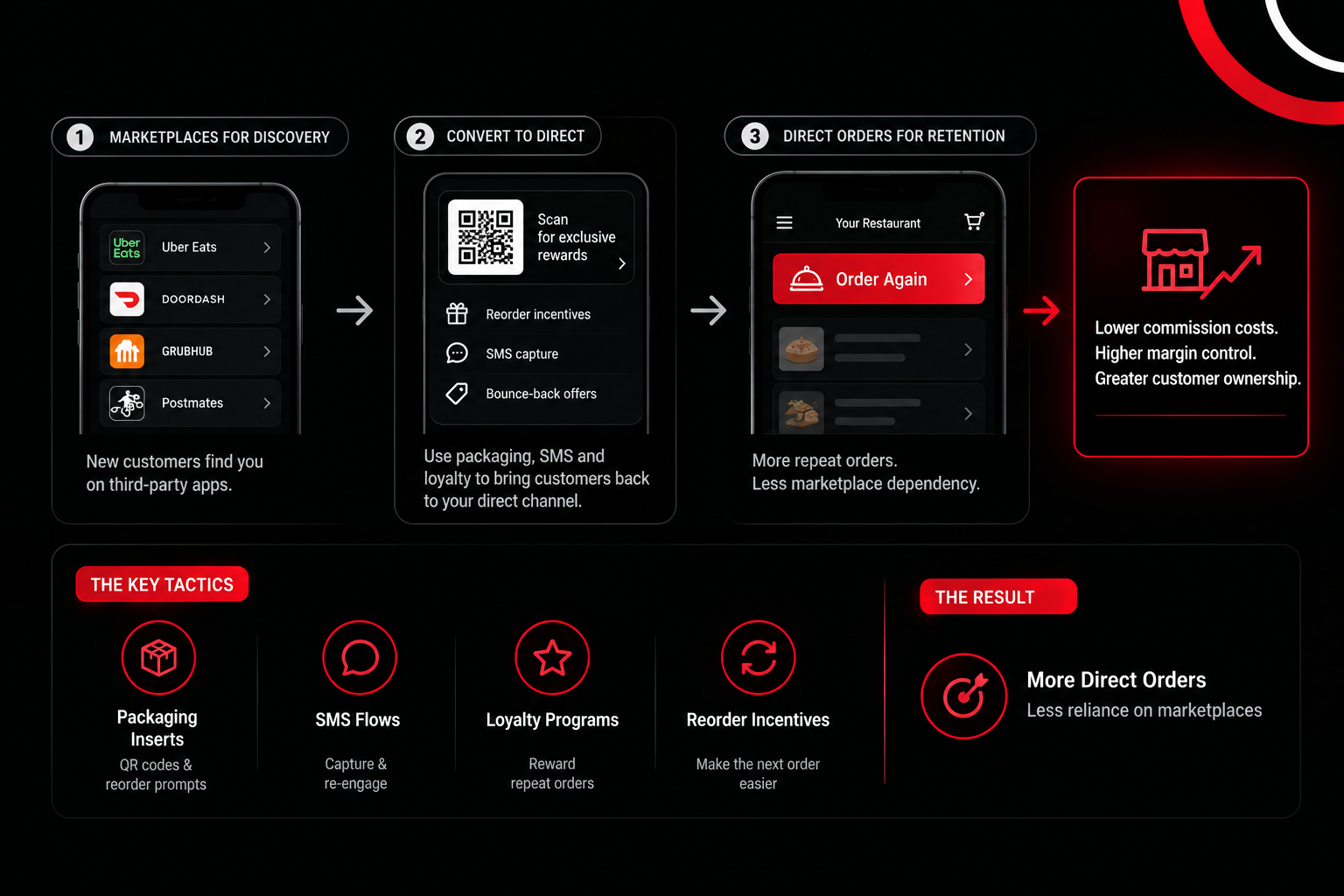
Restaurants reduce marketplace dependency by using third-party apps for discovery while systematically converting repeat customers to direct ordering through loyalty, SMS, and packaging-based retention tactics. The goal isn't abandoning marketplaces entirely—it’s changing their role from primary revenue channel to customer acquisition engine. According to The Hungry Times citing industry reporting in 2025, marketplace commissions still range from 15–30% per order. That margin pressure compounds quickly once customers already know your brand and continue ordering through expensive third-party channels.
Problem: Marketplace Growth Often Creates Margin Compression
In our work with operators at Nabeeats, the strongest online orders only brands rarely try to eliminate DoorDash or Uber Eats completely. They use marketplaces for discovery and direct channels for retention. That distinction matters because delivery represented 22% of all U.S. restaurant spending in 2025, according to Bloomberg reporting cited by The Hungry Times. Discovery demand still lives inside the apps.
We've seen this play out with business owners and decision-makers clients repeatedly. I worked with a five-unit Mediterranean fast-casual brand in Texas that originally believed adding every marketplace would maximize sales. Instead, 72% of orders came from just two channels while the extra tablet management added nearly 11 labor hours weekly.
The operator shifted strategy fast. QR code inserts inside every delivery bag outperformed expensive website redesign efforts almost immediately. Over eight weeks, direct orders increased from 18% to 41% of total volume after the team introduced reorder incentives, SMS capture prompts, and bounce-back offers tied to their own online ordering site.
Approach: Convert Marketplace Buyers Inside the Bag
Direct-order retention starts with the packaging insert strategy, not the website design. Most operators focus too heavily on the homepage while ignoring the physical handoff moment when customer behavior is easiest to influence. By the time someone searches for your restaurant independently, their ordering habit already exists.
The highest-performing operators usually combine four tactics together:
One Southeast chicken concept we advised had a different problem—they were overspending on sponsored marketplace placement to support expansion. Their effective commission reached nearly 28% after paid ranking fees. Cutting sponsored marketplace spend by 60% improved store-level EBITDA by 8.5 points within one quarter.
The surprising part? Order volume barely changed. Repeat customers were already searching by brand name through Google Maps, Instagram, and saved text offers rather than browsing marketplaces generically.
Result: Direct Ordering Improves Margin Control and Customer Ownership
Operators often assume the key to direct-order growth is building a beautiful website for online ordering. That helps, but retention infrastructure matters more. Packaging inserts, SMS flows, and reorder incentives consistently drive stronger migration rates than cosmetic website improvements alone.
A practical framework works best:
This approach works especially well for pickup-heavy brands and multi-unit fast casual concepts (and yes, smaller operators can use it too). Operators with weak local brand awareness may still need heavier marketplace exposure initially. The upside is stronger margin retention, but the tradeoff is operational complexity around CRM management and campaign consistency.
Technology now supports this transition more effectively than even two years ago. Platforms like Toast, Square, Olo, and Nabeeats integrate SMS automation, loyalty tracking, and reorder prompts directly into the ordering flow. Restaurants also increasingly use AI-powered systems for missed-call recovery and direct ordering capture—especially during peak periods when staff can't answer phones consistently. For operators exploring that strategy, this guide on building a direct ordering website for delivery-first brands breaks down the infrastructure requirements in more detail.
The next operational question becomes practical rather than strategic: what systems, staffing expectations, and operational realities should operators prepare for before launching or scaling an online-only restaurant model?
Frequently Asked Questions
Are online orders only restaurants cheaper to operate than dine-in restaurants?
Yes, online orders only restaurants usually operate with lower fixed overhead than traditional dine-in restaurants. Operators can reduce front-of-house labor, dining room rent, furniture costs, and utilities, often lowering expenses by 20% to 35% according to National Restaurant Association and Ghost Kitchen Association data. However, delivery packaging, marketplace commissions, and order throttling software replace part of those savings, so operators who ignore those costs often overestimate profitability.
How many delivery apps should a restaurant use when launching an online-only concept?
Most operators should launch with two major delivery apps plus one direct online ordering site. Adding DoorDash and Uber Eats first usually creates enough customer discovery volume without overwhelming kitchen operations during the first 90 days. More than three marketplace channels at launch often creates menu sync issues, courier timing conflicts, and refund management problems, especially for kitchens running fewer than eight staff members per shift.
Does AI ordering actually work for independent restaurants?
Yes, ai ordering works for independent restaurants when tied to marketing automation and customer retention instead of simple chatbot ordering. Operators use AI-powered tools to send reorder SMS campaigns, recover abandoned carts, and generate localized social content, often improving repeat direct orders by 15% to 28% over six months. Deloitte's 2024 restaurant technology research found operators adopting automation tools reported stronger labor efficiency gains than businesses relying on manual promotion workflows.
How do pickup-only restaurants manage rush-hour congestion?
Pickup-only restaurants manage congestion by separating courier staging from customer pickup flow and using timed order throttling. One operator added a numbered shelving system and shifted pickup promises from 18 minutes to 24 minutes during dinner rush, reducing courier crowding by nearly 40% within two weeks. Strong online orders only kitchens optimize for predictable handoff timing instead of maximum order volume every minute.
What are the biggest mistakes operators make with online orders only restaurants?
The biggest mistake is treating an online orders only business like a smaller dine-in restaurant instead of a logistics operation. Operators often overload menus, underestimate packaging failures, and ignore direct customer data collection, which makes profitability unstable once marketplace fees rise. Many brands also launch without a dedicated online ordering website, forcing repeat customers back through commission-heavy marketplaces.
Can direct online ordering realistically compete with marketplace apps?
Yes, direct ordering can compete when restaurants use marketplaces for discovery and their own channels for retention. Data from providers like Toast and Owner.com shows repeat customers commonly generate 40% to 70% of monthly order volume, giving operators a realistic chance to migrate loyal buyers toward direct channels over time. This works best for brands with strong repeat frequency because concepts dependent on tourist traffic usually remain more reliant on marketplaces.
What technology should operators prioritize before launching an online-only restaurant?
Operators should prioritize a reliable online ordering site, kitchen display system, integrated POS, and automated customer marketing before adding advanced delivery tools. Nabeeats recommends building direct-order infrastructure first because customer retention systems become harder to retrofit after volume scales. Platforms combining commission-free ordering with ai ordering workflows can simplify rollout and reduce operational complexity as a delivery-first business grows.
Build a Smarter online orders only Operation
Online orders only restaurants can scale in 2026, but the operators winning long term aren't chasing every marketplace order—they're controlling fulfillment, protecting margins, and building direct customer relationships from day one.
Start with a focused menu, one reliable direct-order channel, and operational systems you can maintain at peak volume.
The next wave of delivery-first brands will win because their systems hold up when volume spikes.

.png)


