.png)


Nearly 90% of diners search online before choosing where to eat, and gmb for restaurants is now one of the biggest drivers of visibility across Google Maps, AI-generated recommendations, and mobile search. Diners are no longer scrolling through pages of links—they’re acting on quick summaries, map results, photos, reviews, and direct ordering options that appear instantly inside Google’s ecosystem.
A complete and optimized Google Business Profile can influence both discovery and conversions. Accurate hours, updated menus, strong photos, active reviews, and direct ordering links help restaurants appear more often while reducing dependence on third-party delivery marketplaces that charge high commissions. This guide walks you through the exact optimization areas that matter most, including menus, reviews, photos, business information, and ordering integrations, before showing how profile completeness and data quality directly impact rankings and AI-driven recommendations.
Why GMB for Restaurants Matters in AI Search and Google Maps
Google Business Profiles have evolved from simple directory listings into one of the restaurant industry’s most important discovery systems. When diners search “best tacos near me,” ask Google Assistant for “late-night pizza,” or browse Google Maps while traveling, Google often pulls information directly from business profiles before considering a restaurant’s website. Today, gmb for restaurants is more than a local SEO task. It is a customer acquisition channel tied to Maps visibility, AI-generated recommendations, and direct ordering behavior.
Google uses business profile data across multiple surfaces, including:
Restaurant searches are increasingly action-oriented. Diners often choose directly from Maps listings based on reviews, photos, menu previews, wait times, and convenience signals. In many cases, the restaurant website is never visited.
This behavior is known as a “zero-click search.” A customer searches, evaluates options inside Google’s ecosystem, and takes action immediately by requesting directions, calling, reserving a table, or placing an order. For restaurants, discovery optimization now matters as much as traditional website SEO. Your website still supports branding and deeper information, but Google Business Profiles often determine whether diners reach your site at all.
Google’s local ranking system relies on several core signals: relevance, proximity, completeness, and engagement. Understanding these factors helps restaurants focus on updates that improve visibility instead of relying on guesswork.
Relevance measures how well your profile matches search intent. If someone searches for “vegan brunch,” Google evaluates your categories, menu descriptions, reviews, attributes, and business details to decide whether your restaurant fits. Restaurants that clearly define cuisine types, dietary options, and services usually perform better because Google has more structured data to interpret.
Proximity refers to how close your business is to the searcher or the geographic area included in the query. Restaurants cannot control location, but they can strengthen geographic relevance with consistent address information and accurate local signals across their profile and website.
Completeness is one of the most overlooked ranking factors in gmb for restaurants. A fully completed profile gives Google confidence in your business data. Restaurants with updated hours, menu links, high-quality photos, ordering integrations, and active posts often outperform incomplete listings because Google prioritizes businesses that reduce friction for users.
Engagement includes reviews, photo views, calls, bookings, direction requests, and orders. Restaurants with recent reviews and active customer interactions send stronger trust signals to Google. Review freshness also affects diner decisions. An inactive profile with outdated photos and unanswered reviews can reduce both visibility and customer trust.
Inaccurate information creates problems beyond rankings. Outdated hours, broken menu links, or failed ordering pages can cause customers to abandon purchases entirely. Google tracks user behavior closely, and repeated complaints or corrections can weaken confidence in your listing.
Operational accuracy is even more important in AI-driven search experiences. Google’s AI systems attempt to summarize reliable information quickly. If your profile contains conflicting details, the AI may exclude your restaurant from recommendations. Consistent data across Google and other platforms helps restaurants appear more trustworthy.
This is where discovery optimization differs from traditional SEO. Traditional SEO focuses on helping websites rank through content, backlinks, and technical performance. Discovery optimization focuses on helping restaurants appear inside Google’s decision-making interfaces before a website click occurs.
Strong profiles also help restaurants reduce dependence on third-party marketplaces. When diners can access menus, reservations, and direct ordering links through Google, they are more likely to engage with owned channels instead of commission-heavy delivery apps. Optimized profiles help restaurants capture more direct business while improving visibility across Maps, AI search, and local discovery experiences.
How to Set Up and Optimize GMB for Restaurants
Building an effective gmb for restaurants strategy starts with complete, accurate data. Google uses your Business Profile to decide when your restaurant appears in Maps results, AI recommendations, voice search, and direct ordering experiences. Missing or outdated information can reduce visibility and cost you orders.
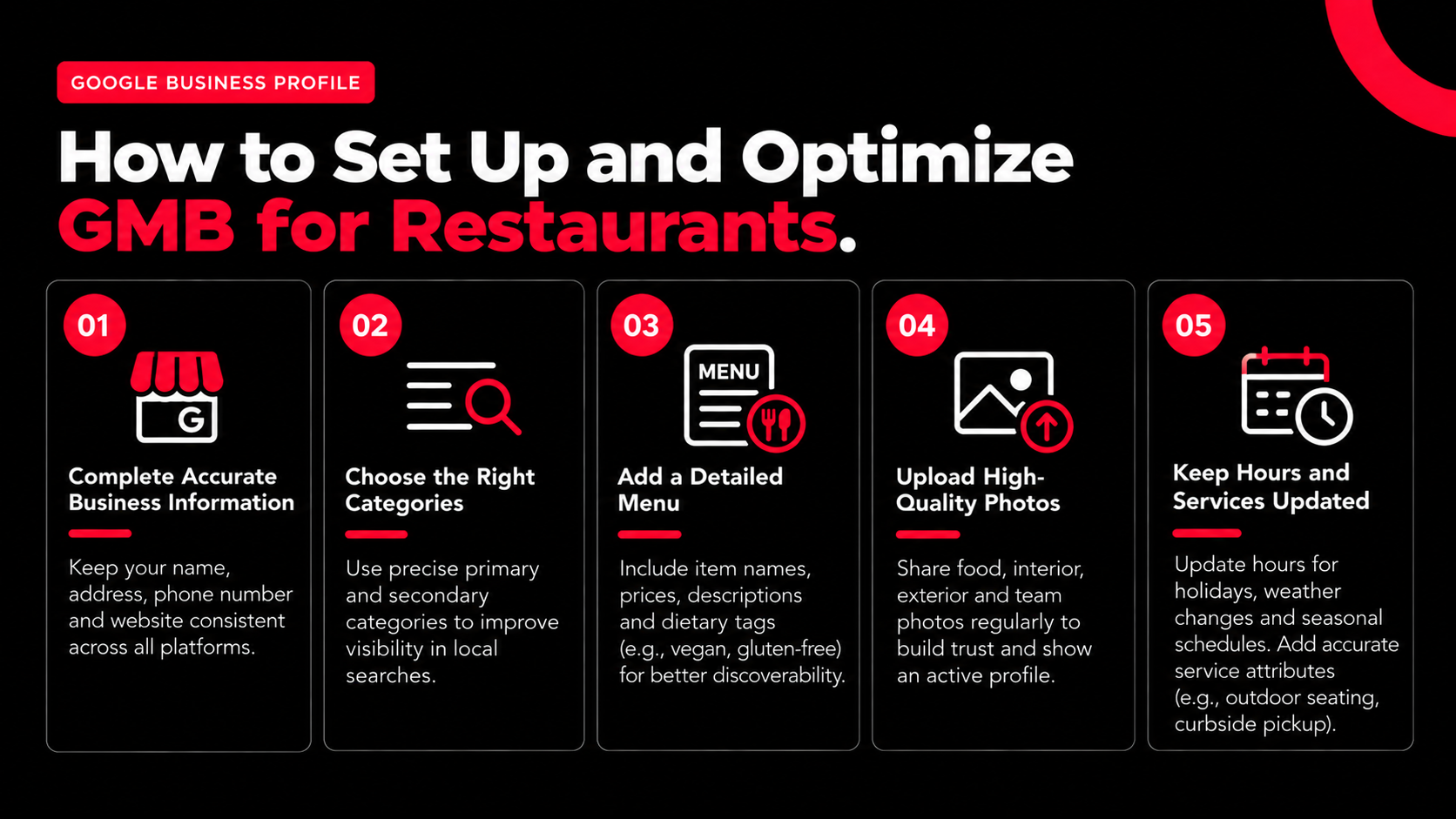
Select precise primary and secondary categories. A pizza shop should choose “Pizza Restaurant” instead of the broader “Restaurant” category when possible. Secondary categories help Google understand added offerings like “Italian Restaurant,” “Takeout Restaurant,” or “Brunch Restaurant.” Accurate categories improve performance in local intent searches because Google can better match diner queries.
Your business description should explain what you serve, where you are located, and what makes your restaurant different. Google allows 750 characters, but the first section matters most. Avoid generic claims and focus on searchable details.
Service attributes influence both visibility and conversions. Restaurants can identify accessibility features, dining options, dietary accommodations, and amenities. Diners often filter searches by terms like “vegan options,” “outdoor seating,” or “curbside pickup,” and AI search systems rely on these structured attributes when generating recommendations.
Your contact information should remain consistent across your website, delivery apps, and social profiles. Use the same restaurant name, phone number, address formatting, and website URL everywhere online. For multiple locations, create separate profiles with unique landing pages for each store.
Operational accuracy also matters. Google tracks whether users encounter incorrect hours, failed calls, or unavailable services. Restaurants should update hours immediately for holidays, weather closures, private events, or seasonal schedule changes. Assign one person to review profile accuracy weekly and confirm holiday hours at least a week in advance.
Menus are another critical optimization area for gmb for restaurants. Google increasingly reads menu data to answer AI-driven searches like “best spicy ramen near me” or “restaurants with gluten-free desserts.” Uploading only a PDF menu limits Google’s understanding of your offerings. Structured menu data performs better because item names, categories, prices, and descriptions become machine-readable.
Every menu item should include a concise description. Compare these examples:
The second example gives Google more context while helping diners make faster decisions. Include dietary tags like vegetarian, vegan, spicy, gluten-free, or dairy-free when relevant to improve discoverability in Google Maps and conversational AI searches.
Photo strategy is equally important because restaurant discovery is highly visual. Restaurants should upload a balanced mix of:
Fresh photos signal activity and build trust. Upload new images consistently during seasonal launches, renovations, events, or patio openings to strengthen engagement signals and reassure diners that the business is active.
Ordering, reservation, and booking integrations directly affect conversion performance. Google prioritizes frictionless customer actions. If diners can reserve a table or place an order without leaving search results, conversion likelihood increases.
Integrating direct ordering platforms instead of relying entirely on third-party marketplaces helps restaurants retain customer data and reduce commission fees. Solutions like chownow for restaurants support direct ordering integrations that connect with Google Business Profiles, allowing diners to order directly from search or Maps listings.
Reservation integrations through OpenTable, Resy, or Toast Tables can also improve engagement metrics by increasing completed actions from your profile. The easier it is for customers to act, the more likely your profile is to generate measurable business outcomes.
Once the foundational setup is complete, the next layer of optimization focuses on trust and engagement signals. Reviews, customer interactions, profile activity, and behavioral data all influence how Google ranks restaurants and how confidently AI systems recommend them to diners.
Using Reviews, Photos, and Posts to Help Restaurants Build Trust
For restaurants competing in Google Maps and AI-driven search results, engagement signals are critical. Google evaluates how customers interact with your profile to determine whether your business is active, trustworthy, and relevant. AI recommendation systems also rely on review language, photos, and recent updates to understand what makes a restaurant distinct.
To help restaurants improve visibility and convert more searchers into diners, operators need an ongoing process for generating reviews, responding to feedback, updating visuals, and publishing fresh content.
Review quantity still matters because it acts as a trust signal for both algorithms and customers. A restaurant with hundreds of reviews and a strong rating typically appears more credible than a competitor with only a few reviews. Google also weighs review recency. A steady flow of new reviews signals that your restaurant is active and consistently serving customers.
Review quality and specificity increasingly influence discovery. Reviews mentioning menu items, service experiences, location details, or atmosphere provide keyword-rich context that helps Google understand your business. Phrases like “best late-night tacos” or “great vegan ramen” strengthen relevance for those searches.
AI recommendation engines process this same language when generating restaurant suggestions. If diners repeatedly mention “family-friendly brunch” or “fast lunch spot,” those patterns become part of your restaurant’s digital identity. That is why review management has become a core component of gmb for restaurants.
The most effective review systems are simple and ethical. Google prohibits incentivized or fake reviews, and violations can damage rankings or lead to suspensions. Focus on increasing participation from real customers.
Restaurants using direct ordering systems have an advantage because they own the customer relationship and can automate review requests after deliveries or pickups.
Owner responses also influence visibility and customer trust. Generic replies like “Thanks for visiting!” waste an optimization opportunity.
Weak response: “Thank you for your review.”
Better response: “We’re glad you enjoyed the wood-fired margherita pizza and patio dining experience during your Friday visit.”
The stronger version reinforces menu offerings and atmosphere while sounding authentic. Over time, these responses create richer keyword associations across your profile.
Negative reviews matter too. Restaurants that respond professionally and quickly often build more trust than businesses that ignore complaints. Future customers pay close attention to how management handles problems.
Photo freshness is another major ranking and conversion factor. Restaurants depend heavily on visuals because dining decisions are emotional and appearance-driven.
Outdated or low-quality images create friction immediately. If your profile still shows old menu items or outdated interiors, customers may question whether the business information is current. AI systems also use image analysis to understand ambiance, cuisine type, and service format.
To help restaurants maintain stronger engagement, create a recurring photo schedule tied directly to operations. Upload:
Consistency matters more than perfection. Restaurants posting fresh smartphone photos regularly often outperform competitors relying on outdated professional photos.
Google Posts are another underused engagement tool within gmb for restaurants. Posts let you publish updates directly inside your profile, including promotions, events, seasonal menus, and limited-time offers.
The best approach is to align Google Posts with your broader marketing calendar. Publish matching updates across your Google profile, social media, email, and SMS campaigns simultaneously to strengthen brand consistency.
Common mistakes include generic owner responses, expired promotions, inconsistent photos, unanswered negative reviews, and menu items no longer available. These issues signal neglect to diners and search systems alike.
Once your profile generates consistent engagement signals, the next challenge is connecting visibility to measurable business outcomes through direct ordering, attribution tracking, and marketing systems that convert discovery into repeatable revenue.
Driving Direct Orders and Measuring Results from Your Google Business Profile
For many operators, the value of gmb for restaurants is turning visibility into direct revenue. Every call, reservation, menu click, and online order through your own channels reduces dependence on delivery marketplaces charging commissions of 15% to 30%.
Your Google Business Profile should act as a revenue channel, not a static listing. Customers discovering your restaurant through Maps, Search, or AI-powered local recommendations should immediately see a direct path to order from you. Restaurants that simplify direct ordering capture more profitable sales and retain more customer data.
.png)
The first step is configuring direct ordering links correctly. Google allows restaurants to add online ordering buttons, reservation integrations, and menu links inside the profile. If your direct ordering system is not connected properly, Google may prioritize third-party delivery providers instead.
Many operators use platforms like ChowNow for restaurants because they support low-fee or commission-free direct ordering and integrate cleanly with Google Business Profiles. Shifting even part of delivery volume away from marketplace apps can save thousands each month while improving customer retention.
Direct ordering also creates marketing advantages. Orders placed through your own system generate first-party data such as email addresses, phone numbers, order history, and customer preferences. That information supports loyalty programs, SMS campaigns, email marketing, and remarketing efforts that are impossible when third-party apps control the customer relationship.
Consistency matters across every customer touchpoint. Your ordering platform, website, menu, hours, and Google Business Profile should match exactly. If customers encounter outdated menus or inconsistent hours after clicking “Order Online,” conversion rates drop quickly.
Tracking performance separates casual profile management from a measurable acquisition strategy. Google Business Profile Insights shows profile views, website clicks, calls, direction requests, and photo interactions. These metrics help restaurants understand how local visibility turns into customer action.
However, Insights alone are not enough for optimization. Adding UTM parameters to website and ordering links improves attribution inside Google Analytics. A tagged ordering URL can reveal how many orders came from Google Maps versus organic search or paid campaigns.
Call tracking adds another layer of operational insight. Using a forwarding number for Google Business Profile calls helps restaurants measure call volume, missed calls, peak inquiry times, and booking intent. For high-volume restaurants, unanswered calls often mean lost reservations or catering opportunities.
The most useful metrics are tied to customer intent rather than vanity rankings:
Many restaurant teams focus on rankings without connecting visibility to revenue outcomes. Appearing in the top map results means little if customers abandon the ordering process or end up using expensive third-party apps.
A repeatable monthly optimization process helps maintain performance. Google favors active, accurate profiles that reflect real operational activity. Restaurant teams should review profile performance regularly instead of treating optimization as a one-time setup task.
A practical monthly checklist includes reviewing hours, testing direct ordering links, updating menu photos, responding to reviews, monitoring unanswered questions, checking for duplicate listings, reviewing Insights data, and comparing direct order performance month over month. Operators should also confirm that preferred direct ordering links appear more prominently than third-party delivery options.
Restaurants with multiple locations benefit from standardized reporting dashboards that compare actions across stores. One location may generate stronger direction requests while another produces more online orders, revealing operational or demographic trends that can refine marketing strategy.
As AI-driven search evolves, Google Business Profiles will increasingly influence how restaurants are recommended across Maps, Search, voice assistants, and AI-generated results. Restaurants that succeed long term will treat gmb for restaurants as a measurable growth channel tied directly to profitability, customer ownership, and acquisition costs.
Frequently Asked Questions
How often should restaurants update their Google Business Profile?
Review core information weekly and update menus, hours, promotions, and holiday schedules immediately. Restaurants posting accurate updates consistently maintain stronger engagement in Google Maps and AI-driven search results.
What types of photos perform best for restaurant Google Maps listings?
High-quality food photography, dining atmosphere images, and clear exterior photos generate the most engagement. Upload current team, bar, patio, and popular menu item photos because diners often decide within seconds using visual trust signals.
Do ordering integrations improve visibility or only conversions?
Ordering integrations improve conversions by reducing friction between discovery and checkout while strengthening engagement metrics over time. Platforms like chownow for restaurants connect diners directly to ordering experiences and reduce marketplace commission dependency.
How long does it take to see results from gmb for restaurants optimization?
Most restaurants see improvements in profile interactions, calls, direction requests, or direct orders within 30 to 90 days of consistent optimization. Competitive markets may take longer when nearby restaurants have stronger review volume and engagement history.
Can multi-location restaurant groups manage Google Business Profiles centrally?
Yes. Google Business Profile Manager lets restaurant groups control multiple locations from one dashboard while assigning local access to managers. Standardizing menus, categories, branding, and response workflows maintains consistency without duplicate administrative work.
What is the biggest ongoing mistake restaurants make with Google Business Profiles?
Many operators treat optimization as a one-time setup instead of an ongoing process. Restaurants increasing direct traffic usually update profiles regularly, respond to reviews quickly, and monitor performance trends monthly to improve local visibility.
The Bottom Line
GMB for restaurants is no longer just a local listing. It is now a core driver of AI search visibility, Google Maps discovery, and direct online orders. Restaurants that maintain accurate business data, fresh photos, consistent reviews, and clear direct ordering links are better positioned to capture high-intent diners where decisions are happening.
As AI-driven search continues to rely on structured and trustworthy business information, ongoing optimization matters more than ever. Treat your Google Business Profile like an active marketing channel by reviewing performance regularly, updating operational details, and responding to customer engagement consistently.
Your next step is simple: audit your current profile today. Check for outdated information, missing menu or ordering links, unanswered reviews, and low-quality images. Small updates made consistently can improve local visibility, increase direct traffic, and help turn more searches into orders over time.
.png)



.png)


