.png)


77% of restaurant brands reported digital sales growth, yet most independent operators still feel squeezed by labor costs, delivery commissions, and rising ad spend. That’s why the restaurants that actually help restaurants grow in 2026 won’t be the ones adding more apps—they’ll be the ones building connected systems that turn first-time buyers into repeat guests.
According to Qu’s 2024 State of Digital Report and the National Restaurant Association, convenience-driven ordering keeps accelerating, while disconnected tech stacks quietly create more admin work and weaker margins. In our work with restaurant operators, we’ve seen owners juggle separate POS tools, loyalty apps, delivery tablets, and email platforms that barely communicate with each other (and yes, it gets messy fast).
This guide breaks down the restaurant tech stack that matters most: direct ordering, POS integration, CRM, marketing automation, loyalty, local SEO, and retention workflows. You’ll learn which tools actually improve repeat orders and operational efficiency—without overspending on software you won’t use. It starts with the most important decision: owning the customer relationship through direct ordering infrastructure.
How Direct Ordering Platforms Help Restaurants Protect Margins
Direct ordering platforms help restaurants improve margins and guest retention by giving operators control over customer data, repeat marketing, and checkout experience instead of relying entirely on third-party delivery marketplaces. Direct online ordering is first-party ordering through your website, branded checkout, or app connected to customer data you actually own. That ownership matters because repeat guests—not one-time marketplace traffic—usually drive the healthiest long-term margins.
36% of operators reported using direct online ordering systems in 2024, up from 34% the year before. According to TouchBistro’s 2024 State of Restaurants report, more independents now view direct digital ordering as infrastructure rather than a side project. For operators trying to help restaurants grow without sacrificing profit, that shift changes how marketing, loyalty, and guest retention work together.
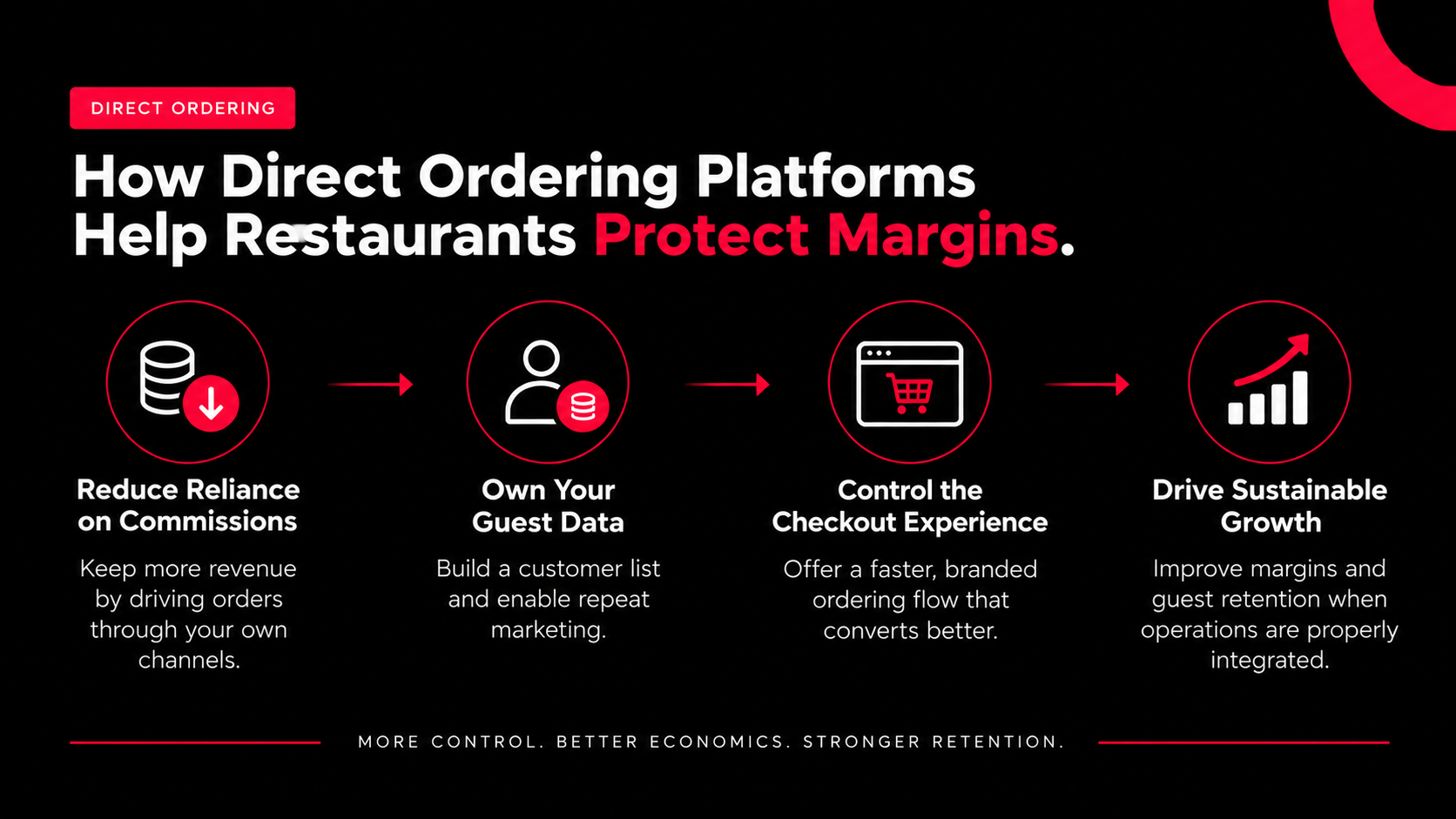
Marketplace Reach vs Direct Ordering Economics
The biggest misconception? More delivery apps don't automatically mean healthier revenue. Adding more marketplace channels is not always the best growth strategy because commission costs and weak guest ownership can quietly erode profitability. According to Restaurant Technology News, 77% of restaurants use delivery marketplaces, but only 8% successfully integrate loyalty programs with those platforms. You gain visibility, but often lose customer insight.
Ordering ApproachMargin ImpactGuest Data AccessBest FitMarketplace-only deliveryLower margins from commissionsLimitedNew brands needing reachDirect web orderingHigher retained revenueFull ownershipMost independentsCustom branded appHigh setup costFull ownershipMulti-unit brandsUnified API-forward commerce stackStrong long-term efficiencyCentralized dataScaling operators
In our work with restaurant operators, we've seen this play out repeatedly. A Southeast burger chain spent nearly $40,000 on a custom app expecting loyalty adoption to follow automatically. The better ROI came from frictionless web ordering with Apple Pay and Google Pay—not the expensive app itself. After simplifying checkout, conversion rates increased 14% within 45 days because guests stopped abandoning carts during account creation.
Why Lightweight Ordering Often Wins
Many first-time owners assume they need the same tech stack as national chains. Usually, they don't. Lightweight web ordering tied to POS integrations often outperforms expensive custom apps for independent restaurants. Tools like using ChowNow to drive direct restaurant orders give smaller operators branded ordering without forcing massive development costs.
According to Restaurant Technology News market research, 38% of restaurants now use integrated POS systems supporting both in-store and online orders. That integration matters more than flashy design. If your menu updates fail to sync across channels—or your kitchen printer lags during Friday rushes—guests notice immediately.
Here’s where operators should focus first:
The upside is stronger margins and better retention, but direct ordering only works when operations stay connected behind the scenes. We've seen restaurants increase digital demand by 20% to 30% without adjusting kitchen workflows, leading to delayed tickets and refund spikes during staffing shortages.
Unified Commerce Matters More Than Another Ordering Channel
The next competitive advantage isn't another front-end app—it’s unified commerce. According to Qu’s 2024 State of Digital Report, 65% of operators are moving toward cloud-based, API-forward commerce systems connecting ordering, POS, loyalty, and guest data together. That unified layer sets up the retention and marketing workflows covered in the next section.
The Restaurant Tech Stack That Can Help Restaurants Scale in 2026
A modern restaurant tech stack links POS, online ordering, loyalty, marketing automation, and guest data so restaurants can manage digital and in-store operations from one system.
65% of operators are moving toward cloud-based, API-forward commerce systems. According to Qu’s 2024 State of Digital Report, operators increasingly prioritize connected infrastructure over standalone apps. That shift helps restaurants reduce fragmented guest data and automate more of the customer journey.
Want help implementing this? See how Nabeeats can help.
Connected systems create the data foundation for retention. Next, we'll look at how operators use guest data through automation, segmentation, and personalized campaigns to increase repeat orders profitably.
Restaurant Marketing Automation and Loyalty Tools for Repeat Orders
Restaurant marketing automation uses guest data, ordering behavior, and triggered messaging to increase repeat orders through personalized email and SMS campaigns rather than constant blanket discounts. The restaurants seeing the strongest guest retention in 2026 usually automate convenience, not coupons. According to the National Restaurant Association’s 2024 technology research, 57% of operators expected to invest in loyalty and rewards systems, yet Qu’s 2024 State of Digital Report found that 80% believed their existing programs were underperforming. That gap matters because most systems still reward spending instead of reinforcing habits.
Problem: Generic Promotions Stop Working Fast
We’ve seen this play out with business owners and decision-makers clients at Nabeeats repeatedly. Broad promotional blasts usually train guests to wait for discounts instead of ordering naturally. A suburban pizza chain we advised sent the same weekly coupon email to every customer, and open rates dropped below 11% within months. After segmenting guests by ordering time rather than spend level, repeat orders increased 19% in eight weeks.
Behavior-based segmentation works because restaurants operate on routines. Families ordering every Friday at 5 PM respond differently than late-night solo diners ordering after 9 PM. TouchBistro’s 2024 report showed increased adoption of personalized restaurant marketing campaigns year over year, especially among operators connecting POS data with CRM systems.
Here’s what high-performing automated flows usually include:
SMS marketing for restaurants performs best when the message removes friction. One three-location Mediterranean fast-casual brand we worked with shifted repeat guests into direct SMS reorder flows tied to its POS. Over 10 weeks, direct digital orders grew from 18% to 41% of online volume, while blended customer acquisition costs dropped roughly 27%. The highest-performing campaign wasn’t a discount—it was a Thursday 4:30 PM reorder text with a two-click checkout flow.
Approach: Simplify Restaurant Loyalty
Restaurant loyalty is most effective when it reinforces convenience and predictability rather than complex point accumulation. Many loyalty programs fail because guests don’t understand the reward structure quickly enough. According to the National Restaurant Association’s 2024 loyalty research, 96% of consumers said rewards programs help them earn more value, but operators often overengineer the mechanics.
A regional Mexican restaurant group illustrated this perfectly. Their original points-based system required too many visits before redemption, so casual guests disengaged early. We simplified the program to surprise rewards after the second visit within 30 days instead of long-term point accumulation, and repeat visit frequency increased 13% in one quarter (and redemption costs actually fell).
Simple frameworks tend to outperform complicated ecosystems:
This approach works best for independent and small multi-unit operators using unified guest data. If your ordering channels still sit in separate systems, automation accuracy suffers because duplicate guest profiles and missing consent records distort campaign reporting.
Retention systems only work when new guests continue entering the funnel. Next, we’ll look at how improving restaurant visibility on Google Maps through local search and AI discovery channels keeps direct ordering growth sustainable over time.
How gmb for restaurants and Local SEO Drive More Direct Orders
Google Business Profile optimization helps restaurants increase direct orders by improving local visibility, mobile discovery, review trust, and one-click access to online ordering. For most independent operators, gmb for restaurants is no longer a branding task—it’s a conversion channel tied directly to revenue. When someone searches “tacos near me” or “best pizza open now,” Google Maps often decides which restaurant gets the order before a guest even visits your website.
63% of restaurant operators planned to devote resources to digital or location-based marketing in 2024. According to the National Restaurant Association’s Restaurant Technology Landscape Report 2024, operators increasingly treat local discovery as a customer acquisition system, not just advertising. That shift matters because direct orders typically produce better margins and stronger guest ownership than marketplace-only traffic.
Audit Your Google Business Profile
A complete Google Business Profile is one of the fastest ways to improve local SEO for restaurants. Accurate menus, hours, photos, and ordering links reduce friction during high-intent searches. In our work with restaurant operators, missing holiday hours and broken ordering links consistently hurt conversion more than weak ad spend.
Start with these operational basics:
A neighborhood burger shop we worked with updated stale menu photos, corrected pickup hours, and added Google ordering buttons. Within six weeks, direct online orders increased noticeably because guests stopped calling to confirm availability. Simple fixes. Real impact.
Connect Local Search to Mobile Ordering
Local SEO for restaurants works because mobile behavior rewards convenience. 7 in 10 limited-service customers say they would likely place an order using a smartphone app, according to the National Restaurant Association’s 2024 technology report. Add in Google Pay or Apple Pay express checkout, and conversion friction drops fast (especially for first-time guests).
What many operators miss is that Google Maps traffic often converts better than social traffic because intent is higher. Someone searching “Thai food near me open now” already wants to buy. They don’t need another awareness campaign—they need fewer taps between discovery and checkout.
We’ve seen this play out with business owners using lightweight web ordering instead of expensive branded apps. One fast-casual client improved mobile checkout completion after simplifying their Google ordering path to two clicks instead of five. More convenience. Higher direct orders.
Track Which Channels Create Repeat Customers
Attribution matters more than raw traffic numbers. The real goal of gmb for restaurants is not clicks—it’s repeat guests who order directly again within 30 days. Google Analytics 4, Toast, Square, Clover, and integrated CRM tools can all help track this if your ordering system passes customer data correctly.
Use a simple tracking framework:
According to the National Restaurant Association’s 2024 consumer technology report, convenience-enhancing tools like smartphone ordering and digital payments strongly influence guest behavior. The upside is clear, but there’s a caveat—traffic growth can overwhelm kitchens if operations stay disconnected.
That’s why operators investing in improving restaurant visibility on Google Maps also need ordering workflows, staffing, and menu systems prepared for higher digital demand. Otherwise, more visibility simply creates more operational stress and negative reviews.
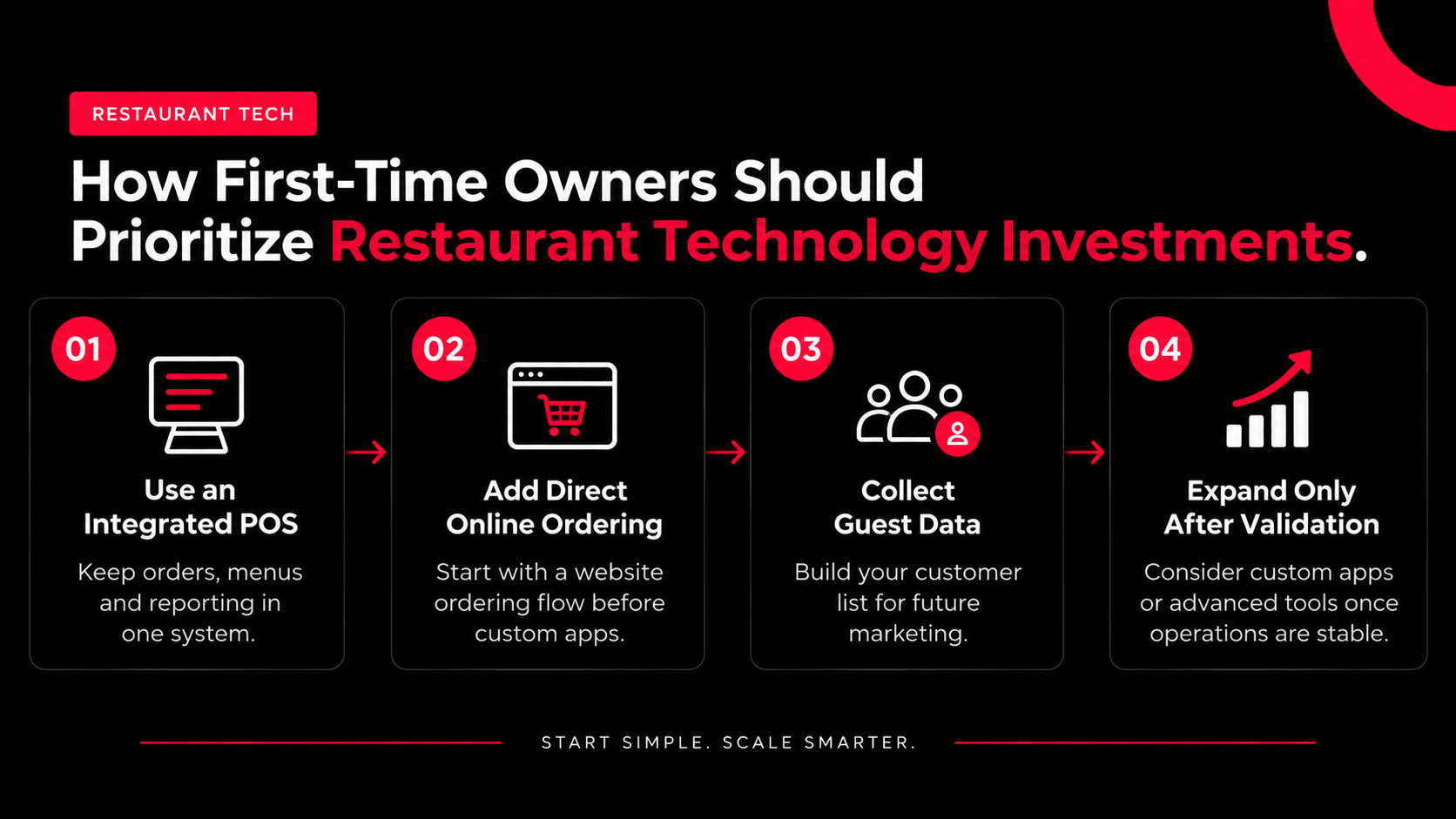
How First-Time Owners Should Prioritize Restaurant Technology Investments
First-time restaurant owners should prioritize integrated POS, direct online ordering, and guest data collection before investing in custom apps or advanced automation. The best restaurant technology roadmap starts simple and expands only after operations can absorb more digital demand.
According to Qu’s 2024 State of Digital Report, 65% of operators planned to move toward cloud-based, API-forward commerce systems. Disconnected restaurant ordering systems create reporting gaps, menu sync errors, and slower service as order volume grows. For small restaurant operators, operational problems usually appear before meaningful revenue gains.
In our work with independent operators, the healthiest rollout pattern usually looks like this:
Most first-time owners lose money by overbuilding too early. We’ve seen operators spend $25,000 to $40,000 on branded apps before validating customer demand. One owner launched a custom app expecting loyalty adoption to rise, but fewer than 9% of weekly guests downloaded it within six months. After switching to frictionless web ordering, conversion rates improved 14% in 45 days because checkout became faster.
Start With Operational Stability
Restaurant technology only works when kitchen throughput and staffing can support added demand. Digital sales spikes expose operational weaknesses faster than dine-in traffic. Qu’s 2024 report found that 77% of brands reported digital sales growth, but many independents still underestimate fulfillment pressure during peak hours.
A restaurant adds online ordering, promotes delivery aggressively, then pushes 20% to 30% more tickets through the same kitchen during Friday dinner service. Ticket times climb, refunds increase, and reviews drop within weeks.
The fix usually isn't more marketing. It's pacing controls, simpler prep workflows, and limiting modifier complexity online.
Avoid Expanding Delivery Too Aggressively
More delivery channels do not automatically create healthier margins. Some concepts should prioritize pickup and dine-in quality over delivery volume. A premium sushi operator we advised pushed hard into marketplaces, but delivery-safe menu changes reduced average order value from more than $70 dine-in checks to roughly $31 online. Food quality complaints also rose 22% because high-end rolls degraded during transit.
After reducing delivery radius and focusing on direct pickup ordering, margin per order improved roughly 18% despite lower delivery volume. Protecting experience quality often produces stronger long-term retention than chasing every marketplace order.
Evaluate Vendors Like an Operator, Not a Startup Founder
The best software demo rarely reflects day-to-day operations. Small restaurant operators should evaluate restaurant technology based on usability and integration quality first, not feature volume.
Focus your evaluation around a few practical questions:
According to Restaurant Technology News market research, only 38% of restaurants currently operate integrated POS systems supporting both in-store and online orders. That gap creates an opportunity for operators who prioritize simplicity early.
Frequently Asked Questions
Do small restaurants really need a custom mobile app?
No. Most independent restaurants should prioritize fast web-based direct online ordering before investing in a custom app. Branded apps usually make sense only after a store reaches consistent repeat ordering volume, often 1,500 to 2,000 monthly loyalty members or heavy lunch traffic. A mobile-optimized ordering site tied to restaurant loyalty and SMS generally delivers faster ROI with lower maintenance costs.
How can restaurants reduce dependence on delivery marketplaces?
Restaurants reduce marketplace dependence by moving repeat guests toward owned channels like Google ordering, SMS reorders, and direct online ordering incentives. Operators using first-party ordering systems retain more customer data, improving repeat marketing performance while protecting margins from 15% to 30% third-party commissions. One operator added QR-code reorder cards to delivery bags and shifted 28% of repeat customers to direct ordering within six months.
Which restaurant tech tools usually deliver the fastest ROI?
Integrated POS-connected restaurant marketing automation tools usually produce the fastest ROI because they improve repeat orders and labor efficiency quickly. Reorder reminders and win-back campaigns often outperform paid ads by 3x to 5x in return on spend. Tools like Toast, Square, ChowNow for restaurants, and integrated CRM platforms typically outperform disconnected point solutions because staff spends less time updating systems manually.
How should restaurants measure restaurant loyalty programs beyond signups?
Restaurants should measure restaurant loyalty performance using repeat purchase rate, average order value, and 90-day retention instead of member count alone. Smaller operators often celebrate thousands of signups while fewer than 12% of members reorder monthly. A healthy loyalty system generally drives a 15% to 25% lift in repeat visits when offers connect to actual customer behavior rather than blanket discounts.
What matters more for independent restaurants: kiosks, SMS marketing, or web ordering?
Web ordering usually matters most because it affects revenue capture, customer ownership, and operational simplicity. SMS marketing often comes next because text campaigns consistently generate higher engagement than email, with click-through rates commonly above 10%. Kiosks can help high-volume quick-service locations but are often unnecessary for smaller dine-in restaurants unless labor shortages or line speed become major problems.
How often should restaurants send marketing texts or emails?
Restaurants should send SMS campaigns one to two times weekly and email campaigns two to four times monthly to avoid fatigue while staying visible. Operators sending daily discounts usually see unsubscribe rates rise quickly. A better approach uses restaurant marketing automation triggers like abandoned carts, lapsed guest reminders, or weather-based promotions instead of constant blasts.
What’s the best long-term restaurant technology strategy for first-time owners?
The best strategy is building a connected system focused on repeat orders, operational simplicity, and guest data ownership instead of chasing every new platform. Our team at Nabeeats recommends starting with integrated direct online ordering, Google visibility, and basic restaurant loyalty workflows before adding advanced tools like kiosks or custom apps. That approach works best for independent restaurants under five locations, and platforms like Nabeeats can streamline integration without creating extra operational complexity.
Take Action on Your help restaurants Strategy
Restaurant growth in 2026 won’t come from adding more apps—it comes from building a connected system that protects margins, simplifies workflows, and gives you direct access to guest relationships.
The best results usually come from fixing one friction point first instead of replacing everything at once. Start with a systems audit, map your guest journey from Google search to repeat order, and see how Nabeeats can help restaurants unify ordering, marketing, and retention without adding operational chaos.
The operators who win over the next few years likely won’t use the most software—they’ll use the right systems consistently.
.png)


.png)


