.png)


How Uber Eats Promotions Affect Restaurant Margins
Uber Eats promotions affect restaurant margins by stacking discount costs on top of commissions, payment processing, advertising, and operational overhead—sometimes cutting take-home revenue close to half of gross sales on heavily discounted orders.
Many operators miscalculate this because they track sales growth inside the Uber Eats merchant dashboard without measuring contribution profit. Discounted third-party delivery orders can leave restaurants with roughly 45% to 55% of gross revenue after commissions, promo funding, packaging, and labor costs are applied.
Understanding Who Pays for Uber Eats Promotions
Merchant-funded promotions are absorbed by the restaurant. Co-funded promotions split the subsidy between Uber and the merchant, while platform-funded promotions are subsidized mainly by Uber through marketplace growth budgets or Uber One incentives. The funding structure changes both margin exposure and customer acquisition quality.
Uber Eats promotion terms in 2026 still generally avoid separate redemption fees, but restaurants absorb the discount value on merchant-funded offers. Service fees and commissions may also apply to the discounted subtotal depending on the merchant plan and offer setup.
Promotion TypeWho Funds DiscountTypical Margin ImpactBest Use CaseMerchant-fundedRestaurantHighest direct costFirst-order acquisitionCo-fundedShared with UberModerate costCompetitive urban marketsPlatform-fundedUber EatsLowest direct costNew customer exposureSponsored listings + light offerRestaurant ad budgetLower discount erosionVisibility-focused campaigns
Platform-funded offers tied to Uber One free delivery events or seasonal campaigns often produce stronger repeat behavior than broad merchant-funded discounts. Restaurants frequently lump all promo orders together, hiding whether customers came for price or marketplace visibility.
Promotion strategy also shifts for an uber eats only restaurant or virtual kitchen brand. Because these concepts depend heavily on marketplace ranking and conversion signals, they often run lighter but more frequent offers tied to sponsored placement instead of deep discounts that compress delivery-only margins.
How Fees Stack on Uber Eats Restaurant Orders
Delivery commissions already consume a large percentage of revenue before discounts enter the picture. Current Uber Eats merchant plans in major U.S. markets generally range from roughly 15% for pickup-focused plans to around 30% for full-service delivery and premium visibility tiers. Higher visibility packages can improve reach, but they also raise the breakeven point for promotions.
Add payment processing, ad spend, refunds, packaging, and promo funding, and blended costs often land between 30% and 40% of sales for heavily promoted delivery orders.
Before launching campaigns, operators should model:
A 20% discount paired with 25% commission and 6% advertising can consume over half the order value. Smaller independent restaurants are hit hardest because they rarely have dedicated margin analysts or sophisticated attribution tools.
For virtual brands, packaging and refund exposure can create even tighter economics because every order depends on delivery performance and app ratings. An uber eats only restaurant often treats promotions as a visibility expense first and a sales driver second.
Comparing Percentage-Off, Free Delivery, and BOGO Offers
Not all uber eats promotions damage margins equally. Free delivery campaigns often preserve more contribution margin than percentage-off offers because they reduce customer friction without discounting menu items directly.
Offer TypeCustomer AppealMargin RiskOperational Risk20% Off OrdersHigh conversionModerate-highMediumFree DeliveryStrong trial driverLowerLowBOGO EntréesVery high volumeVery highHighBOGO Sides/Add-onsStrong attachment salesModerateLower
Marketplace data from multi-unit operators continues to show that aggressive BOGO campaigns can exceed 40% to 50% of gross sales value once labor and ad amplification are included. The best-performing promotions are usually narrower, capped, and tied to high-margin items.
Why Incremental Margin Matters More Than Blended Margin
Incremental margin is the profit generated from additional orders after variable costs, while blended margin averages profitability across channels. Operators who confuse the two often shut down campaigns that were actually working.
A promotion can reduce blended margin while still producing profitable incremental sales during underused hours. The upside is increased order density and stronger marketplace exposure, though aggressive discounts can weaken retention and create operational stress if fulfillment quality slips.
Why Uber Eats Promotions Increase Visibility More Than Most Restaurants Realize
Uber Eats promotions increase visibility by improving conversion signals and pairing with sponsored placements in high-traffic areas of the app, including the home-feed carousel, sponsored collections, and keyword search results.
Most operators treat discounts as a margin decision. Uber Eats promotions also function as discovery infrastructure inside the marketplace, influencing whether your restaurant appears where customers browse first.
A large share of Uber Eats orders comes from restaurants near the top of search and feed placements. Uber Eats Manager and Ads Manager updates continue emphasizing click-through rate, conversion rate, and fulfillment quality as visibility drivers. In many cases, moving from position seven to position two outperforms increasing a discount from 15% to 30%.
How Promotions and Ads Influence Placement
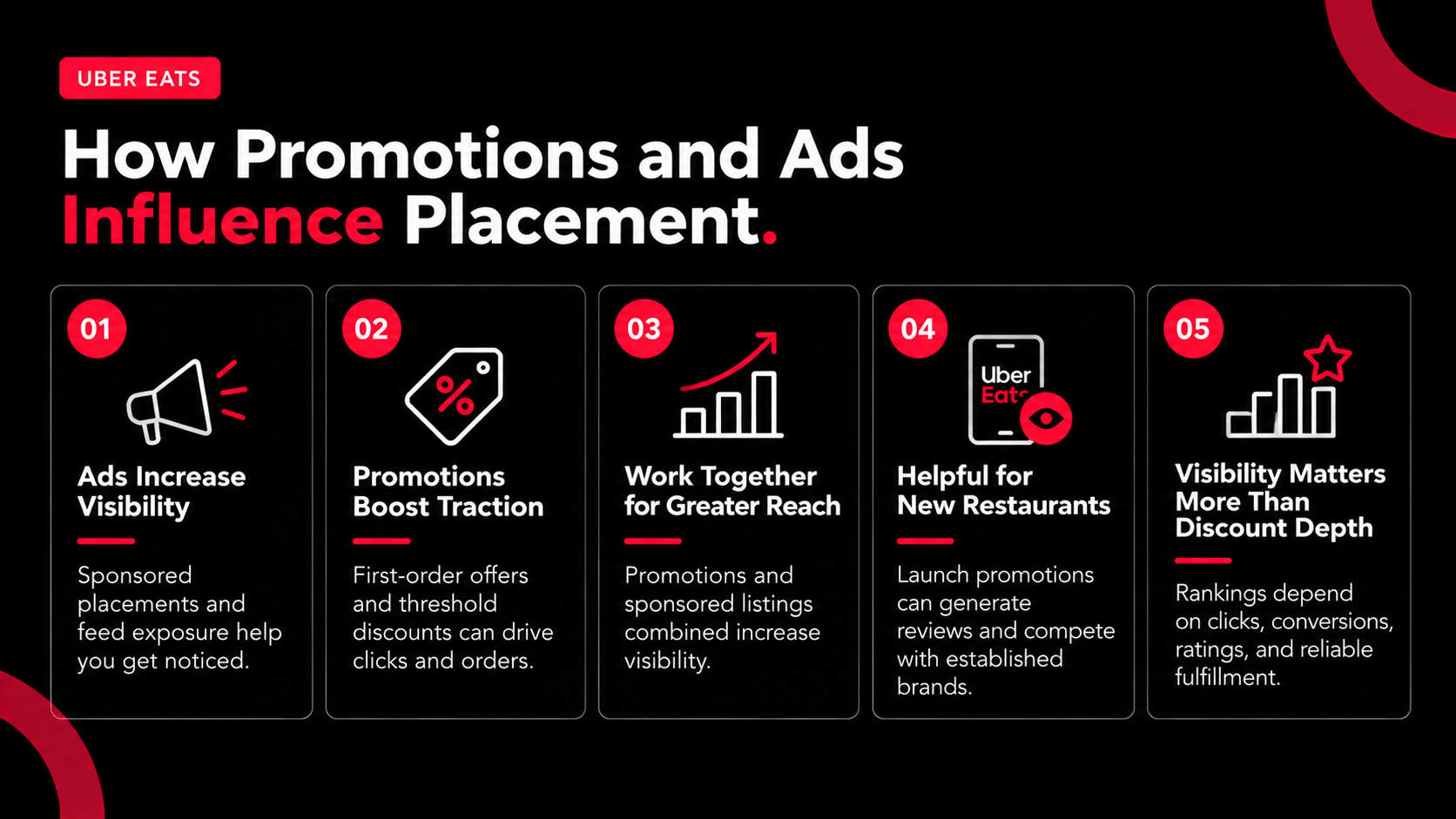
Uber states that ads can “further enhance visibility in the app and support a promotion” through sponsored placements and feed exposure. Visibility compounds when promotions and sponsored listings work together.
This matters for operators completing the uber eats restaurants sign up process. New stores often lack reviews and order history, so modest launch promotions paired with sponsored placement can accelerate traction while the algorithm gathers data.
Restaurants going through an uber eats sign up restaurant onboarding phase often benefit from first-order offers or threshold discounts during their first weeks live. These campaigns can improve click-through rate, generate reviews, and help newer brands compete against established chains.
Uber Eats also expanded app-funded promotional programs in several markets during 2025 and 2026, creating more flexibility for merchants balancing growth and margin protection. App-funded offers can increase exposure without reducing restaurant margin as aggressively.
A premium burger brand we advised resisted discounts because leadership feared brand dilution. After launching a capped $5-off-$35 first-order campaign paired with sponsored placement, impressions increased 37% over six weeks, and most orders still exceeded $40 because the promotion encouraged larger group purchases.
Visibility often matters more than discount depth. Uber's ranking environment rewards click-through rate, conversion consistency, customer ratings, and fulfillment reliability more than simply offering the cheapest basket.
Why Keyword-Targeted Ads Usually Beat Broad Discounts
Keyword targeting remains one of the most overlooked parts of uber eats marketing. Uber's Ads Manager states that keyword targeting can increase visibility in search results and help restaurants reach new audiences.
Many campaigns fail because operators rely on broad discounts instead of intent-based targeting:
In our work with multi-unit operators, keyword-targeted campaigns routinely outperform marketplace-wide discounts on customer acquisition efficiency. One regional pizza group shifted spend from homepage discounts toward search ads tied to family meal terms. Their average order value increased from $28 to $41 because the traffic matched higher-intent dinner occasions.
Sponsored listings frequently outperform direct discounts for restaurants with strong ratings, fast prep times, and quality photography.
For brands preparing to sign up uber eats restaurant locations across multiple markets, marketplace-wide discounts can create fast volume spikes, but targeted campaigns tied to menu searches usually produce cleaner acquisition data and more sustainable visibility growth.
Operational Metrics Quietly Affect Visibility
The Uber Eats algorithm doesn't just evaluate promotions. It evaluates reliability.
A regional sushi chain we worked with stacked ads, free delivery, and deep discounts during a competitive launch campaign. Sales jumped initially, but by month three their organic placement declined because operational instability increased cancellations, refunds, and delivery complaints.
After the operator reduced discount depth from 30% to 15% and tightened the delivery radius, refund rates fell sharply and organic ranking recovered within weeks. Operational quality metrics indirectly shape marketplace visibility even when Uber doesn't publicly frame them as direct ranking factors.
This approach works best for restaurants with stable kitchen throughput and consistent fulfillment times. If your store already struggles with delays during peak periods, aggressive promotions can damage ranking performance instead of improving it.
For operators trying to balance discoverability with profitability, our team at Nabeeats recommends combining moderate offers with strong execution and targeted placement strategy instead of relying on blanket discounts alone. You can also explore more delivery app marketing tactics that improve acquisition efficiency without forcing margin erosion.
Once visibility starts improving, the next question becomes more important: which uber eats promotions actually create profitable repeat behavior instead of training customers to wait for the next discount?
Best Uber Eats Promotions for Repeat Orders and Customer Retention
The best Uber Eats promotions for repeat orders are usually modest threshold discounts, bundles, or targeted first-order offers that improve customer experience and order value instead of maximizing discount depth. Retention-focused uber eats promotions work because they shape ordering habits, not one-time conversion spikes. That matters when delivery commissions already consume 15% to 30% of order value before discounts.
Problem: High Traffic, Weak Repeat Behavior
Multi-unit operators often see weak repeat rates after aggressive percentage-off campaigns tied to core menu items. Deep discounts attract low-intent bargain traffic that disappears once pricing normalizes. Restauboost’s 2026 analysis found that aggressive BOGO campaigns can push promotional costs above 40% of sales value.
A Southeast pizza group generated a 22% traffic lift across uber eats restaurant orders after investing in sponsored listings and steep pizza discounts. Repeat orders stayed below 14% because customers anchored on deal-seeking behavior instead of convenience or routine ordering.
Approach: Smaller Offers With Higher Intent
The operator shifted toward family bundles with drinks and desserts. Bundles increased average order value from $28 to $41 while improving 60-day repeat rates to 24%. Families reordered complete meal solutions more consistently than discounted entrées.
The best-performing offers usually fall into these categories:
Threshold-based discounts often outperform larger percentage cuts. A premium burger concept tested a $5-off-$35 first-order promotion within a 3-mile radius. Impressions increased 37%, and 72% of redemptions still exceeded $40 because customers added group meals instead of gaming the minimum order.
The best-performing Uber Eats promotions are often the least aggressive discounts. Uber Eats ranking systems reward conversion consistency and fulfillment quality more than discount depth, so moderate offers can improve visibility without crushing margin.
Result: Better Lifetime Value and Habitual Ordering
Bundles and threshold offers support longer-term loyalty behavior. Habit formation matters more than first-order volume in uber eats marketing. Operators who connect delivery promotions to repeat ordering routines usually outperform restaurants chasing short-term spikes.
Consumers increasingly reorder the same meals weekly, especially families and office lunch customers. Restaurants can align Uber Eats promotions with broader loyalty systems through SMS reminders, reorder campaigns, and direct online ordering follow-ups.
According to Uber’s Merchant Academy materials, promotions and ads improve in-app visibility when paired with targeted placements and keyword campaigns. The tradeoff is that evergreen discounts often erode profitability because loyal customers redeem them repeatedly. Broad always-on offers can quietly cannibalize full-price demand.
For operators building retention systems beyond marketplaces, these delivery app marketing tactics create stronger long-term economics than relying on discounts alone.
The Real Retention Driver Most Operators Miss
Repeat order growth on Uber Eats depends more on execution than on the promotion itself. Food quality, packaging integrity, and delivery consistency determine whether customers reorder after the discount expires. Restaurants often lose retention because prep times slip or food quality declines during peak periods.
One Mediterranean brand increased promo-driven traffic, but ticket times rose from 18 to 31 minutes during dinner rushes. Refund requests increased and customer ratings declined. After restricting offers to slower periods and simplifying bundled SKUs, contribution margin improved while retention stabilized.
That operational reality leads directly into the next challenge: implementing Uber Eats promotions without overwhelming kitchen throughput or damaging customer experience.
How to Structure Uber Eats Promotions Without Destroying Profitability
Restaurants should structure uber eats promotions around targeted audiences, simple menu items, capped budgets, and off-peak scheduling to protect margins while increasing visibility. The operators who win on the Uber Eats platform treat promotions like controlled acquisition campaigns instead of permanent discounts. Restaurant owners evaluating uber eats for restaurant growth should build promotion strategy into onboarding from day one, since commission structure, delivery zones, and menu setup inside an uber eats restaurant account all affect long-term margin performance.
Set Clear Campaign Goals Before Launching
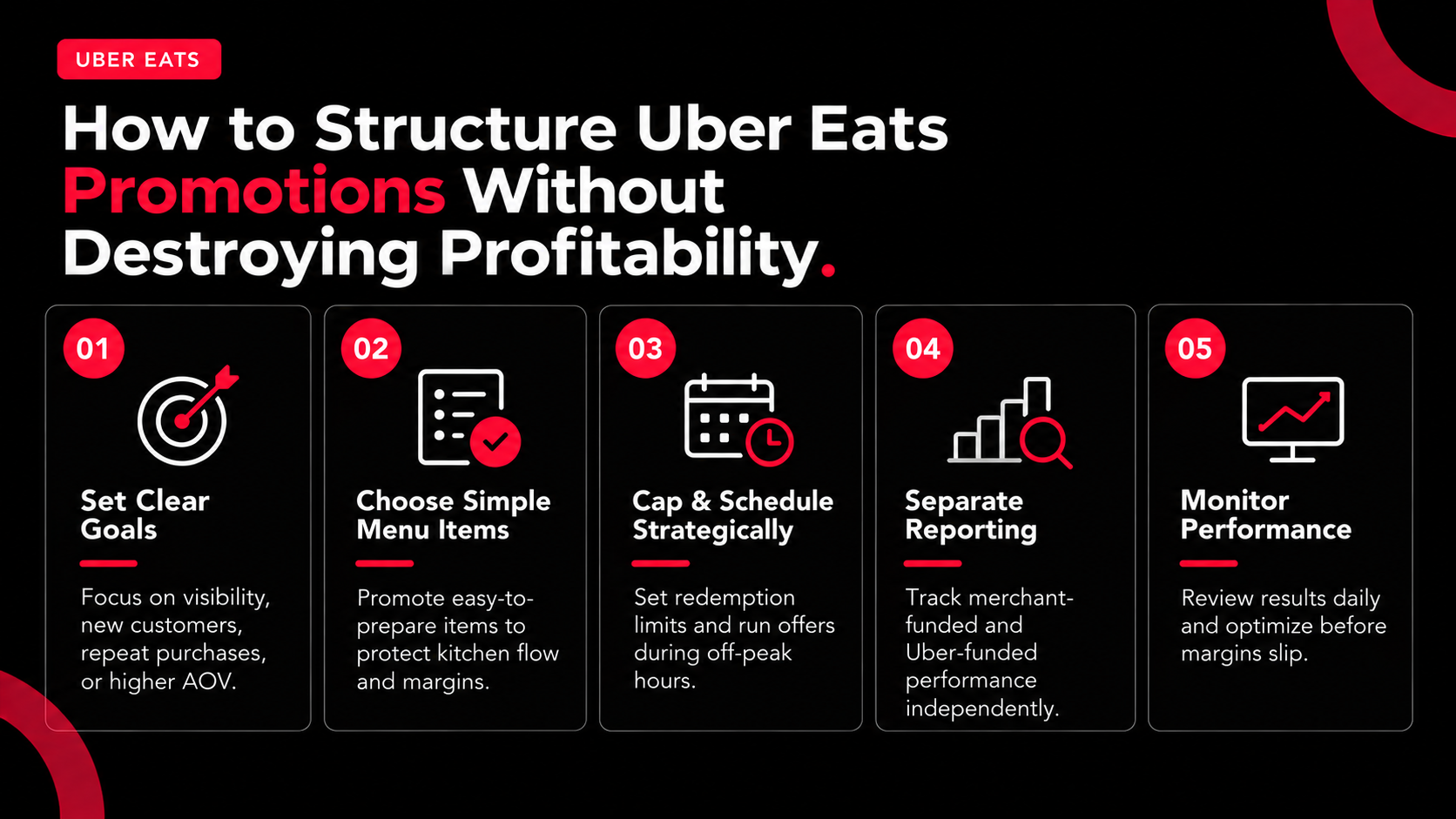
Define one outcome per campaign. A promotion designed for visibility should not be measured the same way as one built for repeat purchases. Strong campaigns usually focus on increasing first-time customers, filling slow dayparts, or lifting average order value.
Operators using uber eats for restaurant expansion should also review onboarding settings before activating offers. Delivery radius, prep times, menu photos, and item availability all influence whether discounts produce profitable volume or operational strain.
Use this framework before activating any offer:
Broad evergreen offers usually underperform. Limited-time campaigns often create healthier uber eats restaurant orders because urgency improves conversion without permanently resetting customer expectations.
Choose Operationally Simple Menu Items
Menu selection is where most profitability problems begin. Many operators underestimate how promotions distort kitchen sequencing rather than just lowering check average. Modifier-heavy discounted items can overwhelm production lines during peak periods.
Promote operationally simple SKUs with shared prep paths. A pizzeria might discount garlic knots instead of custom specialty pizzas. A fast-casual bowl concept might feature preset combos rather than build-your-own meals.
Restaurant owners setting up uber eats for restaurant owners often make the mistake of uploading their entire dine-in menu without adjusting for delivery production speed. Narrowing delivery menus and excluding labor-intensive items usually protects both ticket times and contribution margin.
One Mediterranean chain restricted BOGO offers to weekday afternoons after ticket times climbed during dinner rushes. After shifting the offer to 2pm–5pm, contribution margin improved while maintaining most promo volume.
Cap Redemptions and Schedule Promotions Strategically
Redemption caps protect profitability. The best-performing uber eats promotions usually have hard limits tied to budget, daypart, or customer eligibility. Without caps, operators often subsidize orders they would have received anyway.
According to Uber Eats Merchant Academy, ads and promotions can improve placement visibility inside the app, especially in high-traffic feed positions. That visibility works best during slower operational windows because fixed labor already exists.
Use scheduling intentionally:
Separate Merchant-Funded and Platform-Funded Reporting
Merchant-funded promotions and Uber-funded promotions behave differently. Operators who combine both reporting streams usually misread acquisition costs and repeat behavior. Merchant-funded campaigns may still apply platform fees to post-discount pricing, making reporting accuracy critical.
Uber-funded traffic often produces stronger first-order conversion because those offers reach newer audiences. Merchant-funded discounts can attract lower-intent bargain behavior if targeting stays too broad.
Track these metrics separately for every campaign:
For a deeper breakdown of campaign economics, review this complete Uber Eats promotions guide.
Monitor Campaign Performance Daily
Real-time monitoring is no longer optional. Operators using live campaign analytics usually identify margin problems before promotions spiral out of control. Tools inside Uber Eats Manager, paired with POS platforms like Toast or Square, make same-day optimization possible.
Brands managing multiple locations through one uber eats restaurant account often spend hours reconciling reimbursement disputes, expired offers, and menu syncing errors. Centralized ownership and consistent reporting standards matter as promotional volume increases.
That operational complexity raises additional questions around setup costs, ranking mechanics, and visibility behavior on the uber eats platform.
Frequently Asked Questions
Many searches around uber eats promotions focus on consumer promo codes and free-delivery offers. Restaurants using Uber Eats for my restaurant operations should separate platform-funded discounts from merchant-funded promotions that affect margins. Knowing who funds each offer helps operators evaluate profitability, visibility, and customer value.
Are Uber Eats promotions worth it for restaurants?
Yes, uber eats promotions work when treated as customer acquisition costs instead of blanket discounts. Campaigns tied to high-margin items and repeat orders usually outperform broad percentage discounts. The biggest mistake is measuring only short-term uber eats restaurant orders instead of repeat purchase behavior.
Who pays for Uber Eats promotions?
Restaurants fund most uber eats promotions, though Uber Eats also runs co-funded campaigns and sponsored discounts. Consumer promo codes may be fully funded by Uber Eats or partially subsidized. Separate merchant-funded discounts from platform-funded incentives when measuring margin impact in Uber Eats for my restaurant settings.
Do Uber Eats promotions improve app visibility?
Yes, uber eats promotions can improve visibility because the platform rewards clicks, conversions, and order velocity. Operators using modest offers with strong service metrics often report higher menu impressions. Promotions work best as visibility amplifiers, not substitutes for strong ratings and fast fulfillment.
What's the difference between Uber Eats ads and discounts?
Uber Eats ads buy placement, while discounts reduce customer price sensitivity. Ads in Uber Eats Manager usually use a cost-per-click model, increasing exposure without reducing margin on every order. Targeted uber eats marketing campaigns using sponsored listings plus smaller offers often outperform aggressive discounts alone.
How should restaurants measure repeat-order ROI from Uber Eats campaigns?
Restaurants should track retention, contribution margin, and payback period over 60 to 90 days. Repeat digital customers usually spend more annually than first-time buyers, so retention matters more than short campaign spikes.
When do Uber Eats promotions become unprofitable?
Uber Eats promotions become unprofitable when discount costs exceed lifetime value from retained customers. If contribution margin drops below labor and packaging thresholds, higher uber eats restaurant orders can increase operational strain without improving cash flow.
What's the best way to manage Uber Eats promotions without losing control of margins?
The best way to manage uber eats promotions is to set limits around redemption volume, timing, and customer segments before launch. Successful uber eats marketing depends on disciplined testing, retention goals, and systems that connect delivery demand to long-term customer ownership—and tools like Nabeeats can help streamline that process.
Restaurant owners can also use Uber Eats Manager to adjust campaign settings, pause promotions, review billing activity, and monitor redemption performance. For operational issues, merchants can contact uber eats restaurant support through the in-app help center. Using official uber eats restaurant help channels helps operators keep campaigns aligned with margin targets before scaling promotions.
Make Your Uber Eats Promotions Profitable Long-Term
Uber Eats promotions work best when treated as a customer acquisition investment, not a permanent pricing strategy built around short-term order spikes.
The upside of uber eats promotions is real, but only if retention and operational consistency follow the first order. Audit the last 30 days of campaigns across CAC, average order value, reorder rate, refund volume, and ticket times, then use tools like Nabeeats to automate reporting and retention follow-up.
Restaurants that win on delivery will measure customer quality better, not simply discount harder.
.png)


.png)


