.png)


A 30% commission sounds expensive, but the bigger question behind “uber eats for my restaurant” is whether those extra orders actually produce profitable growth. We’ve seen restaurant owners add Uber Eats, boost delivery sales by 20%+, then watch margins shrink because packaging, labor, refunds, and promo discounts quietly stacked on top of marketplace fees (spoiler: commissions rarely tell the full story).
According to Uber Eats’ 2026 marketplace pricing updates, standard fees now range from 20% to 30%, while industry estimates from Rezku place the effective all-in cost closer to 30% to 40% after processing and operational overhead. This guide will help you evaluate whether Uber Eats creates sustainable profit—or just busier kitchens.
You’ll see:
Next, we’ll break down why the headline commission percentage is often the least important number in the equation.
Is Uber Eats for My Restaurant Profitable After Fees and Delivery Costs?
Uber Eats is profitable for some restaurants only when average order value, menu pricing, and kitchen capacity can absorb a 20% to 30% marketplace fee plus added operating costs.
Uber Eats’ standard Marketplace Fees now range from 20% to 30%. Uber One exposure through Plus-tier placement can push effective marketplace fees toward 30%, far above the older 15% assumptions many operators still use.
Most operators also underestimate the “all-in” delivery cost by 5% to 10% once payment processing, refunds, promos, packaging, and labor are included. Effective delivery costs can reach 30% to 40% after related charges.
What Uber Eats Costs Actually Look Like
Cost ComponentTypical RangeOperational ImpactMarketplace fee20%–30%Largest direct platform expensePayment processing2.5%–3%Reduces contribution marginPromotions & discounts3%–10%Can spike during slow periodsPackaging costs$1–$3 per orderHigher for bowls and combosRefunds & remakesVariableOften tied to delivery qualityExtra labor8–12 hrs weeklyBagging and courier handling
The hidden labor line catches operators off guard most often. Delivery commonly adds 8 to 12 labor hours weekly for sealing bags, staging orders, and coordinating drivers during rushes.
One burger QSR group added Uber Eats across 11 stores and increased delivery sales by 31% within eight weeks. Store-level profit improved only 4% because kitchen utilization was already near capacity and delivery pricing stayed unchanged.
Contribution Margin Matters More Than Sales Volume
Contribution margin is the remaining profit after food, packaging, commissions, and direct labor tied to the order. A restaurant can grow delivery revenue while shrinking margins, especially on low-ticket orders.
| Restaurant Type | Avg. Uber Eats Order | Typical Margin Pressure | Better Fit? |
|---|---|---|
| Pizza & wings | $22–$28 | High commission sensitivity | Only with markup |
| Sushi & family bundles | $45–$70 | Better fee absorption | Often strong |
| Coffee & cafe | $12–$18 | Weak after packaging | Usually difficult |
| Fast casual bowls | $25–$40 | Moderate if optimized | Depends on labor |
Higher average order value usually determines whether uber eats for my restaurant works financially. A sushi operator with $60 family bundles can absorb a 25% fee far more easily than a café selling $14 tickets.
Raising Uber Eats menu prices often protects margins without destroying demand. Many operators maintain order volume with 10% to 18% delivery markups, especially in suburban markets where convenience outweighs price sensitivity.
For many uber eats for restaurant owners, delivery works better as paid customer acquisition than as a pure margin channel. Before enabling heavy discounts, read our breakdown of how promotions affect profitability.
Where High Uber Eats Volume Can Backfire
High order volume does not automatically improve profitability if your kitchen already runs near full utilization. Once a line exceeds roughly 80% peak-hour capacity, delivery orders often create labor inefficiency, slower ticket times, and refund risk.
Want help modeling delivery profitability against your own menu mix and labor structure? See how Nabeeats can help.
How Uber Eats for My Restaurant Changes Customer Reach and Brand Control
Uber Eats works best as a customer acquisition channel rather than a standalone profit center because marketplace exposure can generate incremental demand while limiting direct customer ownership.
Most restaurant owners asking whether to get Uber Eats for my restaurant already understand delivery demand exists. The harder question is whether the platform introduces customers you would not reach on your own. For many independent restaurants, Uber Eats expands geographic and demographic reach faster than paid social ads or direct mail.
We've seen this with operators at Nabeeats, especially in apartment-heavy trade areas where convenience drives ordering behavior. A pizza and wings franchisee in the Midwest assumed Uber Eats would cannibalize direct online ordering, but over 12 weeks, direct orders fell only 6% while total delivery transactions increased 24%. Most incremental demand came from customers who had never visited the restaurant before.

Why Marketplace Reach Still Matters
Restaurant Business Online reported in 2021 that Uber Eats marketplace tiers were designed to improve discovery through promoted placement and Uber One exposure. Discovery—not delivery logistics—is often the real value proposition. An Uber Eats restaurant listing functions like paid search placement inside a high-intent food marketplace.
Operators often miscalculate the tradeoff by comparing commission costs against existing direct orders instead of comparing them against the cost of acquiring a new customer through Meta ads, Google Ads, direct mail, or local sponsorships. A new customer acquired through Instagram ads can easily cost $15 to $35 before converting.
The upside is meaningful reach expansion, but marketplaces still control the customer relationship. You do not fully own the email address, ordering behavior, or remarketing path the way you do through first-party ordering. Relying entirely on marketplace demand creates long-term brand risk.
Why Cannibalization Fears Are Often Overstated
Many operators assume every Uber Eats order replaces a direct order. In practice, that rarely happens at the rate owners fear.
Businesses most worried about cannibalization usually had weak digital discovery before joining delivery apps. They were not losing direct customers—they simply were not visible enough online. Marketplace demand often behaves more like paid acquisition than customer theft.
A multi-unit sushi operator we advised initially rejected Uber Eats because leadership assumed premium customers would not order delivery. After launching at three suburban stores, Uber Eats generated 18% new-customer acquisition over 90 days. Family bundles also increased average ticket size by 11% compared to dine-in purchases.
Not every concept benefits equally. Restaurants with loyal direct-order audiences or strong neighborhood density may see more overlap. Operators with thin margins also need tighter pricing architecture because Uber Eats commissions commonly range from 20% to 30% before additional promotion costs.
The Smartest Operators Build an Exit Path
The best operators do not treat Uber Eats as the final destination—they treat it as the top of the funnel.
Commission-free first-party ordering platforms have gained traction because restaurants want customer ownership back after acquisition. Instead of abandoning marketplaces, many restaurants now use hybrid models: acquire through Uber Eats, then drive repeat orders through branded ordering, SMS offers, loyalty programs, and email campaigns.
A regional cafe group we worked with inserted QR-coded bounce-back offers into every delivery bag. Customers who reordered directly within 14 days received a free appetizer. Repeat direct ordering climbed because the restaurant gave customers a reason to leave the marketplace ecosystem. Retention systems like this often matter more than adding another delivery app.
If you're evaluating how promotions affect profitability, visibility, and reorder behavior, this breakdown of how promotions affect profitability explains where many operators lose margin without realizing it.
Want help implementing this? See how Nabeeats can help.
Still, acquisition strategy alone will not determine whether delivery succeeds. Kitchen throughput, packaging flow, menu design, staffing, and courier coordination usually decide whether incremental orders become sustainable profit or operational chaos.
Operational Problems Restaurant Owners Underestimate With Uber Eats
The biggest operational challenges with Uber Eats are labor strain, menu synchronization, packaging workflow, and food-quality degradation during delivery. Most operators evaluating uber eats for restaurant owners focus on commission percentages first, then discover the real pressure appears during dinner rush when tickets stack, couriers arrive early, and dine-in guests still expect normal service.
Problem: Delivery Orders Quietly Add Labor You Didn’t Budget For
Delivery assembly is labor. Courier coordination is labor. Packaging drinks, sealing bags, and handling remake requests count too.
Many stores underestimate delivery-related labor by 8 to 12 hours weekly per location once Uber Eats volume stabilizes. The hidden cost usually isn't cooking food — it's managing the handoff process efficiently. High-volume stores often lose 20 to 30 seconds per order because packaging stations are disorganized.
One poke bowl chain treated delivery tickets as secondary during lunch peaks. Missing modifiers affected about 7% of tickets, triggering refunds and complaints. After adding a dedicated expo role from 11 a.m. to 1:30 p.m., complaint rates dropped sharply and monthly store profit improved despite higher labor costs.
Operators who handle this well usually make three changes quickly:
Small workflow adjustments often outperform expensive staffing changes.
Problem: Menu Synchronization Breaks More Often Than Owners Expect
Menu synchronization means keeping your POS, Uber Eats menu, modifiers, and inventory aligned in real time. Sounds simple. It rarely is.
Multi-unit operators using Toast, Square, or Clover integrations still run into sold-out items staying live because inventory syncing lags. Restaurant owners routinely lose hours weekly fixing pricing mismatches and unavailable modifiers. The larger problem is customer frustration when orders can't be fulfilled correctly.
A Mediterranean concept in Texas had strong in-store reviews, but lower Uber Eats ratings because modifiers and unavailable items created fulfillment errors during busy periods. Once the team simplified the delivery menu and limited seasonal promotions, refunds dropped within one quarter.
Our team at Nabeeats recommends middleware or direct POS integrations that auto-sync inventory and pricing whenever possible. Simpler delivery menus consistently outperform oversized menus operationally.
Problem: Some Dine-In Favorites Fail Completely in Delivery
A delivery-friendly menu is engineered for travel time, moisture retention, and holding temperature—not just popularity inside the restaurant.
Many operators upload their full dine-in menu into the uber eats restaurant platform without testing how items hold after 20 minutes in transit. One fast-casual brand discovered fries and grilled proteins lost texture after 18 to 22 minutes, contributing to a major reorder decline compared to pickup customers.
Food quality degradation destroys repeat ordering faster than pricing does. Switching to vented packaging and removing two high-failure menu items reduced refunds by 38% within one quarter.
The restaurants that succeed with delivery usually create a separate menu engineered for transport:
This also protects profitability when you're experimenting with how promotions affect profitability.
Result: Smaller Delivery Radiuses Often Produce Better Economics
Counterintuitively, smaller delivery radiuses often outperform broader coverage areas. Long travel times hurt food quality, increase refunds, and lower ratings faster than most operators expect.
We advised a sushi operator that initially accepted a wide delivery zone to maximize volume. Sales increased, but late deliveries caused remake costs and complaints to climb. After tightening the radius and focusing on nearby neighborhoods, ratings improved and higher-ticket family bundles became more consistent.
Higher order volume doesn't always create better operational outcomes. Restaurants with tight delivery zones often perform better because fulfillment metrics stay stronger, which can improve marketplace visibility over time.
The operational risks don't automatically mean Uber Eats is a bad fit. They mean you need a disciplined framework for deciding whether your restaurant model, staffing structure, and menu can support delivery profitably before scaling too aggressively.
Should I Get Uber Eats for My Restaurant? A 5-Step Decision Framework
Restaurant owners should evaluate Uber Eats using a framework that measures contribution margin, kitchen capacity, delivery menu fit, and customer acquisition value before signing up. The decision depends less on sales volume and more on whether delivery orders remain profitable after commissions, packaging costs, refunds, and operational strain.
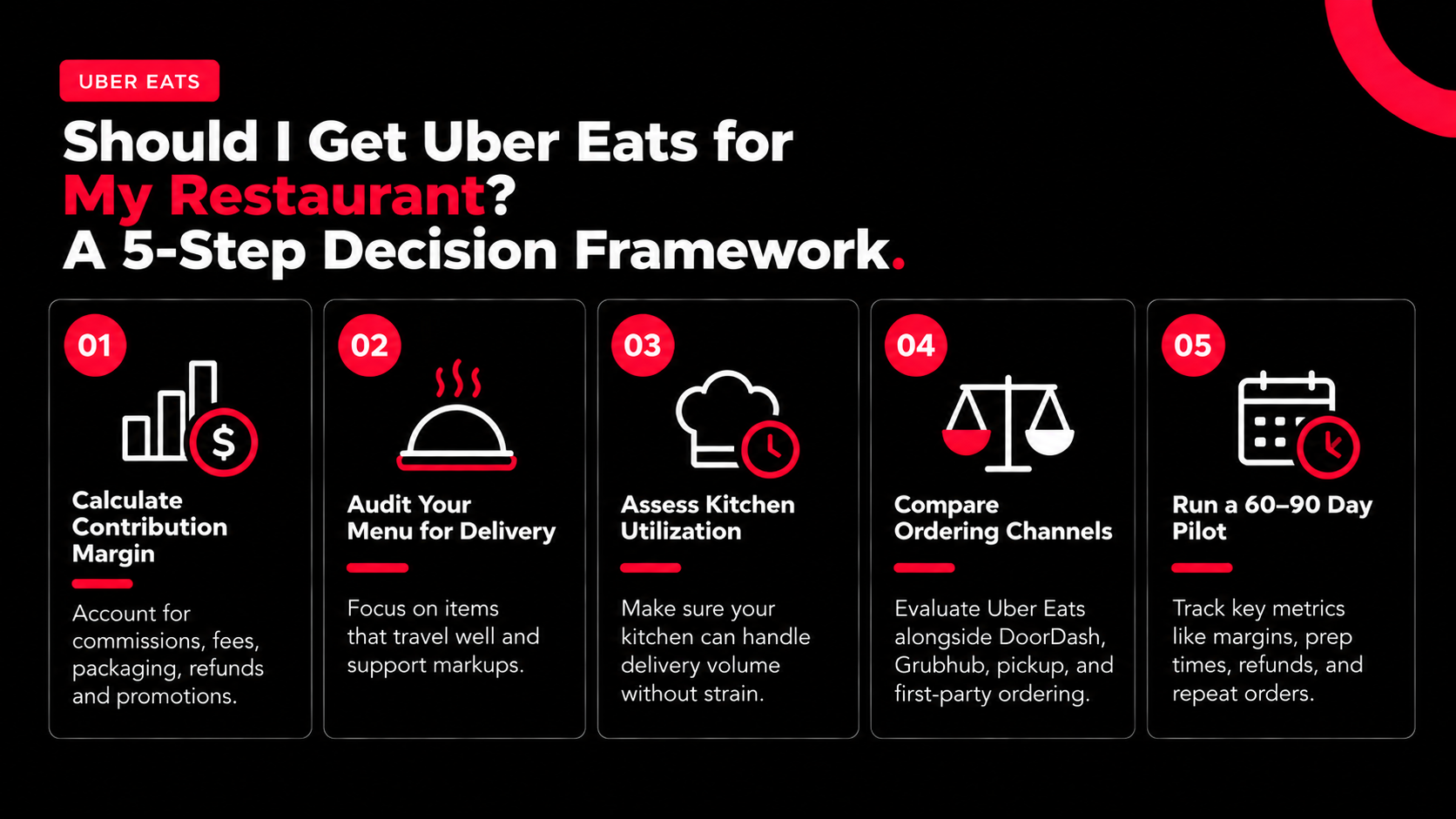
Calculate Contribution Margin by Delivery Order
Start with contribution margin, not gross sales. Uber Eats marketplace fees in 2026 range from 20% to 30% depending on plan structure and Uber One exposure. A $42 delivery order can shrink quickly once commissions, processing fees, refunds, packaging, and promo discounts are applied.
Operators struggling with uber eats for my restaurant decisions often focus only on topline revenue. One pizza chain increased delivery transactions 24% in 12 weeks, but profits improved only after marketplace pricing rose 14% to offset fees. Small pricing adjustments can materially change margins.
Audit Whether Your Menu Travels and Supports Markups
Delivery-friendly menus consistently outperform oversized menus. Items that lose texture, temperature, or presentation during a 20-minute trip usually hurt repeat ordering faster than higher pricing does.
A Mediterranean fast-casual brand removed two weak delivery items and switched to vented packaging, cutting refunds 38% within one quarter. Delivery markups between 10% and 18% also held better than expected in suburban markets.
Before you get uber eats for my restaurant operations fully live, test:
Assess Kitchen Utilization Before Onboarding
Kitchen utilization is the filter many operators skip. If your line already runs near capacity during dinner rushes, delivery volume can dilute profit instead of improving it.
One burger QSR group added Uber Eats across 11 stores and increased delivery sales 31% within eight weeks. Profit improved only 4% because labor efficiency collapsed once kitchens exceeded roughly 80% utilization. In some cases, limiting delivery windows creates better economics than adding labor.
Compare Uber Eats Against Other Ordering Channels
You shouldn't evaluate Uber Eats in isolation. DoorDash, Grubhub, pickup ordering, and first-party systems create different tradeoffs around fees, visibility, and customer ownership.
Uber Eats pickup still carries 7% to 10% commission fees. Review how promotions affect profitability before assuming marketplace visibility offsets margin pressure.
Run a 60-90 Day Pilot Before Scaling
A controlled pilot is the safest way to evaluate uber eats for my restaurant economics. Track delivery-specific KPIs weekly instead of assuming early order spikes equal sustainable profit.
Measure contribution margin, prep times, refund rates, repeat ordering, and labor impact by daypart. Restaurants already struggling on weekends may get cleaner data from a smaller pickup-only test first.
Frequently Asked Questions
Can Uber Eats commissions be negotiated?
Yes. Uber Eats commissions are sometimes negotiable, especially for multi-location operators or restaurants in competitive delivery markets. Most independent restaurants report rates between 15% and 30%. Restaurants with strong local demand, high order values, or existing DoorDash and Grubhub volume usually have more leverage during negotiations.
Why does Uber Eats pickup still have fees?
Uber Eats pickup orders still carry fees because the platform charges for marketplace exposure, payment processing, and order management tools, not just delivery. Uber Eats for restaurant owners often includes pickup commissions ranging from 6% to 15%. Pickup is simpler than delivery, but margins can still shrink if menu pricing ignores platform costs.
Is Uber Eats better than first-party delivery for small restaurants?
Uber Eats is usually better for customer acquisition, while first-party delivery is stronger for long-term profit retention. A small restaurant using Uber Eats restaurant tools can reach local users immediately, but direct ordering platforms often preserve 15% to 30% more margin per order. Many restaurants use Uber Eats for discovery, then push repeat customers toward direct ordering through SMS and loyalty programs.
How long should restaurants test Uber Eats before deciding if it works?
Restaurants should test Uber Eats for at least 60 to 90 days before judging ROI because order volume, reviews, and ranking placement need time to stabilize. A two-week trial rarely provides reliable data. Nabeeats recommends tracking repeat order rates, prep times, refund percentages, and contribution margin weekly instead of focusing only on gross sales.
Should restaurants raise prices on Uber Eats menus?
Yes, most restaurants should raise Uber Eats menu prices modestly to offset commissions and packaging costs. Delivery-specific markups between 10% and 20% have become common across major marketplaces. Many uber eats for restaurant owners apply flat markups across every item instead of adjusting pricing by margin and delivery durability.
What types of restaurants usually struggle with Uber Eats?
Restaurants with low-margin menus, long ticket times, or highly customized orders usually struggle most with Uber Eats profitability. Breakfast diners, premium steakhouses, and labor-intensive scratch kitchens often see delivery strain offset sales gains unless they streamline menus aggressively.
What’s the safest way to get Uber Eats for my restaurant without overcommitting?
The safest way to get Uber Eats for my restaurant is to launch with a limited delivery radius, a reduced menu, and clear profitability targets before expanding. Success depends on operational fit, pricing discipline, and whether marketplace customers become repeat direct buyers.
Making the Right Uber Eats for My Restaurant Decision
Uber Eats can grow sales, but whether uber eats for my restaurant makes financial sense depends on margins, kitchen capacity, and your ability to convert marketplace traffic into repeat direct customers.
Uber Eats’ 2026 fee structure commonly ranges from 20% to 30%, with effective costs reaching 40% after promotions and processing. Restaurants with strong delivery economics and available kitchen throughput benefit most, while thin-margin or overloaded operations usually need a cautious approach.
Track one delivery KPI dashboard for four weeks, then use Nabeeats to convert marketplace buyers into commission-free repeat customers while monitoring exactly how promotions affect profitability.
.png)


.png)


