.png)


42% of restaurant operators said they weren’t profitable in 2025, according to the State of the Restaurant Industry 2026 report—and that pressure is hitting every uber eats only restaurant model entering 2026. Lower rent sounds like an easy margin win, but 20% to 30% marketplace commissions, promo costs, refunds, and packaging often erase the savings faster than founders expect.
In our work with ghost kitchen operators, we’ve seen brands generate strong top-line delivery sales while quietly running single-digit margins (and sometimes negative cash flow). The operators still winning in 2026 treat delivery as an operations business first, not a growth hack. This article breaks down the real economics behind Uber Eats-exclusive concepts, how kitchen systems affect ranking and repeat orders, where platform dependency becomes risky, and why more founders now prioritize first-party ordering ownership alongside marketplace visibility.
Because for delivery-only brands, headline revenue rarely tells you whether the business actually works.
Is an Uber Eats Only Restaurant Still Profitable in 2026?
An uber eats only restaurant can still be profitable in 2026, but most viable operators need strong contribution margins, disciplined labor control, and enough order volume to absorb marketplace fees that often consume 25% to 40% of revenue.
An uber eats only restaurant is a delivery-first concept that routes nearly all sales through apps like Uber Eats rather than serving dine-in traffic. That distinction matters. A hybrid fast-casual restaurant may treat delivery as 20% to 40% of revenue, while a true delivery-only operation pushes almost 100% of sales through the uber eats restaurant platform. When every dollar flows through a marketplace, commissions stop being a side expense and become the core economic variable.
According to Food on Demand's 2026 fee analysis, Uber Eats marketplace commissions now range from 20% to 30% depending on the merchant plan and order type. Uber Eats Lite increased from 15% to 20%, while Premium remains around 30% for many operators. Once you add sponsored listings, refunds, packaging, payment processing, and promo subsidies, effective delivery costs can climb to 30% to 40% per order. Foodshot.ai's 2026 ghost kitchen guide confirmed that blended delivery costs regularly land inside that range for high-volume delivery brands.
Uber Eats-Only vs Hybrid Restaurant Economics
ModelRevenue SourceTypical Marketplace ExposureFixed CostsMargin RiskUber Eats-only ghost kitchen90%-100% deliveryVery highLower rentPlatform fees compress profitHybrid dine-in restaurantMixed dine-in and deliveryModerateHigher occupancy costsMore diversified revenueCommissary multi-brand kitchenShared virtual brandsHighShared labor and prepComplexity risk rises fastSelf-delivery operatorUber Eats demand plus in-house driversMediumHigher labor coordinationBetter fee control
Here's the contrarian reality most founders miss: lower rent doesn't automatically create a healthy business. Platform commissions can erase the savings from skipping a dining room—especially in dense urban markets with aggressive promo competition. The SSRN study "Uber Your Cooking" highlighted reduced fixed costs as a major advantage for ghost kitchens, but the same economics weaken quickly once operators rely heavily on paid app visibility.
We've seen this play out with business owners and decision-makers clients at Nabeeats. One Midwest operator reduced occupancy costs by nearly 40% after moving into a commissary kitchen, yet their store-level margin barely improved because Uber Eats ads consumed another 12% of gross revenue during launch months. Volume increased. Cash flow didn't.
A Realistic Uber Eats Contribution Margin Example
A common mistake is evaluating an uber eats only restaurant using gross sales instead of contribution margin. According to Zayos, a ghost kitchen processing 1,200 monthly uber eats restaurant orders at a $30 average ticket generates $36,000 in monthly sales, or $432,000 annually. At a blended marketplace cost of 25% to 35%, that operator could pay roughly $129,600 per year in commissions and delivery-related platform fees alone.
Use this simplified monthly model:
That leaves an operating margin near 8% before taxes, equipment replacement, and unexpected refund spikes. Thin margins. Very thin.
The upside is that some operators still outperform traditional restaurants despite compressed percentages. According to the NCAER 2025 assessment, platform restaurants often report higher total net profits even while carrying lower net profit margins. More orders can spread fixed labor and prep costs across higher volume, which explains why some delivery-first concepts still scale aggressively.
When an Uber Eats Only Restaurant Actually Works
Profitability becomes realistic when operators control complexity early. According to a 2026 executive brief cited by Restaurantecercademi, ghost kitchens become sustainable when contribution margin clears 18% after aggregator fees and order volume reaches at least 40 orders per day per virtual brand within 90 days. That's a meaningful benchmark—not vanity revenue.
In our work with operators, the strongest performers usually share three traits:
That last point matters more every year. NCR Voyix consumer research found that 58% of customers prefer ordering directly from restaurants instead of marketplaces. The most durable operators use Uber Eats for discovery, then shift repeat customers into owned ordering systems where commissions disappear. If you need a broader delivery marketplace platform overview, study how fee structures and integrations shape long-term retention economics.
This approach works best for brands with operational discipline and repeat-friendly food categories like bowls, pizza, wings, and burgers. If you're building a highly customized menu with fragile packaging requirements, profitability becomes harder fast (and yes, small kitchens feel this pressure even more).
The next challenge isn't just attracting orders. It's protecting those margins once real kitchen operations, prep-time volatility, and delivery execution start affecting every ticket.
How Ghost Kitchen Operations Affect Uber Eats Restaurant Orders
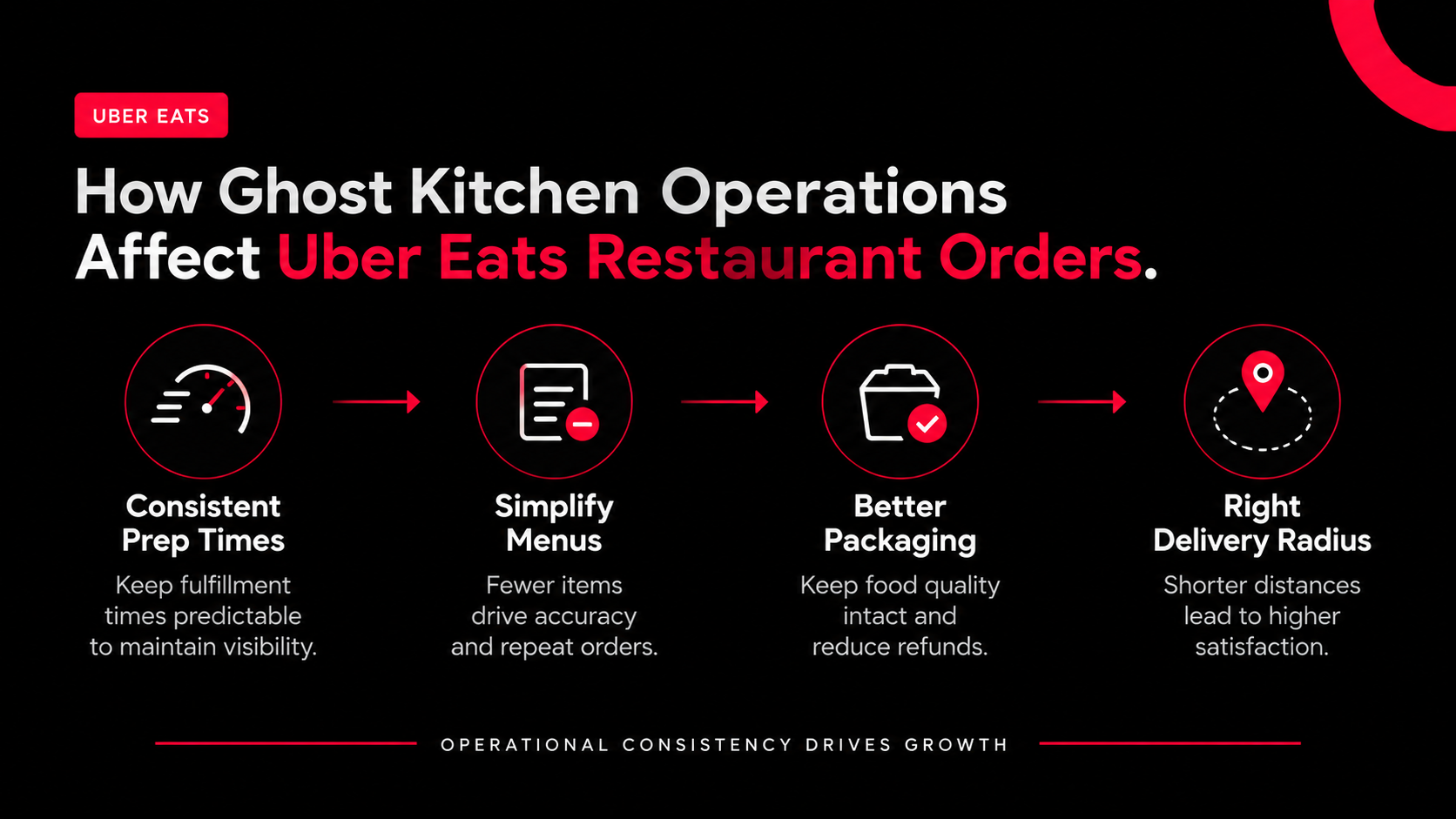
Uber Eats restaurant orders are heavily influenced by operational consistency, because delayed prep times, weak packaging, and oversized menus reduce app visibility, increase refunds, and lower repeat purchase rates. The uncomfortable reality for many delivery-first founders is that Uber Eats rewards predictable kitchens more than creative ones. Operational discipline drives marketplace growth more reliably than concept novelty.
Problem: Prep-Time Volatility Quietly Kills Order Flow
We've seen this play out with business owners and decision-makers clients running multi-brand ghost kitchens in dense delivery zones. A kitchen that swings from a reliable 15-minute prep time to inconsistent 20-35 minute ticket times can lose ranking visibility within days, especially during dinner rushes. According to operational benchmarks from recent ghost kitchen operator guidance, unstable prep estimates can reduce organic order flow by 15-25% before most founders even notice the decline. Uber Eats ranking systems heavily favor kitchens with predictable fulfillment performance.
One Midwest operator we worked with launched five virtual brands from a single line station to maximize marketplace exposure. Within 90 days, prep times climbed from 14 minutes to 27 minutes during peak periods, driver wait times increased, and Uber Eats restaurant orders started falling despite aggressive in-app promotions. The ownership team expected more brands to create more demand. Instead, complexity crushed throughput.
What changed the business was surprisingly simple—cutting from five brands down to two. Weekly sales increased 18% over six weeks because operational consistency improved search placement, order accuracy, and repeat purchases. Adding more virtual brands often reduces total profit instead of increasing it.
Approach: Simplify Menus and Engineer for Repeatability
Menu simplification is one of the highest-ROI operational changes available to restaurants for Uber Eats. In our work with operators using Toast, Deliverect, and Uber Eats Manager, the kitchens with the strongest repeat-order metrics usually run highly standardized menus with overlapping ingredients and narrow cook-time variance. Boring? Sometimes. Profitable? Frequently.
A delivery-only chicken concept in the Northeast learned this the hard way. Their menu had 42 items, multiple modifiers, and inconsistent station workflows (honestly, this is where most teams lose control). They were spending 14% of gross sales on sponsored listings while already carrying roughly 28% platform commission costs.
After reducing the menu to 17 items, prep errors dropped nearly 40% and 60-day reorder rates increased from 21% to 34% within one quarter. Repeat ordering improves when kitchens reduce operational friction, not when they endlessly expand choice.
Here’s the framework our team at Nabeeats recommends for delivery-first kitchens:
According to a 2026 executive brief cited by Restaurantecercademi, ghost kitchen scale works best when two brands share one production line and food-cost variance stays tightly controlled. Operational overlap matters more than brand count.
Want help implementing this? See how Nabeeats can help.
Result: Packaging and Delivery Radius Became Profit Drivers
Most founders treat packaging as a commodity expense. That's a mistake.
A Southeast Asian rice bowl concept operating from a California commissary kitchen had strong in-store taste tests but weak Uber Eats ratings. We discovered their packaging trapped steam during 18-22 minute deliveries, causing soggy proteins and texture breakdown. After redesigning venting patterns and separating sauces into side containers, ratings improved from 4.1 to 4.6 over 10 weeks while refund requests dropped 31%. Packaging changes often improve profitability faster than recipe changes.
Delivery radius creates a similar hidden problem. We've seen repeat purchase rates fall by 10-14 percentage points once average delivery distances crossed roughly five miles in suburban markets. Longer trips increase driver batching, food degradation, and handoff delays—even if the initial order still looks profitable.
The counterintuitive insight is this: the most profitable Uber Eats-only restaurants in 2026 are often operationally boring. They sell food that travels well, uses repeatable assembly systems, and survives 25 minutes inside a delivery bag without collapsing in quality. Think rice bowls, wings, wraps, and standardized burger builds—not fragile tasting-menu concepts with complicated plating.
This approach works best for operators optimizing retention economics and throughput. If you're running a premium chef-driven concept, strict Uber Eats exclusivity may limit your ability to control guest experience over time. The kitchens winning long term aren't maximizing creativity; they're maximizing consistency, reorder rates, and fulfillment reliability.
That operational reality leads directly to the next question: if marketplace algorithms control visibility, customer access, and margins simultaneously, how sustainable is an Uber Eats-exclusive business over the long run?
Uber Eats Only Restaurant vs Multi-Platform Delivery Strategy
An Uber Eats-exclusive strategy can accelerate launch speed, but multi-platform and first-party ordering models usually create stronger long-term margins because they reduce customer acquisition dependency on a single marketplace.
Founders often treat the choice as operationally simple: stay exclusive to one app for focus, or spread across several apps for reach. The real decision is about dependency risk and customer ownership. An uber eats only restaurant can launch quickly and benefit from concentrated reviews, ad spend, and ranking velocity inside one marketplace. The tradeoff appears later—when one algorithm update, fee increase, or visibility drop affects revenue.
StrategyPrimary AdvantageMain RiskMargin ImpactBest FitUber Eats only restaurantFaster launch and operational focusTotal platform dependencyLower long-term marginsEarly-stage single-market conceptsMulti-platform deliveryBroader customer reachMore operational complexityMore stable revenue mixGrowth-stage ghost kitchensFirst-party ordering + delivery appsCustomer ownership and retentionRequires marketing infrastructureHighest long-term margin potentialBrands with repeat-order demandHybrid approachDiscovery plus owned retentionNeeds disciplined CRM executionBalanced acquisition economicsMature delivery-first operators
Marketplace concentration works best when speed matters more than retention economics. Focused concepts in dense urban markets often gain traction faster by concentrating reviews and sponsored listings on one uber eats restaurant platform instead of splitting volume across multiple channels.
Uber Eats marketplace fees typically range from 20% to 30% per order subtotal. Food on Demand's 2026 fee analysis found some Uber One orders push commissions close to 30%. For a ghost kitchen processing 1,200 monthly orders at a $30 average ticket, annual marketplace fees can exceed $129,000. That becomes a central financial variable, not a minor operating expense.
Why Platform Dependency Changes the Math
A delivery-only restaurant routes most revenue through aggregators, so platform fees apply to nearly every dollar earned. That creates a structurally different business than a dine-in restaurant using delivery apps as a supplemental channel. According to the NCAER 2025 platform assessment, operators on delivery marketplaces often generate higher sales but lower net margins.
Platform dependence compounds over time.
At Nabeeats, we've seen operators assume repeat orders would naturally improve profitability after customer acquisition. Instead, many discover they're repeatedly renting the same customer from the platform because they don't control retention channels.
One owner we worked with spent 14% of gross sales on sponsored placements inside Uber Eats while also paying a 28% platform commission. The business looked healthy from a revenue perspective but produced weak store-level cash flow. After introducing direct reorder incentives through SMS and email, repeat economics improved within one quarter.
Why First-Party Ordering Is Becoming More Important
First-party ordering means customers order through your website or branded flow instead of a marketplace app. That distinction matters because ownership of customer data changes retention economics dramatically.
58% of consumers prefer first-party ordering channels. NCR Voyix 2024 consumer research found most customers would rather order directly when the experience feels convenient. That shifts the strategic question away from marketplace reach and toward customer migration.
The strongest operators now use a simple framework:
The best delivery brands don't optimize for platform exclusivity—they optimize for direct reordering.
A multi-platform strategy does create operational friction. Menu syncing issues, modifier inconsistencies, and refund disputes can consume management time across multiple brands. Operators using Toast, Deliverect, Otter, or Square integrations usually manage this complexity better because menu architecture stays centralized.
A single-platform approach can still outperform diversified delivery during tightly controlled launch phases. If you're validating one concept in one trade area with limited labor, concentrating operational focus may produce cleaner execution and stronger rankings initially.
Still, the long-term trend points toward ownership. Commission-free ordering systems, branded loyalty programs, and CRM-driven reordering increasingly determine whether delivery-first brands build durable margins or simply generate marketplace revenue for someone else.
For founders evaluating scalability, the better question isn't "Which app should I use?" It's this: how quickly can your business reduce marketplace dependency without losing order volume?
How to Build a Profitable Uber Eats Only Restaurant Model
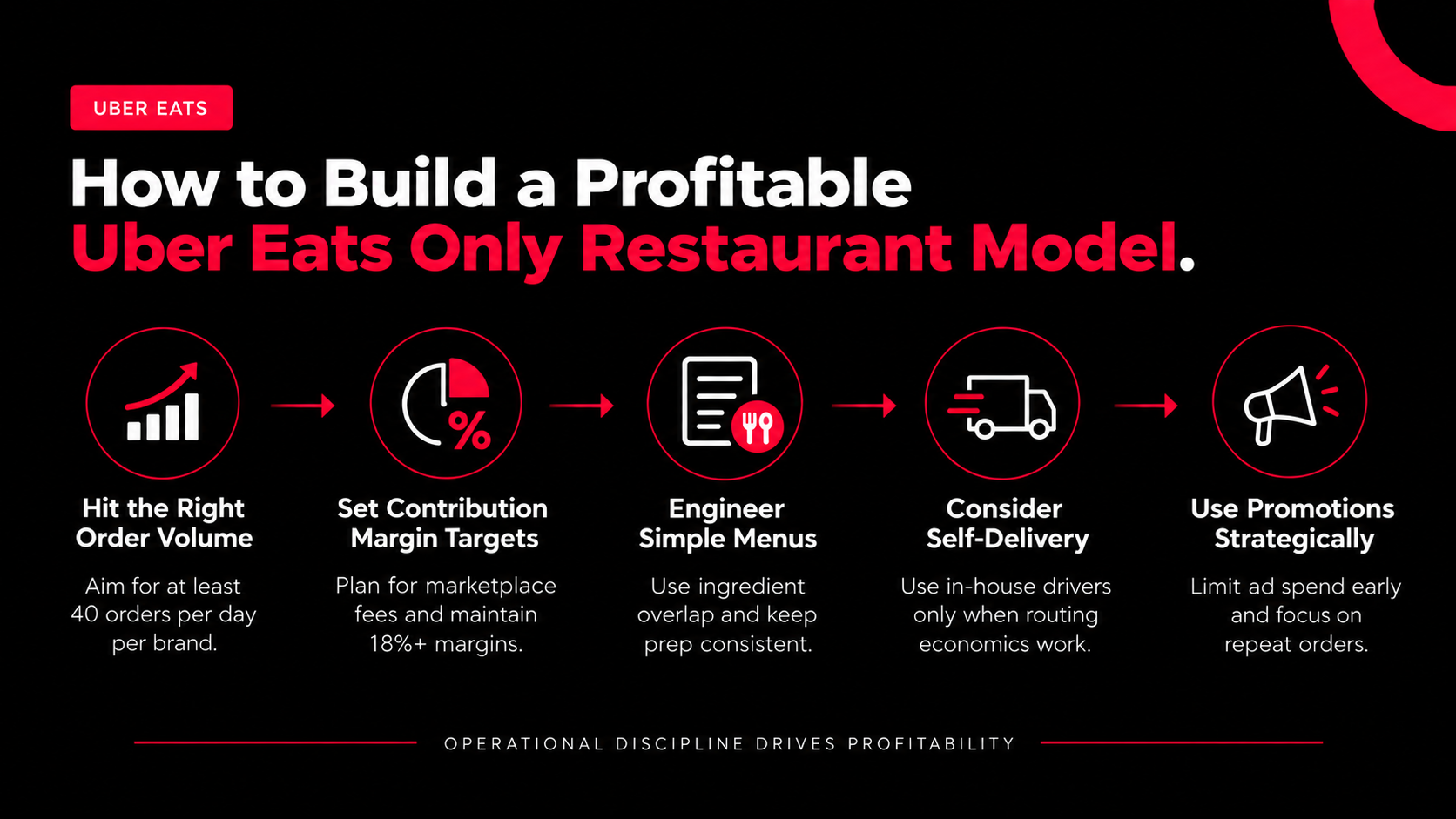
A profitable uber eats only restaurant model usually requires at least 40 daily orders per virtual brand, disciplined menu engineering, and post-commission contribution margins above 18% before scaling.
The 40-order benchmark matters because low-volume delivery brands rarely absorb marketplace costs efficiently. According to a 2026 executive brief from Restaurantecercademi, operators should target at least 40 orders per day per brand within 90 days while maintaining contribution margins above 18% after Uber Eats commissions.
Set Contribution Margin Targets Before Launch
Start with contribution margin, not gross sales projections. Food on Demand and RestoLabs estimate Uber Eats marketplace fees at roughly 20% to 30% of order subtotal in 2026, while Foodshot.ai estimates total delivery costs can reach 30% to 40% once promotions, refunds, and payment processing are included.
Your launch model should assume fee pressure from day one. A brand generating $30,000 monthly sales at a 10% contribution margin leaves only $3,000 before fixed overhead. That's thin for operators building restaurants for Uber Eats exclusively.
Use this pre-launch framework:
Brands that survive usually reject weak economics early instead of hoping volume fixes them later.
Engineer Menus Around Kitchen Simplicity
Menu engineering is operational design. The most profitable delivery brands often look operationally simple because standardized prep wins on the Uber Eats restaurant platform.
Ingredient overlap protects margins more effectively than menu variety. Restaurantecercademi's 2026 guidance found scaling becomes more viable when two brands share one production line and maintain food-cost variance below 3 percentage points. Shared sauces, proteins, and prep stations reduce labor volatility during rush periods.
A Midwest ghost kitchen operator running five virtual brands from one line station saw prep times climb from 14 minutes to 27 minutes during dinner service. Rankings dropped because delivery estimates became unreliable. After reducing operations to two tightly engineered brands, weekly sales increased 18% over six weeks because fulfillment consistency improved.
Build menus using three operational filters:
A Chicago bowl concept improved attachment rates from 9% to 26% by adding packaged desserts and bottled drinks that required no extra cook time.
Use Self-Delivery Selectively to Improve Margins
Self-delivery means using your own drivers while still acquiring orders through Uber Eats. According to Food on Demand, operators using self-delivery typically pay around 15% platform fees instead of the standard 20% to 30% marketplace commission.
Self-delivery only works when routing economics stay disciplined. If labor and mileage costs exceed the commission savings, the model breaks quickly, especially in suburban markets with longer drive times.
One operator reduced blended delivery costs by roughly 8 percentage points after shifting dense lunch zones to in-house drivers. Their average delivery radius stayed under four miles, driver utilization remained high, and refund rates fell because handoff timing became more predictable.
This approach works best for high-density urban zones or repeat lunch corridors. In sprawling suburban territories, marketplace delivery often remains more efficient despite higher fees.
Control Sponsored Listings and Promotion Spend
Sponsored listings can accelerate launch visibility, but they become dangerous when operators use ads to compensate for weak retention.
Paid visibility becomes unprofitable when acquisition costs exceed repeat-order value. Some brands spend 14% of gross sales on sponsored listings while already paying 28% marketplace commissions. Those businesses generate top-line growth with little cash flow.
Instead, treat promotions as temporary demand accelerators. Launch with limited sponsored placement for the first 60 to 90 days, then evaluate reorder behavior carefully. If repeat rates remain weak, fix operations before increasing ad spend.
A practical benchmark:
For a broader delivery marketplace platform overview, founders should understand how ranking systems, integrations, and fulfillment metrics interact before scaling ad budgets.
Build Operational Discipline Before Expanding
Expansion should happen only after operational metrics stabilize for at least one full quarter.
The strongest uber eats only restaurant operators scale systems before they scale brand count. NCR Voyix consumer research cited in 2026 operator guidance found 58% of customers prefer first-party ordering channels. Long-term margin strategy cannot depend entirely on marketplace discovery.
Track these metrics weekly before opening another virtual concept:
Operators who ignore those signals usually discover instability late, after rankings soften, refund rates rise, and paid acquisition starts masking operational decline.
Why Many Restaurants for Uber Eats Fail After Initial Growth
Many restaurants for Uber Eats fail because rising order volume often hides weakening contribution margins caused by commissions, advertising, operational complexity, and inconsistent fulfillment quality.
Growth often looks healthy on the surface. A kitchen can post 25% month-over-month increases in Uber Eats restaurant orders while cash flow deteriorates underneath. Higher order count does not automatically create a healthier business. According to Foodshot.ai's 2026 delivery economics guide, total delivery costs can reach 30% to 40% per order once commissions, payment processing, refunds, and promotions stack together.
We've seen this repeatedly with operators at Nabeeats. One delivery-only chicken concept spent 14% of gross sales on sponsored listings while already paying a 28% platform commission. Their acquisition costs consumed almost every first-time order. After reducing ad spend and shrinking the menu from 42 items to 17, 60-day reorder rates climbed from 21% to 34% because operational consistency improved.
Ranking Volatility Creates Invisible Revenue Risk
Marketplace rankings are more fragile than many founders expect. Uber Eats rewards predictability as much as popularity. A kitchen that slips from stable 15-minute prep times into inconsistent 25-minute windows can lose organic visibility within days.
Ranking volatility behaves like paid rent inside the app ecosystem. Once discoverability falls, operators often compensate with heavier advertising, discounts, or wider delivery zones that create even more fulfillment problems. According to Food on Demand's 2026 fee analysis, Uber Eats marketplace commissions commonly range from 20% to 30% before advertising costs.
A two-location burger ghost kitchen in Texas demonstrated this clearly. They extended service until 2 a.m. expecting incremental profits, but orders after 11 p.m. produced negative contribution margin after labor premiums, refunds, and remake costs. Cutting late-night hours improved EBITDA by 11% despite lower gross revenue.
Operational Complexity Creeps Up Fast
Complexity is the hidden tax inside delivery-only operations. Founders launch additional virtual brands believing more storefronts create more visibility, but the backend often breaks first.
In our work with operators managing three to five virtual brands, we routinely see:
Operational complexity destroys margins gradually. One Midwest operator launched five concepts from a single line station and watched prep times rise from 14 minutes to 27 minutes within 90 days. After consolidating back to two brands, weekly sales increased 18% because rankings, fulfillment accuracy, and repeat ordering stabilized.
That pattern matters because marketplace algorithms reward reliability. According to a 2026 executive brief cited by Restaurantecercademi, shared production lines only scale efficiently when food cost variance stays below 3 percentage points between brands.
Refund Exposure and Quality Degradation Hurt EBITDA
Refunds create more damage than operators model in early forecasts. The direct refund hurts, but ranking penalties and lower reorder behavior often create larger downstream losses.
Late-night batching makes this worse. Drivers frequently handle multiple stacked deliveries across wider radii, extending hold times for fries, fried chicken, and steamed items. Food quality degradation quietly lowers customer lifetime value.
We've seen founders obsess over recipe development while ignoring delivery logistics. A rice bowl concept improved ratings from 4.1 to 4.6 simply by redesigning packaging vents and separating sauces into side containers. Refund requests dropped 31% in 10 weeks without changing recipes.
For operators trying to diagnose these issues, our guide on how delivery volume impacts margins breaks down the relationship between delays, batching, refunds, and reorder rates in more detail.
Marketplace Saturation Is Changing Customer Trust
The marketplace environment became more crowded in 2025 and 2026. Consumers now scroll through dozens of nearly identical virtual brands selling burgers, wings, bowls, and tenders from overlapping commissary kitchens.
Customer trust weakens when marketplaces become saturated with low-differentiation brands. Operators lose traction when diners become skeptical of generic concepts with inconsistent reviews and recycled photography. Delisting risk compounds the problem because a single suspension tied to fulfillment complaints or menu violations can eliminate revenue overnight.
This doesn't mean the model is dead. According to the NCAER 2025 platform assessment, platform restaurants often generate higher total profits even while operating with lower margins. The upside remains real for disciplined operators.
The strongest delivery-first businesses in 2026 usually share a few characteristics:
That balanced approach matters more now because industry consolidation is accelerating. Operators who treat Uber Eats as a discovery engine rather than a permanent dependency tend to build more durable economics over time.
Frequently Asked Questions
Do you need a physical restaurant to sell on Uber Eats?
No, but you do need a licensed commercial kitchen to operate on the Uber Eats restaurant platform. Most delivery-only founders use ghost kitchens, commissary kitchens, or shared prep facilities that meet local health requirements. The lowest-risk launches usually start inside existing licensed kitchens before committing to a standalone facility.
How much does Uber Eats take from restaurant orders?
Uber Eats typically takes 15% to 30% of Uber Eats restaurant orders depending on your delivery, marketing, and visibility package. According to Uber Eats merchant pricing documentation and 2025 benchmarks from Restaurant Dive, many restaurants for Uber Eats spend another 3% to 8% on sponsored listings to maintain visibility. That means a $38 order can lose more than $11 before food and labor costs if pricing is not engineered carefully.
Are ghost kitchens legal and licensed in 2026?
Yes, ghost kitchens are legal in most U.S. markets if they comply with local food safety, zoning, and licensing regulations. The biggest compliance issue is not legality but operators underestimating inspection requirements for shared kitchens and late-night operations. Cities like New York, Los Angeles, and Chicago tightened enforcement on virtual brand disclosures after 2024, so transparent branding matters more than many founders expected.
Is self-delivery cheaper than Uber-managed delivery?
Self-delivery can be cheaper than Uber-managed delivery when order density stays high within a tight radius. Based on data from operators using platforms like Onfleet and Tookan over 12 months, self-delivery often becomes cost-effective once a kitchen consistently handles 18 to 25 daily direct orders in a compact zone. The upside is lower commission exposure, but driver downtime and insurance costs can erase savings if volume fluctuates.
Do restaurants for Uber Eats need first-party ordering to stay profitable long term?
Yes, most restaurants for Uber Eats eventually need first-party ordering to protect margins and customer ownership. According to the National Restaurant Association's 2025 off-premise report, repeat direct customers typically generate 20% to 40% higher contribution margins than marketplace-only customers because operators avoid recurring platform commissions. Nabeeats recommends treating marketplace apps as acquisition channels while using email, SMS, and loyalty offers to move repeat buyers into owned ordering systems.
How many virtual brands should one kitchen realistically operate?
Most kitchens should operate one to three virtual brands before operational complexity starts hurting accuracy and ticket times. Operators running six or seven concepts from one line station often see refund rates climb while prep consistency drops, even when gross sales increase. A smaller menu with strong ingredient overlap usually outperforms a large multi-brand setup, especially during peak dinner windows.
Are Uber Eats-only restaurant models still worth starting in 2026?
Yes, an uber eats only restaurant can still work in 2026 if you combine disciplined operations with a plan to build direct customer relationships over time. The strongest operators treat the uber eats restaurant platform as demand generation rather than a complete business model, reducing exposure to ranking volatility and fee pressure. If your strengths are menu engineering, fast fulfillment, and retention marketing, the model can scale efficiently, and tools like Nabeeats can help centralize direct ordering, customer data, and automated retention campaigns.
What the uber eats only restaurant Model Really Demands in 2026
An uber eats only restaurant can still scale profitably in 2026, but the easy-margin era is over—operators now win through operational discipline, controlled costs, and customer retention rather than pure order volume.
In our work with restaurant operators, the strongest delivery-first brands treat Uber Eats as a growth engine, not their entire business model. The upside is real—higher order volume can increase profit—but dependency risk grows fast when revenue flows through marketplace fees that often reach 20% to 30%, according to Food on Demand's 2026 reporting.
Start by mapping how many repeat customers you can move to direct ordering over the next 90 days, then use Nabeeats to centralize online ordering, customer data, and automated retention campaigns without adding operational complexity.
The founders who last through 2026 probably won't be the loudest brands on the app—they'll be the operators with the most durable systems.
.png)


.png)


