.png)


67% of consumers now prefer ordering from a restaurant’s own site or app, according to Restolabs, yet most operators still treat a website for online ordering like a commission-saving checkbox instead of a conversion engine. That’s expensive—because 75% of QSR sales already flow through online and phone orders, and small UX mistakes quietly kill repeat revenue.
In our work with restaurant operators at Nabeeats, we’ve seen brands increase direct orders without adding traffic simply by fixing mobile checkout friction, menu structure, and reorder flows (spoiler: more menu choices rarely help). The restaurants winning direct sales in 2026 aren’t just “commission-free” — they make ordering faster, easier, and more personalized than third-party apps.
This guide breaks down the tactics that actually move conversion rates: menu UX, QR ordering, AI-assisted ordering, wallet-friendly mobile checkout, and POS integrations that protect customer data while reducing operational headaches. First, though, you need to understand why most conversion problems start with menu structure and ordering flow—not traffic volume alone.
How to Structure a Website for Online Ordering That Converts More Customers
A high-converting website for online ordering prioritizes fast item discovery, simplified customization, and low-friction checkout over deep browsing or aggressive account creation. The restaurants winning more direct orders treat online ordering as an operational UX system—not just a marketing channel. According to Restolabs’ 2026 ordering research, 75% of quick-service restaurant sales now come through online and phone orders. Small friction points inside your ordering flow can quietly cost more revenue than weak advertising campaigns.
Simplify Your Ordering Paths
Direct ordering is an operational UX challenge because customers usually arrive with intent already formed. They want dinner in under 60 seconds. The best online ordering site structures reduce decisions, taps, and hesitation.
A 14-location Mediterranean chain we worked with forced users through five category taps before exposing best sellers on mobile. After rebuilding the menu into a single-scroll experience with pinned combos and “Most Ordered” items, direct orders increased 18.7% over eight weeks—and average order value climbed 9% because customers stopped abandoning during navigation fatigue.
Most operators assume more browsing increases basket size. Usually, the opposite happens.
Use this structure instead:
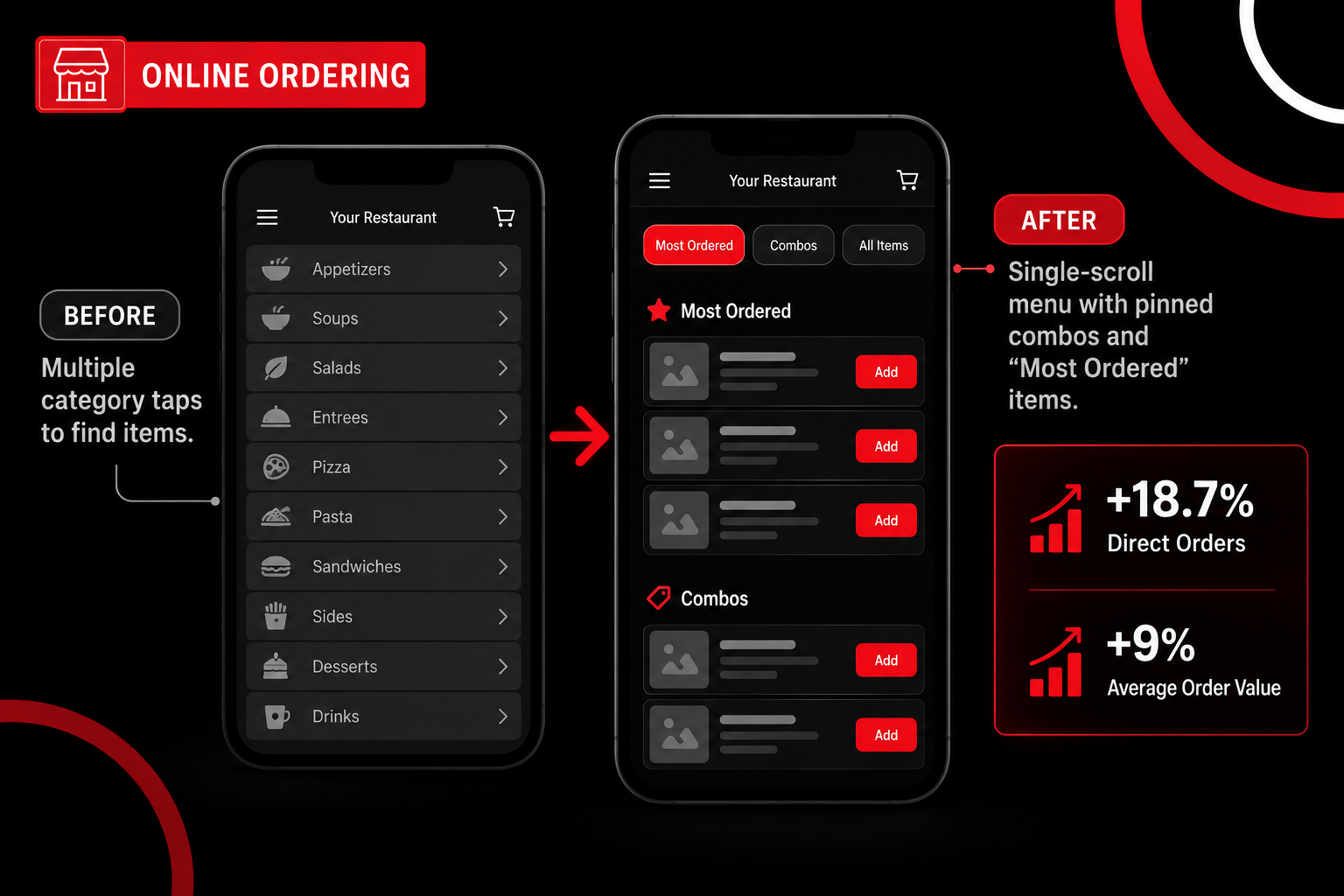
Fewer menu paths often increase both conversion rate and AOV. That matches how customers actually order food on mobile devices.
Organize Menus Around Real Ordering Behavior
Menu hierarchy is the foundation of a strong website for online ordering. Customers scan digitally differently than they order in person. Categories built for kitchen operations often fail online because users don't think in POS terminology.
According to Bounteous’s 2024 restaurant UX research, rich imagery, streamlined customization, and visual error prompts consistently improved digital ordering performance. Restaurants frequently overload modifier trees with edge-case options that few guests use.
At Nabeeats, we recommend progressive disclosure for modifiers. Show common choices first, then reveal advanced options only when needed.
A strong structure usually looks like this:
Progressive disclosure reduces cognitive load during ordering. Customers complete orders faster when your interface reveals complexity gradually instead of all at once.
Longer menus don't automatically hurt conversion if the structure mirrors real ordering behavior. We've seen 150-item menus outperform 40-item menus because reorder paths stayed obvious and customization stayed clean.
Reduce Checkout Friction Aggressively
Guest checkout consistently outperforms forced account creation for restaurants. Restaurants lose completed orders when they prioritize customer data capture too early in the funnel.
One Midwest pizza chain we advised buried guest checkout beneath loyalty signup prompts. Mobile conversion sat at 2.1% despite strong repeat traffic. After moving guest checkout into the primary path and delaying loyalty enrollment until after payment confirmation, conversion increased to 3.4% within six weeks while loyalty signups dropped only 8%.
More completed orders create more retention opportunities later.
Your checkout flow should include:
Wallet payments and autofill reduce abandonment because they eliminate typing friction. Restaurants often underestimate how much extra taps hurt mobile conversion during peak dinner hours.
According to Restolabs’ 2026 report, 67% of consumers prefer ordering directly from a restaurant’s own website or app, and 61% say they do it specifically to support the restaurant. Your job is removing obstacles—not forcing loyalty enrollment popups.
For operators evaluating platforms, this guide on comparing ordering site structures and platforms breaks down the UX differences that materially affect conversion rates.
Limit Upsells, Pop-Ups, and Modifier Overload
More upsells don't automatically increase revenue. Excessive prompts, pop-ups, and modifier layers often lower completion rates instead of raising ticket size.
We've audited restaurant checkout flows where users encountered loyalty popups, coupon prompts, survey requests, delivery upsells, and app download banners before payment. Conversion dropped because the checkout experience felt like work.
According to Bounteous research, personalized upsells perform best when they're contextual and lightweight. Suggesting “Add fries for $3” inside the cart works better than interrupting the ordering flow with modal windows.
The upside is higher basket sizes, but every additional decision increases abandonment risk. This approach works best for restaurants with repeat ordering behavior and clear menu anchors.
Want help implementing this? See how Nabeeats can help.
Once your structure is clean, the next challenge becomes execution on smaller screens—because mobile-specific friction usually determines whether customers finish checkout.
Mobile Checkout Optimization for Restaurant Online Orders
Mobile checkout optimization for restaurants means reducing taps, improving load times, and enabling fast payment methods so customers can complete orders in under a minute.
Mobile speed directly impacts restaurant revenue. According to Restolabs’ 2026 ordering research, 75% of quick-service restaurant sales now come through online and phone orders. That turns your website for online ordering into a primary revenue channel, especially during lunch and dinner rushes when ordering intent is immediate.
What High-Converting Mobile Ordering Actually Looks Like
Speed Fixes That Usually Produce Immediate Gains
Want help implementing this? See how Nabeeats can help.
Faster mobile ordering works best when backend systems stay synchronized. If POS inventory, delivery zones, or modifier rules update inconsistently, customers still hit dead ends during checkout even on a fast interface.
Once the mobile experience feels effortless, the next layer is using AI ordering tools to increase ordering speed, recover missed demand, and assist customers without adding friction.
How AI Ordering Can Improve Direct Restaurant Sales
AI ordering works best when it speeds up common decisions, suggests relevant add-ons, and hands complex requests to staff when needed. The best AI experiences on a website for online ordering reduce friction instead of trying to replace hospitality. Most restaurant customers want speed and confidence, not a long chatbot exchange while choosing between fries or salad.
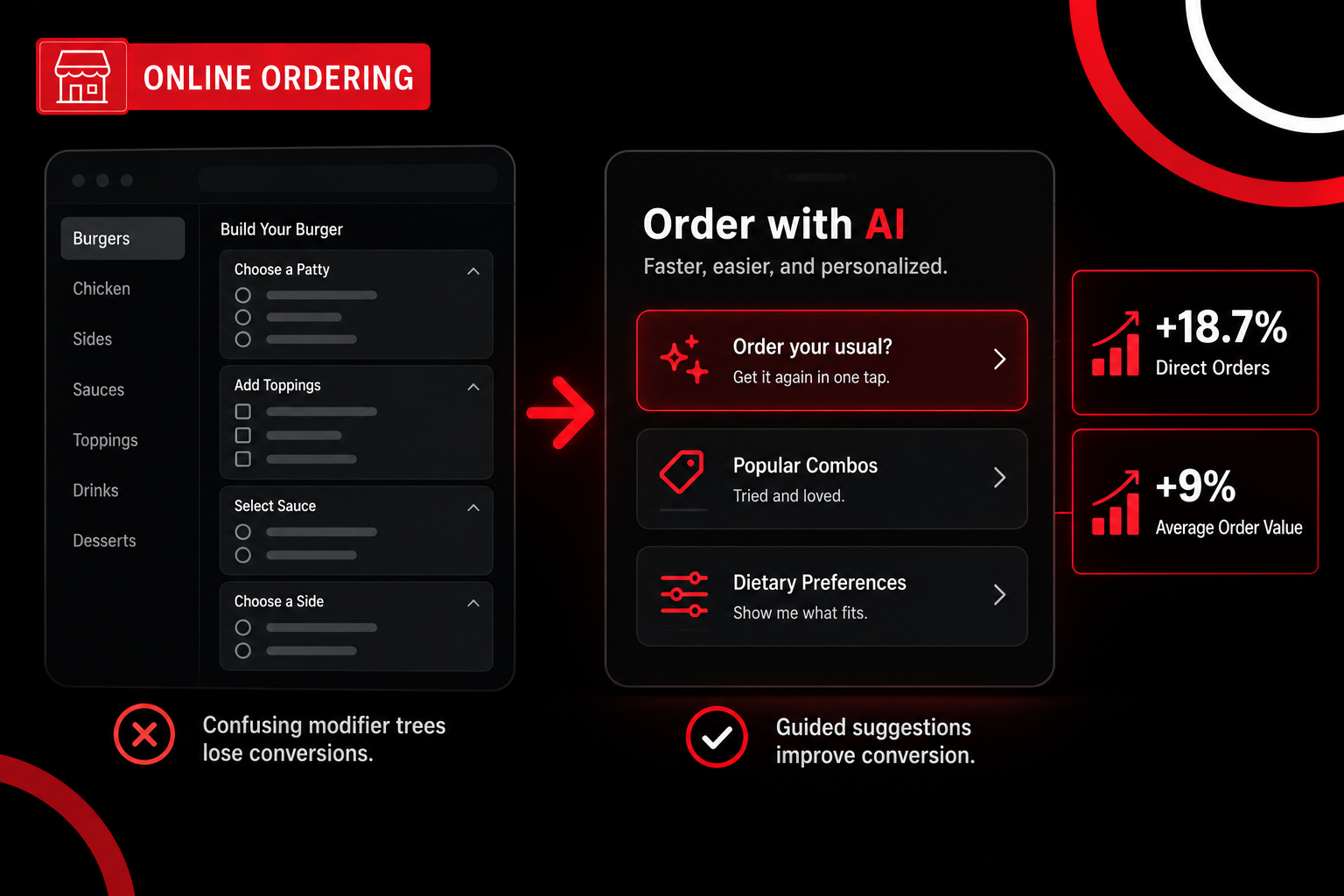
Restaurant Technology News reported in 2025 that 34% of restaurant operators had already adopted AI technology and another 48% planned implementation that year. As adoption grows, customer expectations shift quickly. Ordering flows with confusing modifier trees lose conversions against competitors using guided reorders and intelligent suggestions.
Which AI Ordering Features Actually Improve Conversion
AI ordering is guided automation that helps customers order faster and more accurately. The highest-performing tools narrow decisions instead of expanding them. At Nabeeats, simple prompts like “Order your usual?” consistently outperform open-ended chatbot flows.
AI ordering approachBest use caseConversion impactMain limitationVoice AI orderingPhone and drive-thru overflowFaster order completionStruggles with heavy customizationChat orderingLate-night and mobile supportReduces abandoned sessionsCan become overly conversationalSmart upsellsCombo meals and add-onsIncreases average order valuePoor recommendations feel intrusiveReorder promptsRepeat customersSpeeds repeat purchasesRequires clean customer dataAI-assisted support flowsFAQ and order trackingReduces staff interruptionsNeeds human escalation paths
Voice AI already improves operational speed in measurable ways. Intouch Insight's 2025 Drive-Thru Study found voice AI ordering completed orders 12 seconds faster than traditional interactions while scoring higher for friendliness, 83% versus 79%.
Operators often misunderstand where AI creates value. AI ordering assistants work best when they narrow decisions, not when they try to sound human. One multi-location operator replaced a free-form chatbot with guided prompts tied to best sellers, dietary filters, and reorder history. Conversion improved because customers stopped typing long requests and followed recommended paths.
Why Human Fallback Still Matters
Do not fully automate every ordering interaction. Hybrid AI flows consistently outperform fully automated systems when orders become complex. Intouch Insight reported in 2025 that 22% of voice AI orders still required employee intervention, and 65% of AI errors came from failed customization requests.
Customization remains a weak spot for pizza, sushi, poke, and allergy-sensitive menus. Requests like “half onions on one side, extra crispy, sauce on the side” still create parsing challenges. Restaurants removing staff fallback paths often see more refunds and remake requests.
When staff stepped in to resolve AI ordering issues, accuracy improved by 14 percentage points according to Intouch Insight's 2025 findings. AI still needs escalation logic for edge cases.
Practical fallback paths usually include:
Structured Menus Matter More Than Restaurants Realize
Structured menu data is standardized item, modifier, pricing, and availability information that AI systems can interpret consistently. Restaurants with clean menu structures gain an advantage in ordering accuracy and future AI discovery systems.
Most operators focus only on visual design. The backend matters just as much. If your website for online ordering uses inconsistent modifier naming, duplicate categories, or outdated availability logic, AI systems struggle to recommend items accurately.
Bounteous highlighted streamlined customization and visual error prevention as major restaurant UX trends in 2024. Structured menu fields, standardized dietary tags, and predictable modifier logic improve how AI tools interpret catalogs across voice ordering, QR ordering, WhatsApp flows, and future discovery platforms.
For operators comparing ordering platforms, this becomes a strategic consideration, not just a cleanup project. Learn more about how AI ordering tools improve conversion and speed.
The restaurants getting the strongest results from AI ordering are not necessarily using the flashiest tools. They're building reliable operational systems underneath the experience.
POS Integrations and Analytics for a High-Performing Website for Online Ordering
The best restaurant integrations synchronize menus, pricing, inventory, loyalty, and customer data in real time. A website for online ordering only performs as well as the systems connected underneath it. As order volume grows, weak integrations create refunds, inaccurate menus, missed upsells, and customer frustration before operators notice the revenue loss.
According to Restolabs’ 2026 online ordering research, 67% of consumers prefer ordering directly through a restaurant’s own channels. That preference disappears when pricing differs from the POS or unavailable items remain purchasable online. Operational accuracy becomes part of conversion optimization, not just maintenance.
Which integrations matter most for restaurant ordering performance?
High-performing restaurant stacks prioritize reliability before marketing complexity. Most restaurants don't need 14 disconnected plugins—they need six systems that sync cleanly.
Integration AreaOperational ImpactCommon Failure PointPriority LevelPOS syncingAccurate pricing and inventoryModifier mismatchesCriticalLoyalty + CRMRepeat order visibilityFragmented customer profilesHighSMS reorder flowsFaster repeat purchasesBroken attribution trackingHighDelivery dispatchReduced staff coordinationDelayed courier syncingMediumAnalytics platformsConversion visibilityIncomplete event trackingCriticalCall trackingPhone-to-web attributionLast-click reporting gapsMedium
POS syncing failures create silent revenue leaks through pricing errors, unavailable items, and refund requests. Restaurants often spend hours correcting modifier conflicts between Toast, Square, Clover, or legacy POS systems and their website for online ordering. The labor cost matters, but customer trust matters more.
One ghost kitchen group operating three virtual brands assumed paid social campaigns were failing because marketplace dashboards showed weak conversions. After integrating first-party analytics, SMS reorder links, and call tracking, they found 31% of repeat customers reordered directly within seven days. The issue was attribution blindness, not retention.
Why first-party analytics matter more than marketplace dashboards
First-party analytics collect customer behavior directly through your ordering system instead of third-party marketplaces. Marketplace reporting prioritizes transactions, not customer lifecycle visibility.
A strong analytics setup should track:
Restolabs reported that direct-to-consumer channels represented 68.75% of online food delivery volume in 2025. Operators should stop asking, “How many orders came in?” and instead ask, “Which channels produced profitable repeat customers within 30 days?”
This matters even more for operators testing WhatsApp ordering, QR ordering, or AI-assisted flows. Tools like Google Analytics 4, Segment, Triple Whale, or native dashboards reveal where customers reorder without discounts. For operators evaluating technology stacks for online-only restaurants, attribution infrastructure is critical because there is no in-store fallback revenue.
Multi-location menu governance usually breaks first
Multi-location governance controls pricing, modifiers, availability, and promotions across stores. Most integration failures happen during promotions, seasonal launches, or regional menu changes.
We've seen operators publish inconsistent pricing because no approval workflow existed before updates went live. In another case, delivery windows stayed active after kitchen close during a sports promotion, creating refunds and overloaded support teams.
A better governance framework looks like this:
Older POS systems often cannot support real-time modifier syncing cleanly. If your POS stack is outdated, simplify online modifier complexity instead of forcing unsupported integrations.
Competitors market restaurant integrations as instant setup, but reliable POS, CRM, loyalty, SMS, analytics, and dispatch implementation usually takes weeks. According to Restaurant Technology News, 34% of operators adopted AI technology in 2025 and another 48% planned adoption that year, but successful operators phased integrations gradually instead of replacing everything simultaneously.
With reliable infrastructure and governance controls in place, the next challenge becomes execution—showing what high-converting restaurant ordering experiences look like when the operational foundation supports growth and online orders only revenue models.
Restaurant Online Ordering Examples That Increased Direct Sales
Restaurants increase direct online sales when they reduce ordering friction, simplify mobile navigation, and optimize checkout speed instead of relying on discounts or marketplace exposure. The highest-performing website for online ordering experiences usually win on operational UX—not flashy marketing campaigns.
At Nabeeats, we’ve seen conversion gains come from small workflow changes. Restolabs’ 2026 industry report found 67% of consumers prefer ordering directly from a restaurant’s own channels because they want to support the business. That preference matters only if the experience feels fast and predictable.
Simplifying Mobile Menus Increased Both Orders and Average Check Size
A 14-location Mediterranean fast-casual chain came to us with a traffic problem that wasn’t actually traffic. Their online ordering site attracted strong mobile visits from Instagram ads and branded search, but customers abandoned before checkout.
Session recordings showed users tapping through five categories before finding best sellers, while modifier screens buried combo meals below sides. The menu structure created navigation fatigue before customers reached high-margin items.
We rebuilt the flow around one-scroll mobile ordering with pinned combo meals, “most ordered” labels, and fewer category jumps. Over eight weeks, direct online orders increased 18.7%, while average order value climbed 9%.
Bounteous’ 2024 restaurant UX research supports this pattern. Rich imagery and streamlined customization outperform cluttered promotional layouts because customers complete orders faster and with fewer errors. That matters even more as ai ordering tools become part of restaurant discovery and reorder flows.
Guest Checkout Improved Conversion Without Hurting Loyalty
One Midwest pizza operator required account creation before ordering because loyalty enrollment mattered to their retention strategy. The result: mobile conversion stalled at 2.1% despite strong repeat traffic.
We moved guest checkout above account creation and delayed loyalty signup until after payment confirmation. Within six weeks, conversion rose to 3.4%, while loyalty enrollment dropped only 8%. Completed transactions created more long-term value than forcing account creation upfront.
Most restaurant teams miss how loyalty friction compounds during dinner rush ordering. Customers ordering pizza on a phone at 6:30 p.m. rarely want password recovery flows or mandatory profile creation.
The operator still captured customer data after purchase through SMS reorder prompts and post-order incentives. Restaurants evaluating comparing ordering site structures and platforms should pay close attention to checkout sequencing—not just loyalty tools.
QR Ordering Increased Upsells More Than Labor Savings
A regional taco chain rolled out QR ordering across 11 stores expecting labor efficiency gains. Labor savings happened, but the larger impact came from customer behavior.
After redesigning the QR flow around visual add-ons and modifier prompts instead of POS categories, average check size increased 14% over 10 weeks. Low-friction upsells consistently outperformed verbal counter selling.
Customers added drinks, queso, and desserts more often because the interface removed social hesitation. The QR menu surfaced high-margin add-ons at the right moment.
We’ve seen this repeatedly with younger dine-in audiences using WhatsApp links, QR menus, and ai ordering assistants. Restaurant Technology News reported that 34% of operators adopted AI technology in 2025, while another 48% planned implementation. The opportunity is reducing friction during repeat ordering.
Faster Experiences Usually Beat Heavier Designs
A sushi brand we advised believed richer visuals would improve conversion. Instead, oversized food photography and autoplay banners pushed mobile load times to 7–9 seconds.
After compressing images and removing unnecessary scripts, mobile conversion increased 22% in under 30 days. Faster ordering experiences usually outperform visually heavier restaurant sites once customers already trust the brand.
This works best for restaurants with established local awareness. New concepts still need strong photography for credibility and appetite appeal.
Next, we’ll answer the operator questions these case studies usually trigger—costs, setup timelines, AI adoption risks, and which direct ordering improvements deserve priority first.
Frequently Asked Questions
Should restaurants still use third-party delivery apps if they have a website for online ordering?
Yes. Most restaurants benefit from using third-party marketplaces alongside a website for online ordering, but each channel serves a different purpose. Apps like Uber Eats and DoorDash help with discovery, while direct ordering supports retention, repeat purchases, and stronger margins. Many operators shift repeat customers into first-party ordering through loyalty offers, QR codes, and SMS campaigns instead of abandoning marketplaces entirely.
How much does a restaurant online ordering site usually cost to maintain?
A restaurant online ordering site typically costs $100 to $800 monthly depending on integrations, menu complexity, and automation needs. Basic systems include hosting, menu management, and payment processing, while advanced setups add POS syncing, CRM tools, AI workflows, and SMS marketing. Many operators now prefer predictable subscription costs over commission-heavy marketplace fees.
Is AI ordering actually worth it for independent restaurants?
AI ordering is useful when it reduces labor or ordering friction without hurting customer experience. Independent restaurants use AI-assisted upselling, automated reordering texts, and voice ordering during peak periods, especially stores handling high online order volume. Fully automated systems still struggle with heavily customized menus and constant modifier changes.
What conversion metrics should restaurants track first on an online ordering site?
Restaurants should first track checkout conversion rate, cart abandonment, repeat order rate, and average order value. Adobe Digital Economy benchmarks from 2024 show mobile checkout abandonment often exceeds 70%, so faster checkout and simpler payment flows can increase direct revenue. Nabeeats recommends focusing on a small set of actionable metrics rather than overloaded dashboards.
How long does it realistically take to launch and optimize a website for online ordering?
A basic website for online ordering can launch within 2 to 4 weeks, but meaningful optimization usually takes 60 to 90 days of customer data. Menu organization, modifier cleanup, and POS integration often take longer than expected. Restaurants reviewing conversion data weekly usually improve direct sales faster than operators relying on quarterly reports.
Do online orders only restaurants need a different website structure?
Yes. Online orders only concepts need faster, conversion-focused websites because customers have shorter decision windows and less brand familiarity. These sites should prioritize menu visibility, reordering, delivery zone clarity, and minimal navigation. Ghost kitchens often improve completed orders by simplifying the homepage to a few primary actions.
What should restaurants prioritize first when improving direct online ordering performance?
Restaurants should prioritize mobile checkout speed, menu clarity, and repeat-order marketing before investing in expensive redesigns. Baymard Institute research shows reducing unnecessary checkout steps improves completion rates more than adding features. Focus first on high-friction problems like slow load times, confusing modifiers, or weak reorder flows, and platforms like Nabeeats can streamline improvements without a full operational overhaul.
Build a Better website for online ordering One Friction Point at a Time
A high-converting website for online ordering wins because customers can complete orders quickly, confidently, and without friction. That’s where many restaurant sites lose sales.
According to Restolabs’ 2026 industry data, direct digital ordering keeps growing as customers increasingly prefer ordering directly from restaurants. Start with one high-friction fix first—mobile checkout, menu clarity, or reorder flows—and use platforms like Nabeeats to improve conversion without a complete rebuild.
The restaurants gaining direct sales will offer the easiest ordering experience.
.png)

.png)


